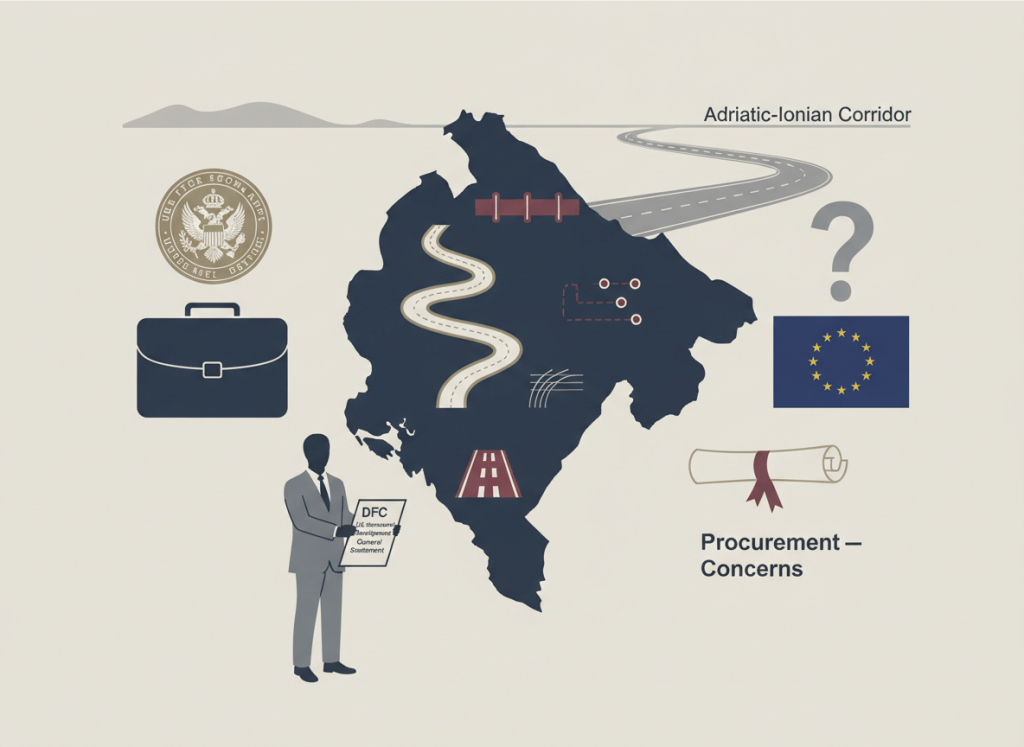
The United States and Montenegro have begun implementing an agreement designed to open major infrastructure, energy and security projects to American companies, even as the European Commission has raised concerns about procurement exemptions associated with the arrangement. The State Department has now confirmed that the U.S. Embassy forwarded American companies’ expressions of interest in two priority projects to the Montenegrin government. Whether the projects will receive U.S. financing, and what selection safeguards will apply, remains unresolved.
The Intergovernmental Agreement on Cooperation for the Implementation of Strategic Projects, published as Treaties and Other International Acts Series 26-813, was signed July 24, 2026, and entered into force August 13. It identifies transportation infrastructure, energy facilities, critical minerals, border-security technology and potential data-center projects as areas for cooperation. It also establishes a process for U.S. government agencies to help identify American businesses interested in undertaking projects in Montenegro.
At issue is not merely whether American companies can compete for foreign infrastructure contracts. It is how companies will be identified and selected, which procurement safeguards will apply, and whether federal financing institutions will ultimately support the resulting projects.
Seven American companies express interest
Following expressions-of-interest calls published through the U.S. Embassy in Podgorica on August 24, Montenegro’s government reported in September that six American companies had expressed interest in the Adriatic-Ionian Corridor and one in an integrated cargo-scanning project. The government announcement did not identify the companies. An expression of interest is not a contract award, and the records reviewed do not establish that any company has been selected for a final contract.
The Adriatic-Ionian Corridor is intended to connect Albania with Croatia through Montenegro and Bosnia and Herzegovina. Under Article 2 of the bilateral agreement, the contemplated infrastructure includes road construction, fiber-optic cables and natural-gas pipelines. The cargo-scanning initiative would cover Montenegro’s borders with Albania, Kosovo, Serbia, Bosnia and Herzegovina, and Croatia, along with the Port of Bar, with a central scanning command facility in Podgorica.
That only one company expressed interest in the cargo-scanning initiative warrants scrutiny of its technical requirements and eventual competitive process, but does not by itself demonstrate favoritism or an improper solicitation.
State confirms embassy forwarded company interest to Montenegro
In a written response to Bureaucracy Times, provided on background and attributable to a State Department spokesman, the department confirmed that the U.S. Embassy in Montenegro received expressions of interest from U.S. companies for both priority projects and transmitted them to the Montenegrin government.
“The U.S. Embassy in Montenegro has received expressions of interest from U.S. companies for both priority projects that will launch concrete cooperation under the U.S.-Montenegro Intergovernmental Agreement.”
State Department spokesman
The spokesman said the embassy passed the expressions of interest to Montenegro as the process entered its next phase. State also reported growing interest among American companies and said it was working with Montenegrin counterparts to identify additional opportunities under the agreement.
The department did not identify the companies, explain what eligibility or conflict-of-interest reviews preceded the transmission, or describe safeguards for exceptions to ordinary competitive procurement. It did not confirm any project award or U.S. financing commitment and referred further questions to the Montenegrin government. Forwarding expressions of interest is not equivalent to endorsing a company, selecting a contractor or approving taxpayer-backed financing.
How the selection process works
Article 3 provides for Montenegro to furnish project specifications and for the United States to share a list of American commercial entities that represent or indicate they meet the requirements. The State Department may draw on mechanisms supported by Commerce, the Export-Import Bank, DFC and the U.S. Trade and Development Agency. Article 5 leaves Montenegro with sole discretion to select its American commercial counterparties, with considerations including price-quality ratio, lifecycle costs and experience.
The agreement itself does not detail a public scoring system, disclosure schedule or independent appeal process. Such safeguards may exist under Montenegrin law or implementing arrangements, but their application to these projects remains to be established. Article 6 also provides exemptions from value-added tax and customs duties for transactions related to covered projects, with the method of exemption governed by Montenegrin law. The fiscal value of those exemptions is not stated.
European Commission identifies procurement concerns
The European Commission’s 2026 Montenegro Report, released November 4, discusses the U.S.–Montenegro arrangement in connection with exemptions from public procurement, taxes and customs. In its broader assessment of public procurement, the Commission urges Montenegro to ensure that government-to-government agreements do not circumvent European procurement requirements.
The Commission’s findings do not establish that the United States or Montenegro violated the law, nor that any contractor has received improper preferential treatment. They do identify a regulatory question with consequences for a country seeking EU membership: whether strategic agreements that use exceptional contracting arrangements preserve adequate competition, transparency and oversight.
DFC describes safeguards, declines project-specific disclosure
In response to a Bureaucracy Times media inquiry, DFC provided a November 10 statement on background, attributable to a DFC official. The official said the United States values its relationship with Montenegro and looks forward to implementing the agreement, seeking opportunities in infrastructure, energy security and technology.
“DFC’s transaction process includes comprehensive financial, commercial, legal, environmental, social, and economic development-impact due diligence to assess project viability, evaluate sponsors and counterparties, identify material risks, and determine appropriate investment terms and safeguards.”
DFC official, statement provided November 10, 2026
The official explained that the agency’s process generally begins with screening for eligibility and alignment with its economic-development mandate, followed by analysis of the investment, its operating environment and expected development benefits.
“Due to commercial sensitivities, DFC does not comment on projects that we may or may not be pursuing.”
DFC official
That response describes DFC’s general safeguards, but does not confirm or deny whether the agency has received an application, evaluated an interested company, considered a guarantee or investment, or committed funds under the Montenegro agreement. It also does not resolve whether Montenegro’s procurement exemptions would affect DFC’s eligibility or due-diligence review. A description of ordinary procedures should not be mistaken for evidence that any particular project has completed them.
Article 4 of the agreement permits DFC, EXIM and USTDA to consider financing or project-development support, subject to their own legal authorities and approval procedures. It does not itself appropriate money, approve a loan or guarantee, or obligate any agency to finance a project. Supplementary arrangements may be required.
USTDA reports no project proposals or funding activity
In a November 12 written response to Bureaucracy Times, the U.S. Trade and Development Agency said it had received no specific requests for assistance associated with the agreement. USTDA also confirmed it had not helped identify American commercial entities or develop specifications for the Adriatic-Ionian Corridor or integrated cargo-scanning initiative, and had not awarded, proposed or considered project-development grants or expenditures for those initiatives.
“No. We have not received any concrete proposals for review and evaluation.”
USTDA spokesperson, November 12, 2026
USTDA said its grantees must select U.S. contractors to perform agency-funded assistance, that the agency pays those contractors directly, and that both grantees and contractors undergo due diligence before funding. Asked whether Montenegrin procurement exemptions could affect future USTDA support, the agency said it evaluates such issues when reviewing proposals and would assess Montenegro’s circumstances if a project came forward. The response therefore establishes an absence of project-specific activity at USTDA, not an absence of activity by other U.S. agencies or Montenegrin authorities. The agency directed readers to its document center for further information on its procedures.
What remains undisclosed
The agreement includes protections for qualifying business-confidential information, while expressly preserving applicable U.S. whistleblower and congressional-reporting protections. The practical boundaries of public disclosure will matter as projects advance, particularly if taxpayer-backed financing is proposed.
On November 6, Bureaucracy Times sent inquiries to the State Department, Montenegro’s Ministry of Public Works, the European Commission, DFC, EXIM and USTDA. The questions seek the identities of interested companies, legal authority for procurement exemptions, selection and conflict-of-interest safeguards, the status of implementation bodies, and any financing applications or commitments. Following a referral and resubmission through State’s media portal, the department confirmed that embassy officials transmitted expressions of interest for both priority projects to Montenegro, but did not provide company names or project-specific screening details. DFC and USTDA also supplied the responses described above. The record reviewed for this update does not establish substantive replies from Montenegro’s government, the European Commission or EXIM.
Those unanswered questions are not proof of misconduct. They are the essential details for determining how a bilateral economic agreement becomes a set of contracts, who receives them, and whether the public can evaluate the process. For now, the agreement is in force, State has confirmed an embassy role in transmitting commercial interest, European procurement concerns have been documented, and neither company selection safeguards nor project-specific federal financing commitments have been established by the responses received.

