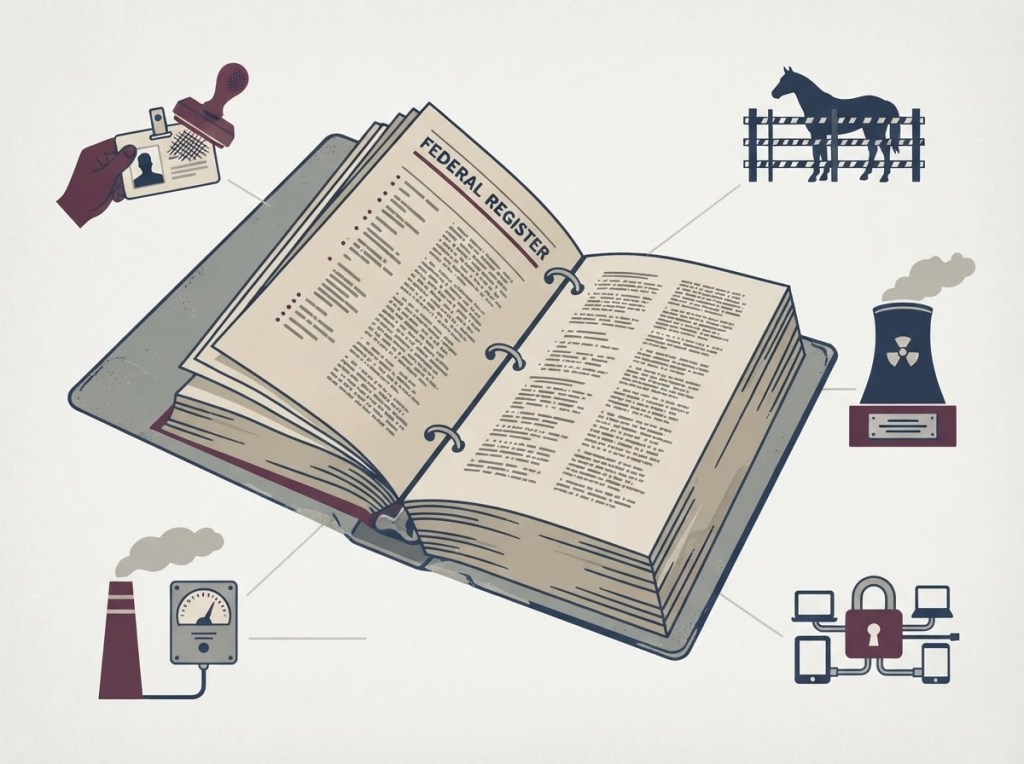
The Labor Department finalizes a new test for who counts as an employee rather than an independent contractor, Agriculture’s inspection service delays its horse protection rule for a second straight year, and the Nuclear Regulatory Commission issues reactor-licensing guidance that formally cites the renamed Department of War. Also in today’s issue: an FCC proposal governing IoT cybersecurity labels, and an EPA notice that will decide which regions fail a sulfur dioxide air standard.
The Wage and Hour Division published a final rule that rescinds the Labor Department’s current method for deciding whether a worker is an employee or an independent contractor, replacing it with a version modeled on the department’s 2021 rule. Because the Fair Labor Standards Act’s wage and overtime protections, the Family and Medical Leave Act’s job-protected leave, and the farmworker safeguards in the Migrant and Seasonal Agricultural Worker Protection Act all depend on who legally counts as an employee, this one definitional change reaches into every industry that relies on contract labor. The rule does not take effect until January 22, 2027, which gives employers time to reclassify workers and gives advocates a window to challenge it before it actually controls anyone’s status.
- Labor Department rewrites who counts as an employee versus an independent contractor. The Wage and Hour Division finalized a new worker-classification standard for the FLSA, FMLA and the migrant and seasonal farmworker law, discarding the current multi-factor approach for one closer to the department’s 2021 rule. Because minimum wage, overtime, job-protected leave and farmworker safeguards all turn on that classification, the change reaches across every industry built on contract labor; it becomes effective January 22, 2027, rather than immediately, which is itself notable, since a rule this consequential is being phased in with lead time instead of taking hold the day it is signed. (Federal Register)
- Agriculture delays its horse protection rule for a second straight year. The Animal and Plant Health Inspection Service further postponed the effective date of its 2024 Horse Protection Act amendments, this time to December 31, 2027, after already pushing the date back once earlier in 2026. Only one piece of the original rule, a ban on certain soring devices, actually took effect back in 2024; the rest has sat dormant for more than two years while litigation worked through the courts. A proposed rule APHIS floated on November 13 would go further still, stripping out the sections a court vacated and formally withdrawing everything else, so this extension looks less like a pause before implementation than a holding pattern ahead of the rule’s abandonment. (Federal Register)
- NRC issues reactor-licensing guidance that name-checks the renamed Department of War. The Nuclear Regulatory Commission published interim staff guidance laying out how a company can get a faster NRC review for a reactor design the Department of Energy, or what the notice calls the Department of War, already evaluated and authorized. Substantively, it streamlines licensing for advanced and demonstration reactors by letting applicants lean on safety work the government has already done rather than repeating it before the NRC; procedurally, its repeated use of “Department of War” in place of “Department of Defense” is a small but telling marker of how quickly the 2025 renaming of the Pentagon has worked its way into routine federal paperwork. (Federal Register)
- FCC asks for comment on how to police its new IoT cybersecurity label. The agency opened a proposed rulemaking on administering the U.S. Cyber Trust Mark, the voluntary cybersecurity label it wants on compliant smart-home and other internet-connected consumer devices, covering how the label is displayed, how certifications are renewed, and how a product or program administrator gets bounced from the program for falling out of compliance. Comments are due December 23 and replies January 7, a staged window meant to let industry and security researchers respond to each other’s filings before the enforcement mechanics are locked in; without workable post-market surveillance and a real decertification process, a voluntary label like this risks verifying a device once, at launch, while promising nothing about its security afterward. (Federal Register)
- EPA notice will help decide which areas fail a 2024 sulfur dioxide air standard. The agency published its intended secondary-standard designations for the revised annual sulfur dioxide air quality standard adopted in 2024, opening a comment period that runs through December 23. A “nonattainment” designation here is not just a label: it is the trigger that forces a state to write a formal cleanup plan for that area, which can mean new permitting hurdles and pollution-control requirements for industrial sources located there, so how EPA draws these lines now will shape which communities and which companies face new obligations once designations are finalized. (Federal Register)
This edition is drawn from the 91 documents the Federal Register published on November 23, 2026. Beyond the five items above, we screened out and did not cover routine agency information-collection and Paperwork Reduction Act notices, foreign-trade-zone production and subzone notices, antidumping and countervailing-duty determinations, SEC self-regulatory-organization rule-change filings, routine Sunshine Act and advisory-committee meeting notices, incidental-harassment and endangered-species permit notices, disaster-declaration notices, and OFAC and State Department sanctions-list notices.

