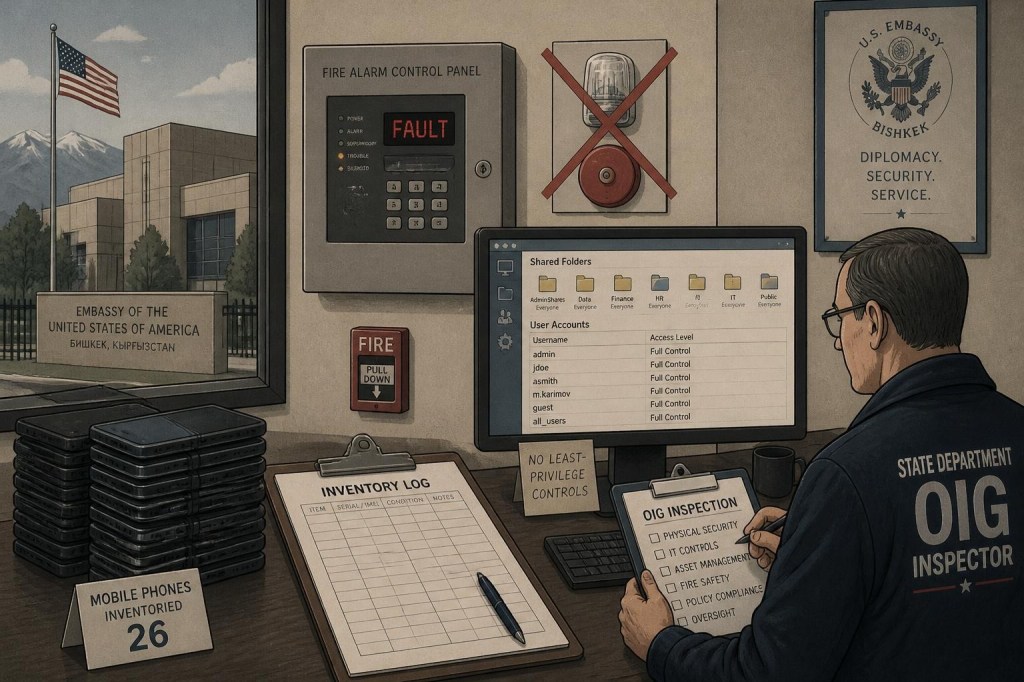
An internal State Department inspection found that a strategically important U.S. embassy operated for nearly two years with a known fire alarm failure, unresolved cybersecurity gaps, and 26 mobile devices missing from official inventory records — with full repairs to the fire system not expected until fiscal year 2027 or 2028.
WASHINGTON, November 9, 2026 — A U.S. embassy responsible for advancing American diplomatic, security, and commercial interests in Central Asia operated with a malfunctioning fire warning system that had remained unresolved for nearly two years, while deficiencies in cybersecurity oversight and government equipment accountability exposed additional weaknesses in its operations, according to a newly released State Department Inspector General report.
The November 2026 inspection of Embassy Tashkent, Uzbekistan (ISP-I-27-10) identified seven areas requiring corrective action, including fire protection, occupational safety training, information systems security, and inventory controls.
Although inspectors concluded that the embassy generally advanced U.S. foreign policy objectives and complied with departmental standards, their findings revealed problems affecting fundamental responsibilities: warning employees of emergencies, restricting access to government information systems, and accounting for federally owned equipment.
The report also raises a familiar question in federal oversight. When inspectors identify a deficiency that an agency has known about for years, what ensures that corrective action actually occurs?
A Fire Alarm Problem Dating to 2024
Among the inspection’s most consequential findings was a fire protection system that could not properly alert occupants on the third floor of the embassy’s chancery building.
According to the Inspector General, activation of the fire alarm system did not produce the required audible or visual notifications, including bells and strobe lights, for people on that floor.
The State Department’s Bureau of Overseas Buildings Operations (OBO) had initially identified the malfunction, along with other fire alarm problems, in September 2024.
Subsequent maintenance visits addressed most of the deficiencies. The third-floor notification failure, however, remained unresolved when inspectors examined embassy operations between May and July 2026.
Embassy personnel attributed the continuing problem to an obsolete fire alarm system and difficulty obtaining replacement components. Inspectors determined that repairs exceeded the embassy’s technical capabilities.
The consequences were not merely administrative.
A fire protection system that fails to notify occupants can delay evacuation and emergency response, increasing the potential for injuries and property damage. The Inspector General specifically identified those risks in recommending that the embassy restore compliance with departmental fire safety standards.
In its October 6 response, Embassy Tashkent agreed with the recommendation and identified a project to replace the obsolete fire alarm system.
But the proposed replacement was not described as an immediately funded repair.
Instead, the embassy stated that the project, designated FWP#13, was expected to receive funding in fiscal year 2027 or early fiscal year 2028.
The response also reported that OBO had completed its annual fire protection system inspection in September. It did not establish that the third-floor notification malfunction had been corrected.
Consequently, the public inspection record documents a fire safety deficiency identified in 2024 that remained unresolved during the 2026 inspection, with replacement funding projected for a later fiscal year.
The report does not identify a fire or injury attributable to the malfunction.
Safety Oversight Problems Extended Beyond the Alarm System
Inspectors also identified deficiencies in the embassy’s occupational safety and health training program.
Required workplace safety instruction had not been provided to management officials and supervisors responsible for administering the embassy’s safety program.
The embassy’s Post Occupational Safety and Health Officer, or POSHO, had not completed required recertification training. The officer’s previous certification had expired in 2021.
Inspectors additionally found that the embassy had not provided required safety and occupational health orientation to all new employees within 30 days of arrival.
Embassy officials attributed the training deficiencies to insufficient institutional knowledge of departmental requirements.
The embassy partially disputed the finding concerning employee orientation, explaining that training had been provided to newly arriving personnel working in higher-risk areas and certain non-desk positions.
The Inspector General acknowledged those efforts but maintained that departmental rules required orientation for all new employees, regardless of their assignments.
In its response, the embassy committed to developing additional training and implementing corrective measures during 2027. Management and supervisory safety training was expected to begin by midyear.
The combination of an impaired emergency warning system and incomplete safety training presents a broader accountability concern. Even where physical safety equipment is functioning, employees and supervisors must understand their responsibilities when an emergency occurs.
The Inspector General warned that inadequate life-safety programs increase the risk of property damage, injury, or loss of life.
Cybersecurity Controls Failed to Meet Department Standards
The inspection also identified weaknesses in the embassy’s information systems security program.
Information Systems Security Officers had not established a process to review shared folders for improperly stored information, including passwords or documents carrying classifications higher than the systems permitted.
Inspectors also found that the embassy lacked adequate procedures for reviewing user accounts to determine whether access remained necessary.
The officers had not consistently applied the principle of least privilege, under which employees should receive access only to the information and systems required for their duties.
Additional deficiencies involved the absence of required procedural and technical protections for non-enterprise networks, which are locally managed computing environments used for particular mission requirements.
Embassy technology personnel told inspectors that they were uncertain which security responsibilities belonged to the embassy and which belonged to the regional diplomatic technology office.
Some personnel were unaware of required duties, while competing operational priorities further limited their ability to perform security oversight.
These weaknesses could leave government networks exposed to unauthorized access or malicious activity, according to the Inspector General.
The report does not establish that embassy systems were compromised, that classified information was improperly disclosed, or that a cyberattack occurred. Its findings concern failures in the controls intended to prevent such incidents.
In its October response, the embassy reported implementing ongoing security officer procedures, incorporating security briefings into newcomer orientation, and enforcing least-privilege access requirements.
Those reported corrective actions are significant, although the public inspection report does not independently establish that every identified security deficiency had been eliminated.
Twenty-Six Mobile Devices Missing From Official Inventory Records
The Inspector General identified a separate weakness in the embassy’s ability to account for government-issued technology.
During the inspection, auditors found 26 enterprise mobile devices awaiting disposal that were not accounted for in the State Department’s Integrated Logistics Management System.
The finding does not mean that the devices were physically missing or stolen. Inspectors located them, but the equipment was absent from the required inventory records.
The distinction matters. Federal property accountability requires agencies to maintain accurate records throughout equipment acquisition, assignment, recovery, and disposal.
Inspectors also found that the embassy had not conducted required quarterly surprise inventory checks.
The embassy lacked a process to ensure employees returned mobile devices for necessary hardware and software updates. It also had not completed the required annual comparison between issued devices and paid cellular service plans.
Together, the deficiencies created risks involving improper equipment issuance, inadequate safeguarding and disposal, potential fraud, and exposure to malicious activity through outdated software.
Embassy personnel attributed the shortcomings partly to competing priorities that delayed improvements to inventory procedures.
In response, the embassy reported strengthening device accountability, requiring approval signatures for newly issued equipment, implementing annual loan renewals, and returning unused devices to inventory.
Officials also reported reviewing SIM card inventories and reducing excess stock.
The inspection does not quantify financial losses or identify any devices as having been used improperly.
Nevertheless, the findings illustrate how incomplete administrative records can undermine cybersecurity and financial accountability at the same time.
Seven Recommendations, but Resolution Is Not Closure
The Inspector General issued seven recommendations addressing deficiencies across consular operations, resource management, safety, cybersecurity, and technology inventory controls.
Embassy Tashkent concurred with six recommendations and partially concurred with the seventh.
OIG classified all seven recommendations as resolved following the embassy’s responses.
That designation should not be confused with confirmation that all corrective actions have been completed.
For example, the embassy’s response projected future funding for the fire alarm replacement and future implementation of portions of its occupational safety training program.
In discussing the safety training recommendation, the Inspector General explicitly stated that closure would depend on receiving and accepting documentation demonstrating compliance.
The inspection also included findings involving inadequate consular officer training, improperly maintained cashiering records, and weaknesses in the oversight of the embassy employee association.
Inspectors found that the association had not completed its required 2025 financial audit, had not performed required monthly surprise inventory and cash checks, and could provide supporting documentation for only three of the preceding twelve months.
Those deficiencies were not findings of established fraud. Rather, the Inspector General identified increased risks of theft and mismanagement resulting from insufficient oversight.
The embassy reported corrective measures, including additional association board members, improved accounting procedures, and the resumption of required inventory and cash checks.
An Embassy With Growing Strategic Responsibilities
The findings come as Embassy Tashkent plays an increasingly important role in American engagement with Central Asia.
According to the inspection, the embassy supported major commercial and diplomatic initiatives involving aviation, critical minerals, nuclear cooperation, and regional security.
The report cited an $8.5 billion Boeing aircraft sale to Uzbekistan Airways in September 2025, agreements involving critical minerals and civilian nuclear cooperation, and an $80 million Uzbek investment in a U.S. aluminum processing facility.
The embassy also helped facilitate Uzbekistan’s acceptance of more than 1,000 deportees from the United States between January 2025 and March 2026.
These activities illustrate the mission’s importance to U.S. foreign policy objectives involving economic competition, immigration cooperation, and regional stability.
The Inspector General credited embassy leadership with generally advancing those objectives and identified no serious management concerns involving the ambassador or deputy chief of mission.
That favorable assessment does not negate the operational deficiencies documented elsewhere in the inspection.
Rather, it underscores a distinction that is sometimes lost in federal performance reviews: an organization can successfully pursue its policy objectives while failing to meet important requirements for protecting personnel, government systems, and public resources.
The Outstanding Accountability Question
Embassy Tashkent has acknowledged most of the deficiencies and reported numerous corrective measures.
The unresolved question is whether those measures have produced verifiable improvements, particularly where the deficiencies involve physical safety and cybersecurity.
The fire alarm problem is especially notable because it was identified in September 2024 and remained outstanding during the 2026 inspection. The embassy’s proposed replacement schedule raises additional questions about how long employees may continue to work under an impaired notification system and what interim safeguards are in place.
The cybersecurity findings similarly warrant confirmation that revised procedures have been implemented and tested, rather than simply adopted on paper.
The State Department Inspector General’s findings do not establish deliberate misconduct, actual cyber intrusion, or financial theft.
They do, however, document preventable weaknesses in systems designed to protect federal employees, government information, and public property.
And after nearly two years of documented fire alarm problems, the distinction between promising a repair and completing one is more than a matter of paperwork.
Source: U.S. Department of State, Office of Inspector General, Inspection of Embassy Tashkent, Uzbekistan, ISP-I-27-10, November 2026. Inspection conducted May 4–July 22, 2026; embassy management response dated October 6, 2026.

