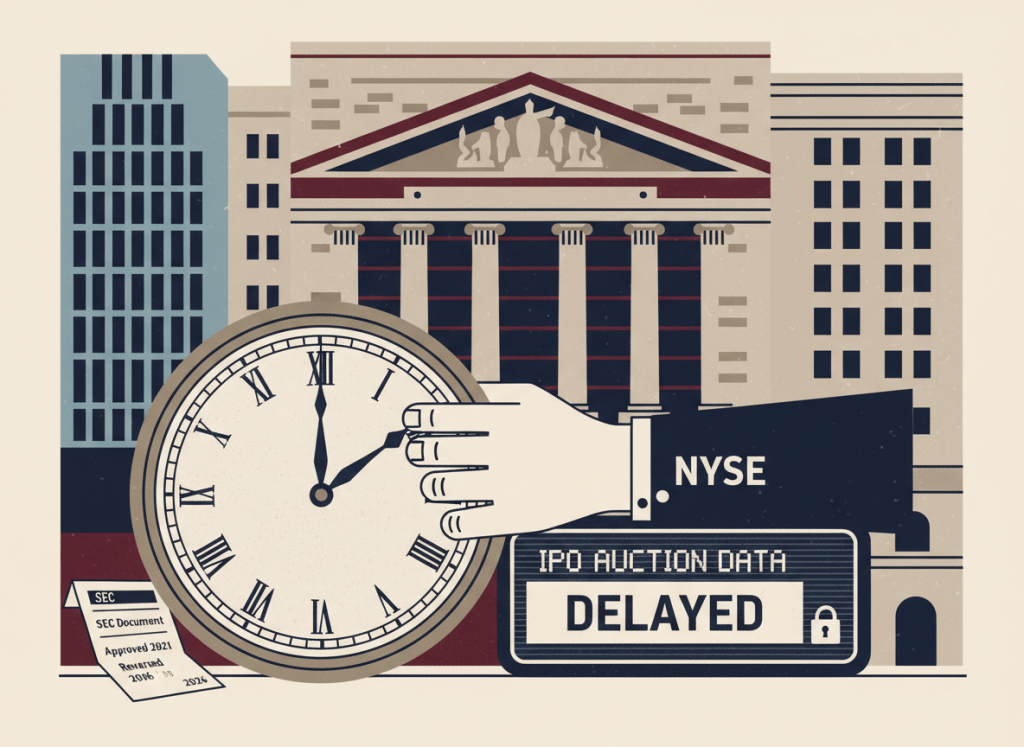
Wall Street’s largest stock exchange says early trading information can mislead investors. Its proposed solution is to release that information later, using a regulatory process that does not require advance public approval.
The New York Stock Exchange is preparing to delay the release of certain trading information ahead of initial public offerings, reversing part of a transparency expansion adopted during the COVID-19 pandemic and subsequently approved by federal regulators.
The change, detailed in a November 6, 2026, Securities and Exchange Commission notice, would allow the exchange to postpone publication of auction imbalance information that currently becomes available at 8 a.m. Eastern Time. Under the revised rules, the information could be withheld until a designated market maker publishes an initial pre-opening price indication, with a mandatory release no later than 10 a.m.
The exchange argues that the existing disclosure schedule can confuse investors by presenting an incomplete picture of buying and selling interest before an IPO begins trading.
The proposal raises a broader question about market transparency: When does protecting investors from potentially misleading information justify delaying information that was previously available to everyone?
And perhaps more importantly, what evidence supports that decision?
A Transparency Policy Born During the Pandemic
The origins of the current disclosure policy date to April 2020, when the COVID-19 pandemic disrupted normal operations on the NYSE trading floor.
As part of temporary operational changes, the exchange began distributing auction imbalance information for IPOs and direct listings in the same manner as other opening auctions.
Before those changes, the exchange generally did not distribute such information for securities that had not yet completed their initial auctions.
The temporary arrangement was extended several times before the NYSE sought to make it permanent in November 2020. The SEC approved the revised approach in July 2021.
For the following five years, IPO auction imbalance information generally became available beginning at 8 a.m., giving market participants an early view of orders accumulating before a newly listed security began trading.
Now, the NYSE says experience has revealed potential disadvantages to that arrangement.
In its latest filing, the exchange explains that early imbalance figures may be published before the underwriting syndicate has completed its distribution of shares, before all intended orders have entered the auction, and before the designated market maker has determined an anticipated opening price range.
The result, according to the NYSE, is information that may appear more representative of market demand than it actually is.
The concern is not necessarily that the figures are mathematically inaccurate. Rather, the exchange argues that the figures may be incomplete because important elements of the IPO process remain unfinished.
That distinction is significant.
A market can receive technically accurate information that nevertheless provides an incomplete picture of developing trading conditions. Whether delaying publication produces a better outcome for investors, however, is a separate question.
How the New Rule Would Work
Under the existing framework, the NYSE generally begins publishing auction imbalance information for an IPO at 8 a.m.
The proposed schedule would establish a different starting point.
Information would begin flowing at the later of 8 a.m. or the earlier of two events: publication of the designated market maker’s first pre-opening indication, or 10 a.m.
A pre-opening indication identifies the price range within which an IPO is expected to begin trading. It is disseminated publicly and is intended to help market participants understand the likely opening price.
If that indication is published before 8 a.m., imbalance information would still begin at 8 a.m. If it is published at 9:15 a.m., imbalance information could begin at that time. If no indication has appeared by 10 a.m., the exchange would begin releasing imbalance information regardless.
The proposal would not change the categories of information distributed once publication begins.
Those disclosures include the size and direction of order imbalances, quantities of buy and sell orders that can be matched, and pricing information relevant to the opening auction.
Nor would the revised schedule apply to direct listings, which follow a different pricing process and do not depend on an underwriting syndicate completing a traditional IPO distribution.
The NYSE says the adjustment would bring its practices closer to those of Nasdaq, which already ties the release of comparable IPO information to later stages of the offering process.
The exchange also maintains that the revised schedule would make the published information more useful and reduce the possibility of investors misinterpreting preliminary figures.
Where Is the Evidence?
The exchange’s explanation presents a reasonable market-structure concern.
But the regulatory filing leaves an important question unanswered: How often has the existing disclosure schedule actually caused investor confusion or measurable harm?
The notice does not provide a quantitative study demonstrating that early IPO imbalance disclosures have resulted in distorted trading decisions, identifiable investor losses, or other measurable market disruptions.
Nor does it identify specific IPOs in which preliminary disclosures produced the confusion the exchange describes.
That absence does not establish that the problem is imaginary. Market-structure concerns can be legitimate even when they are difficult to quantify.
It does, however, leave the public with a regulatory justification that rests substantially on the exchange’s assessment of how market participants might interpret information.
The NYSE acknowledges that the current approach was adopted during the pandemic and made permanent in 2021. It now argues that the passage of time has provided a better understanding of the policy’s disadvantages.
That creates an obvious opportunity for regulatory accountability.
If five years of experience have revealed shortcomings in the earlier transparency policy, investors and the public have a legitimate interest in understanding what those shortcomings were, how they were identified, and whether alternative remedies were considered.
For example, could the exchange provide additional context or warnings alongside preliminary imbalance figures rather than postponing their publication?
Would professional trading firms and retail investors be affected differently by the revised schedule?
And what evidence demonstrates that the proposed timing strikes the appropriate balance between timely disclosure and reliable information?
The filing does not fully resolve those questions.
Effective Without a Conventional Approval Proceeding
The procedural history of the rule change is another important element.
The NYSE submitted its proposal on October 28, 2026, under Section 19(b)(3)(A) of the Securities Exchange Act and Rule 19b-4(f)(6).
That framework allows qualifying self-regulatory organization rule changes to become effective upon filing, without first undergoing a conventional SEC approval proceeding.
The November 6 notice states that the rule change has become effective.
The filing also reports that no written comments were solicited or received by the exchange concerning the proposal before submission.
Neither circumstance, by itself, suggests improper conduct. The Securities Exchange Act expressly provides an immediate-effectiveness process for certain exchange rule changes, and the SEC retains authority to intervene.
Under that authority, the Commission may temporarily suspend the rule within 60 days of filing if it determines that suspension is necessary or appropriate in the public interest, for investor protection, or to advance the purposes of the securities laws.
Such a suspension would trigger further proceedings to determine whether the change should ultimately be approved or disapproved.
The SEC is also soliciting public comments on the filing.
Nevertheless, the procedural distinction deserves attention.
A change affecting when market participants receive information about a major securities offering has become legally effective before the conclusion of the public comment process.
The relevant accountability question is not whether the SEC violated its procedures. The available record does not establish that.
It is whether the expedited process provides sufficient public scrutiny of a decision that changes the timing of information available to investors.
Implementation Still Ahead
Although the rule has become effective, the revised dissemination schedule has not necessarily been implemented.
The NYSE states that the change requires technology modifications and that the exchange will announce implementation through a Trader Update.
It expects to implement the revised rule no later than the first quarter of 2027.
Until that implementation occurs, the existing operational schedule remains the relevant point of comparison.
The distinction matters because immediate legal effectiveness does not mean the exchange has already begun delaying IPO imbalance disclosures under the revised schedule.
The filing also provides for public comments, with the deadline calculated from the notice’s publication in the Federal Register.
Transparency, Accuracy, and the Public Interest
The NYSE’s proposal illustrates a recurring tension in financial regulation.
Market transparency is generally associated with making information available as broadly and promptly as possible. But information released before a process is complete can sometimes be misunderstood, particularly when investors are attempting to determine the value of a security with no established trading history.
The exchange argues that its revised policy would improve the quality of information investors receive without changing the substance of the eventual disclosures.
That argument deserves consideration.
So does the competing concern that delaying public information may reduce visibility into an important phase of the IPO process.
The filing says the information, once released, would remain available to all market participants through the existing distribution framework. It does not establish that any particular class of investors would receive preferential access under the new rule.
The question, therefore, is not whether the NYSE is openly proposing unequal disclosure.
It is whether the exchange has adequately demonstrated that postponing information serves investors better than continuing to publish it with appropriate context.
Five years ago, the SEC approved a system that expanded access to preliminary IPO auction information.
Today, the NYSE says that system needs adjustment because early disclosures may provide an incomplete picture of market demand.
The public deserves to know what changed between those two conclusions.
And in a market where information has measurable economic value, the answer should rest on more than an assurance that less information, delivered later, will ultimately mean greater transparency.
Source: SEC Release No. 34-106838, SR-NYSE-2026-54 (November 6, 2026).

