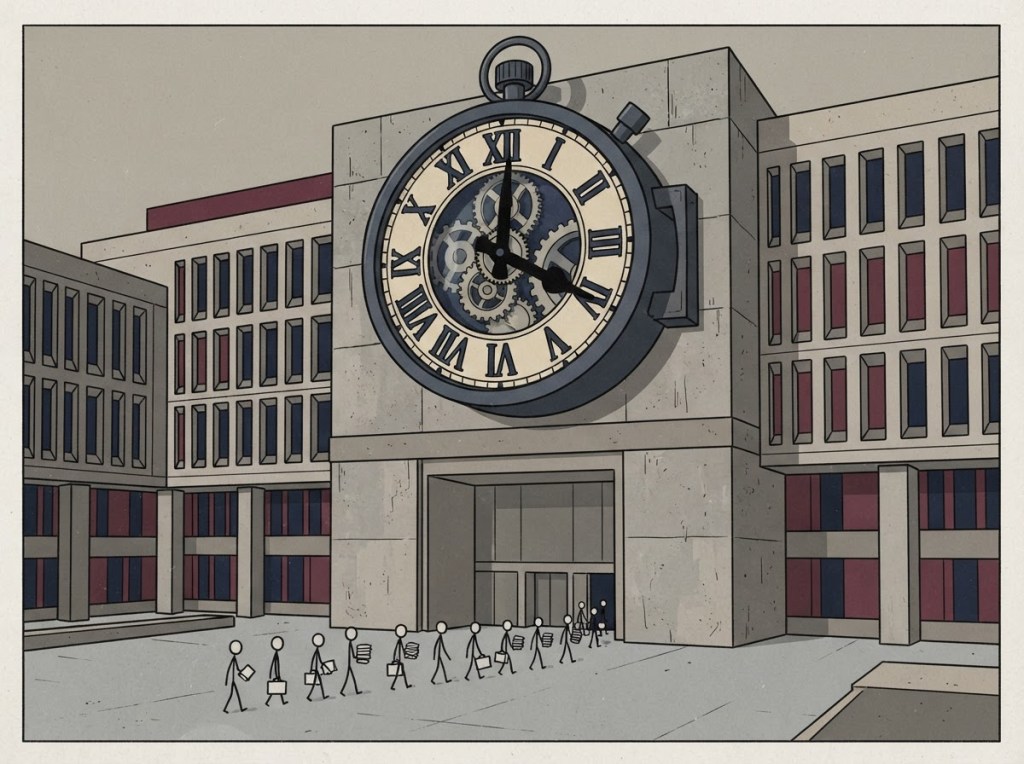
The Senate is expected to pass a permitting overhaul this week that puts federal agencies on a stopwatch. Several of the agencies that would run that clock are much smaller than they were two years ago.
The Bipartisan American Affordability and Jobs Act, known as BAAJA, is mostly about how fast Washington says yes. The Senate voted 73 to 25 on November 9 to begin debate. Final passage could come as early as Wednesday evening, after which the House would have to act.
Most of the coverage has focused on what the bill does to projects. This is about what it does to the agencies that have to issue the permits. The details below draw on the Congressional Research Service’s analysis of the bill as introduced and a C2ES summary updated for the November 7 manager’s amendment.
A Stopwatch With Teeth
Start with the clocks. Once an environmental assessment or impact statement is public, agencies taking part in the review would have 90 days to decide the remaining permits. Agencies outside the review would have 120.
After an impact statement is published, the lead agency would have 45 days to issue its record of decision. After an assessment, it would have seven days to issue a finding of no significant impact or start an impact statement.
The front end gets a clock too. Agencies would have 60 days to say whether an application is complete, then another 60 to decide what level of review it needs. CRS notes that current law sets no general deadline for the first step.
Under current law, an agency can extend a deadline after consulting the project sponsor. Under the bill, it could do so only with the sponsor’s consent. The party waiting for the permit would hold the key to the clock.
Endangered Species Act consultations get shorter timelines as well. If a consultation runs past its deadline without the required notice or the applicant’s consent, the applicant can go to court. C2ES adds that agencies would not have to consider scientific research that becomes public after a review begins, and could not delay a decision to wait for it.
Supporters have a real argument. Reviews that run for years raise costs and kill projects, and enforceable schedules give sponsors something to plan around. C2ES says as much. It also notes that a clock that will not wait for new data can lock in an incomplete record.
The Referee Rules on Itself
When two agencies disagree, the bill turns to the White House Council on Environmental Quality. A project sponsor notifies the CEQ chairman. CEQ has 30 days to broker a fix, then 14 more to decide the matter and order the agencies to comply.
CRS reports that the order would be final, not subject to judicial review, and would count as full compliance with any interagency consultation or similar procedural requirement at issue in the dispute.
Read plainly, that language suggests a CEQ order could stand in for a consultation that an agency would otherwise have to finish. That is an inference from CRS’s description of Section 1106. The summary does not say how it would interact with the Endangered Species Act, and the bill text should be checked before anyone relies on it.
CEQ’s own footing is worth a sentence. According to CRS, it rescinded the government-wide NEPA regulations in 2025. The bill now asks it to standardize how every agency applies the law, set performance measures for agencies and their personnel, build a federal permitting data system by December 1, 2028, and keep a public tracker of delayed reviews.
For all that, CRS says the bill raises CEQ’s general NEPA authorization from $1 million to $5 million a year. A public CEQ headcount did not turn up in the sources reviewed.
The Penalty Is Your Calendar
The bill also says what happens to agencies that miss the clock. The consequences land on people, not budgets.
Thirty days after a CEQ order is missed, the agency’s chief permitting officer and any senior career supervisor involved in the review must spend at least half of their workweek fixing the delay. After 60 days, the head of the agency may not travel more than 25 miles from their duty station until every outstanding authorization is issued. CRS says the Defense Secretary is excluded. C2ES describes the same consequences in the amended bill.
It is a novel theory of management. A department secretary can be held to account without anyone hiring a single reviewer, simply by taking away the frequent-flyer miles.
Who Is Supposed to Do the Work
Now the staffing. The Fish and Wildlife Service handles Endangered Species Act consultations, among other things. The Center for Biological Diversity, using staffing rosters it obtained under the Freedom of Information Act, reports the agency fell from 9,957 employees in 2024 to 6,333 in 2026, a drop of 36 percent.
That figure covers the whole agency, not just the people who review projects. The same group’s funding letter to Congress cites a loss of at least 18 percent, including more than 500 biologists in the Ecological Services program. Counts differ by date and scope, and the group is an advocacy organization.
Whatever the exact number, a former assistant director of the agency’s ecological services program told lawmakers in March that the staff reductions are hurting the Service’s ability to carry out the administration’s own push to speed up permitting.
The Forest Service, which also issues authorizations for energy and infrastructure, has lost almost 30 percent of its staff since 2024, according to Defenders of Wildlife, another advocacy group.
The bill does include money. It authorizes $20 million a year for fiscal 2027 through 2033 for a new Permitting Improvement Fund, to be shared among all the key permitting agencies. It authorizes $150 million a year for 2027 through 2031 for Endangered Species Act consultations and a new program that lets states take over some of that work, per C2ES.
Those are authorizations, which are permission to spend, not spending. For scale, Fish and Wildlife alone is down 3,624 people by the Center’s count. And C2ES says whether state takeover would reduce delays depends largely on whether states have the capacity.
Put the pieces side by side. The bill shortens the clocks, sets penalties for missing them, and lands those penalties on the career staff and leaders of agencies that are smaller than before. The reasonable expectation is more missed deadlines. That is an inference, built on the Center’s staffing figures and CRS’s description of the deadline provisions. None of the sources reviewed projects how many deadlines agencies would actually miss.
The bill is precise about how fast agencies must move. It is a good deal vaguer about who will be left to do the moving.

