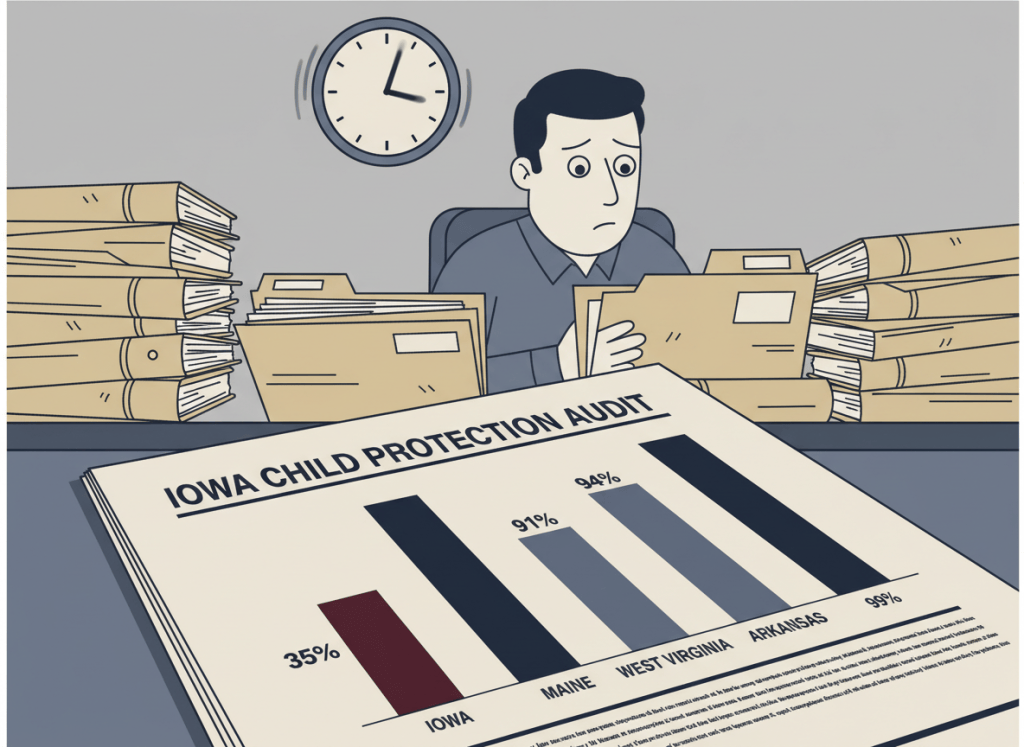
Federal auditors sampled Iowa child abuse reports and found that more than one in three missed at least one state assessment requirement.
That is the best result yet in a four-state series. It is the best because the others were worse. Much worse.
The Best Grade in a Failing Class
The audits test compliance with the Child Abuse Prevention and Treatment Act, the federal law that funds state child protection work. In fiscal 2025, the Administration for Children and Families awarded $103.2 million in those state grants across 50 states, the District of Columbia and Puerto Rico.
The report does not say how much of that went to Iowa. It does say Iowa’s plan includes an assurance, signed by the governor in 2011, of immediate screening, risk and safety assessment, and prompt investigation.
The HHS Office of Inspector General released its Iowa audit (OAS-26-01-033) this fall. Auditors drew 100 reports from the 28,168 accepted between Oct. 1, 2024, and Sept. 30, 2025. Thirty-five failed at least one requirement.
Extrapolated, that is about 9,859 reports. The 90 percent confidence range runs from roughly 7,600 to 12,300.
The 30 sampled rejected reports all met intake rules. That is a small sample drawn from 19,838 rejected reports, and OIG published no estimate for the group. The audit also did not examine what law enforcement did with referrals.
Now the comparison. OIG has run the same child-protection audit in other states:
- Maine: an estimated 94 percent noncompliant.
- West Virginia: an estimated 91 percent.
- Arkansas: 138 of 140 sampled accepted reports did not comply.
Against that field, Iowa is the honor student. The report’s title, “Could Be Improved,” reads like a note on a report card.
Twenty-Seven Letters
Of the 35 failing reports, 27 involved parental notification letters. Twenty-two went out between 1 and 16 days late. For five, there was no documentation that the letters were sent at all.
State policy requires the letter within five business days, to custodial and noncustodial parents alike. OIG’s own example is not trivial: a parent living elsewhere, unaware of the report, could allow the child to spend time with the alleged abuser.
Still, a late letter is a different failure from a child nobody saw.
The other findings are smaller in number. Three reports lacked outcome letters. Three had no documented interviews with siblings or other children in the home. Two lacked documented safety plans, and two abuse assessments closed five and seven days late.
The counts overlap. There were 37 findings across the 35 reports.
One safety-plan file could not be found because the worker had left the agency. For the other, Iowa officials said the plan was done verbally.
The two sides also tell different stories about the letters. OIG says workers did not follow existing policy, and that despite reminders built into the system, they either requested the letters late or never requested them.
Iowa concurs with every finding. It adds that a system error sent some notices on day six instead of day five, and that parents were often notified through interviews anyway. Iowa also says the three children without sibling interviews were all seen, and that the two late assessments came from one worker already under performance monitoring.
The report does not reconcile the accounts. A software bug and a worker who never pressed the button are not the same problem.
The Questions Nobody Printed
The report’s background section lays out what a caseworker must do. The child must be observed within 1, 24, 72 or 96 hours, depending on severity. A face-to-face safety assessment is due within 24 hours of first contact. Every family gets a risk assessment.
The findings contain nothing on any of it. The report does not say whether those requirements were tested and passed, or not tested.
That matters because timeliness drove the other states’ results. In West Virginia, 61 sampled reports were not assessed within the required 30 days. Iowa’s only comparable findings are two late closings.
Here is an inference, and it is only that. It rests on the Iowa report’s background and findings sections, set against the West Virginia coverage. Iowa’s lower rate may partly reflect a narrower set of tested requirements rather than purely better performance, because Iowa’s five finding categories are mostly letters while the other states’ audits cited screening and investigation failures.
The Iowa report cuts the other way in one place. A footnote says Iowa’s term “assessment” is what the federal law calls an investigation, so the labels line up. The report does not settle the scope question either way.
A Warning From 2020, a Fix From 2026
OIG says it picked Iowa after a risk analysis of child poverty, fatality and recurrence rates. It also cites a 2020 Iowa Ombudsman report on the death of Natalie Finn, which identified problems with intake and assessment.
The audit period ended in September 2025. The report does not say whether the 2020 problems were fixed in the years between.
Iowa’s corrective actions are mostly recent. A Help Desk reminder on safety plans went out Dec. 31, 2025, followed by “Back to Basics” training on Feb. 19, 2026. A Central Consult Unit launched in March 2026, and a reminder on outcome letters went out May 27, 2026.
All of that falls after the audit window. Whether it changed anything is unknown.
OIG’s single recommendation is refresher training or periodic guidance. The report contains no dollar finding and no consequence beyond that. It also contains no look at caseloads or staffing. West Virginia’s child welfare agency pointed to heavier worker caseloads. Iowa’s explanation, as OIG relays it, is that workers did not follow policy.
OIG describes the work as a series, with Iowa as one entry. Nothing in the report suggests a penalty is coming. For a state that concurred with everything, the practical consequence is a promise to remind people of rules they already had.
Inquiries are being directed to Iowa HHS and HHS-OIG. Three questions top the list. Which requirements did OIG test, and did the child-observation and safety-assessment deadlines pass? How many notices did the day-six system error affect, and when was it fixed? What were Iowa’s child protection caseloads and turnover during the audit period?
Thirty-five percent is the good news. The harder number is the one the report never prints.

