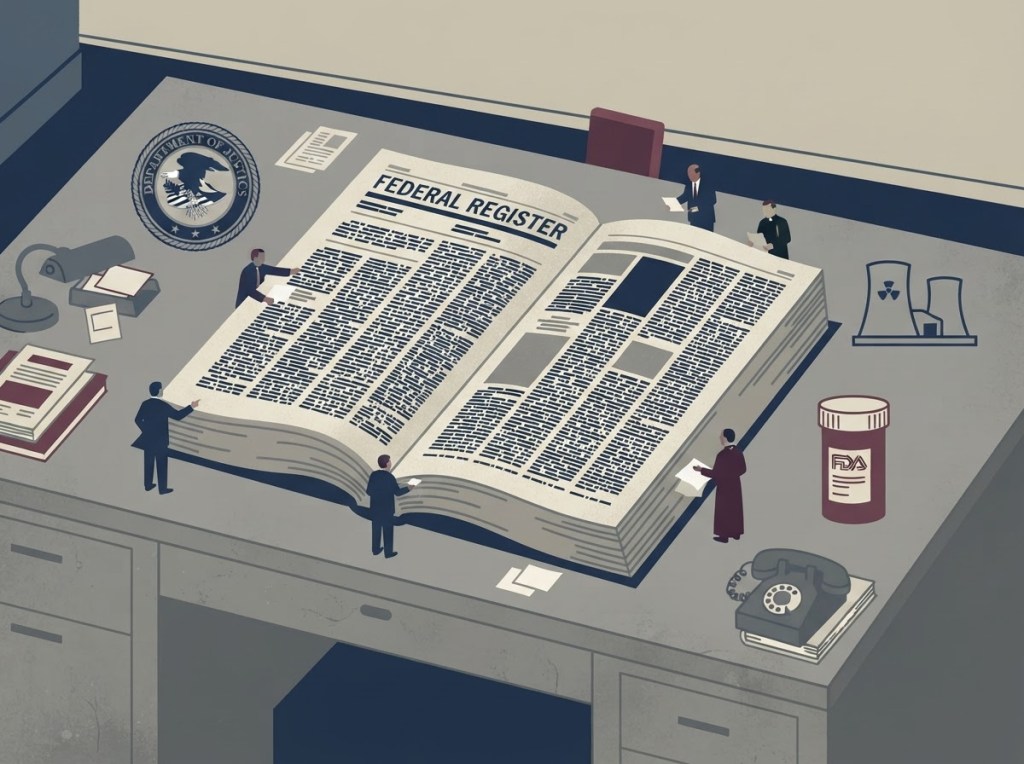
The day’s most consequential document comes from the Justice Department, which finalized a rule making summary dismissal the default outcome for appeals to the Board of Immigration Appeals, so a case now reaches full briefing only if a majority of the Board’s permanent members affirmatively votes to take it up within ten days.
- Justice Department / Executive Office for Immigration Review finalized its rule on Board of Immigration Appeals procedures, responding to 1,615 public comments on a February interim rule. The rule keeps a right to appeal on paper, but flips the default: summary dismissal is now the outcome unless a majority of permanent Board members votes within ten days to accept the case for full review, which matters because it shifts the burden from the agency having to justify a fast dismissal to the immigrant having to first win over a majority of judges just to be heard at all. The rule takes effect December 17, 2026. (Federal Register)
- Nuclear Regulatory Commission published both a direct final rule and an identically titled proposed rule, “Advisory Committee on Reactor Safeguards Functions,” implementing an executive order that orders the NRC to pare its advisory committees to the bare statutory minimum. Publishing the two together is a known procedural shortcut: the direct final version takes effect automatically on February 1, 2027 unless the agency receives “significant adverse comments” by December 17, in which case the parallel proposed rule becomes the fallback path, letting the change go through with less scrutiny than a normal rulemaking would get. The target is the NRC’s own in-house panel of reactor-safety experts, who independently review every new reactor design before it’s licensed, so a cut to its “personnel and functions” is worth watching for what review capacity it actually removes. (direct final rule, proposed rule)
- Labor Department / Employment and Training Administration proposed the first major overhaul of its PERM labor certification program in nearly 20 years, the process that requires an employer to show no qualified American is available before sponsoring a foreign worker for a green card. The proposal would eliminate the Schedule A list of occupations exempt from that labor-market test, add new layoff-reporting requirements, and specifically target employers who lay off American workers while continuing to file PERM and H-1B petitions, citing the department’s own enforcement cases as evidence. Comments are due January 19, 2027. (Federal Register)
- Food and Drug Administration proposed formally reversing a position it has maintained since at least 2001: that N-acetyl-L-cysteine (NAC), an ingredient in hangover and liver-support supplements, cannot legally be sold as a dietary supplement because it was first approved as a prescription drug in 1963. If finalized, the rule would let NAC products be marketed as supplements outright, and FDA says it would withdraw the 2022 enforcement-discretion guidance that has let the industry keep selling them in the meantime. Comments are due January 19, 2027. (Federal Register)
- Federal Communications Commission adopted an order narrowing how it applies the National Environmental Policy Act to communications infrastructure, describing current review as a “barrier to investment” rather than a decision-making tool. Most of the order takes effect December 17, but the FCC delayed the actual environmental-review rule changes, in 47 CFR 1.1303 through 1.1320, indefinitely, with the effective date to be announced in a later notice, meaning the substantive deregulation isn’t actually in force yet even though the order is final. (Federal Register)
- Nuclear Regulatory Commission closed an enforcement matter against TRISO-X, a nuclear fuel manufacturer, through a confirmatory order that makes voluntary corrective-action commitments legally binding rather than pursuing a civil penalty. The underlying issue traced to the main force-resisting structural system at TRISO-X’s TX-1 process building, the kind of design-basis safety question regulators usually treat seriously, and resolving it through private mediation rather than a public enforcement conference means the public record on what actually went wrong is thinner than a contested case would have produced. (Federal Register)
Editor’s note: This edition reflects all 99 documents published in the November 17, 2026 Federal Register. Excluded as routine: Securities and Exchange Commission self-regulatory-organization fee filings (20 of the day’s documents), Paperwork Reduction Act and OMB information-collection notices, agency meeting and Sunshine Act notices, antidumping and countervailing duty determinations, mine-safety petitions for modification, and other standard administrative notices that did not raise institutional or anomaly concerns.

