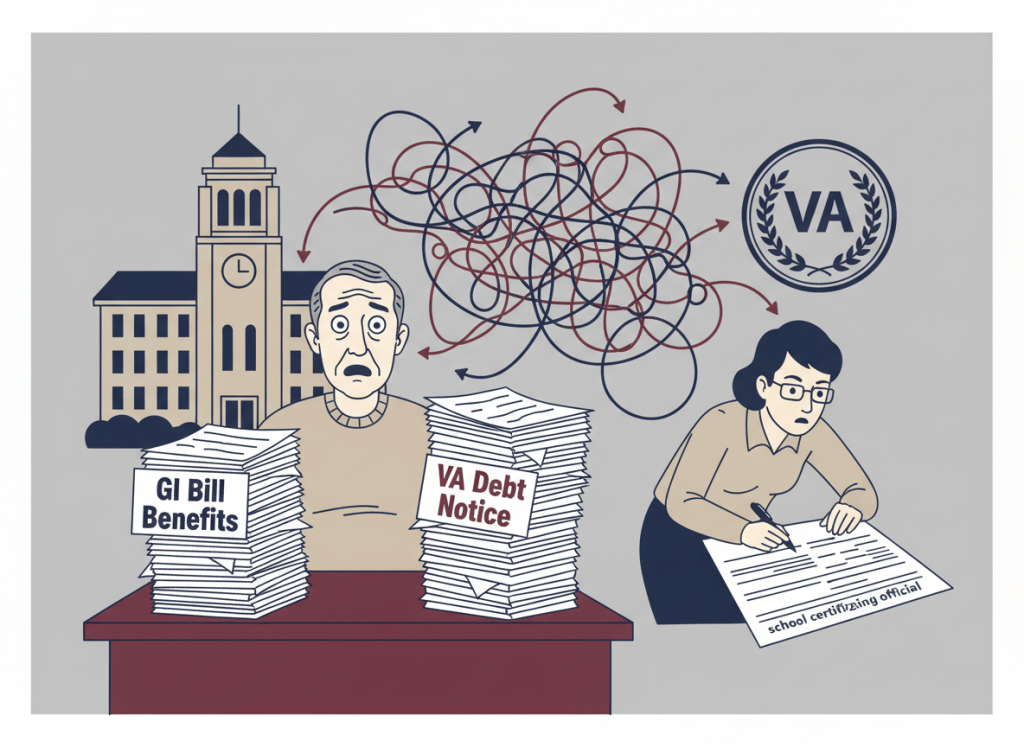
An investigation into George Washington University’s accelerated MBA program uncovered confusing benefit calculations, unexpected tuition bills, and enrollment changes that generated nearly $10,000 in federal overpayments. The VA inspector general closed its review without a formal recommendation.
Six veterans attending George Washington University’s accelerated MBA program questioned why their GI Bill housing allowances were lower than expected. When a university official attempted to correct the problem, the students received additional federal payments. Then the Department of Veterans Affairs determined that the payments were improper and sent them debt notices.
The episode, documented in a November 4, 2026 VA Office of Inspector General report, resulted in approximately $9,815 in housing overpayments to six students, ranging from $390 to $1,948 each. The inspector general also referred the university’s school certifying official to the Department of Justice, which declined the matter. The report does not establish criminal wrongdoing.
Despite these findings, the OIG concluded that the university generally certified enrollments correctly and that students generally received their entitled benefits. The review ended without formal recommendations. What happened to the veterans’ debts remains unclear.
A Congressional Inquiry Into Veterans’ Benefits
The investigation followed a May 2026 request from Representative Derrick Van Orden, chairman of the House Veterans’ Affairs Subcommittee on Economic Opportunity. Six of seven students in GWU’s accelerated MBA cohort raised concerns about housing allowances and unexpected summer tuition charges.
The university initially estimated that affected students could owe approximately $23,571 each for the summer term. Students considered full-time by GWU discovered that the federal rules used to calculate their monthly housing allowance did not necessarily treat their coursework the same way.
Full-Time Students, Different Federal Calculations
VA calculates Post-9/11 GI Bill housing allowances partly using a student’s rate of pursuit. For graduate programs with nonstandard academic terms, that rate may differ from a university’s full-time classification. The OIG generally attributed the lower housing payments to these rules, rather than systemic enrollment-certification errors. For veterans planning household expenses around federal benefits, that distinction carries immediate financial consequences.
The Correction That Created a Debt
In April 2026, a GWU school certifying official amended enrollment certifications to increase the students’ reported full-time status for VA purposes. According to the OIG, the official knew the applicable calculation rules did not support those revisions. The changes produced approximately $9,815 in retroactive housing overpayments to six students. VA corrected the certifications and sent debt letters.
A separate student had genuinely been underpaid approximately $1,594 and received a corrective payment June 8, 2026. The OIG referred the certifying official to DOJ, which declined the matter. The report does not establish whether the six debts were collected, waived, disputed, or otherwise resolved.
When Yellow Ribbon Does Not Cover the Bill
GWU advertised Yellow Ribbon participation for an unlimited number of eligible students, but that did not mean unlimited tuition funding per student. The accelerated MBA’s cost exceeded the approximately $64,920.95 in combined annual GI Bill and Yellow Ribbon funding available under the figures reviewed.
GWU eventually covered additional mandatory summer tuition and fees with institutional funds, approximately $12,700 to $20,600 per affected student, and addressed associated tax consequences. It separately provided approximately $27,886 in university-funded housing stipends to seven accelerated MBA students. The OIG did not find a violation of the university’s Yellow Ribbon agreement, but the episode raises questions about how clearly these limits were disclosed before enrollment.
Problems Beyond the MBA Program
Among 37 Yellow Ribbon recipients examined, the OIG identified eight students with incorrect payments, including approximately $26,696 in overpayments and $3,012 in underpayments. VA reported corrective actions. These sample findings cannot be extrapolated to the university as a whole.
The accelerated MBA began in 2019; 27 students receiving VA education benefits had enrolled since then. GWU reported more than 1,100 military-affiliated students as of June 2026, approximately 43 percent veterans. The OIG advised involving military and veteran services personnel in future program design and obtaining appropriate approvals for substantially different structures. The report also described a mandatory financial orientation introduced for fall 2026.
An Oversight Review Without Recommendations
The inspector general issued no formal recommendations and identified no questioned costs in its final recommendations, notwithstanding the documented payment errors, debt notices, unexpected tuition charges, and DOJ referral. Individual errors do not necessarily establish systemic noncompliance, but they leave practical questions unresolved.
VA described planned Digital GI Bill modernization improvements, including automation of certain rate-of-pursuit and Yellow Ribbon calculations. The OIG said it would monitor those efforts. Its review did not establish how often comparable issues occur at other universities.
VA Points to Its Written Response
On November 16, VA Public Affairs responded to a Bureaucracy Times inquiry by directing the publication to page 26 of the OIG report, which reproduces the Veterans Benefits Administration’s October 6 management comments. Those comments constitute VA’s formal response to the review, although the department did not provide additional case-specific information in its November correspondence.
“VBA concurs with the OIG’s draft report findings”
Veterans Benefits Administration, October 6, 2026 management comments, report page 26
VA said its own targeted risk-based survey, conducted in May 2026, corroborated the inspector general’s findings. It agreed that GW’s accelerated MBA enrollment certifications and resulting payments were generally accurate, while attributing student concerns largely to confusion and inadequate university communication about the difference between full-time academic status and the separate rules governing GI Bill housing benefits.
The agency also outlined planned Digital GI Bill improvements connecting enrollment submissions, program approvals, and benefit adjudication. VA said automation of nonstandard-term rate-of-pursuit calculations should reduce manual errors, while Yellow Ribbon payment functionality remained under development. The written comments do not specify a deployment date or provide an updated disposition of the six students’ VA debt notices. VA Public Affairs did not supplement those comments with answers to those outstanding questions.
University Responds With Administrative Changes
In a November 13 statement to Bureaucracy Times, The George Washington University emphasized that the VA Office of Inspector General found its education-benefit certifications generally accurate and issued no formal recommendations following its review of the Accelerated MBA program.
The university also acknowledged the report’s observations concerning communication with students and coordination of academic programs operating on nonstandard terms.
GW said it has implemented mandatory benefits orientation for incoming military-affiliated students, improved its benefits disclosures, and established a review process intended to identify VA eligibility and student-benefit implications before new or modified academic programs are launched.
The university also reported ongoing efforts to strengthen its Office of Military & Veteran Services through additional staffing, experienced leadership, training, and internal process improvements.
“We will carefully review the final report and continue working with VA to strengthen our processes and support for military-affiliated students,” the university said in its statement.
Although the OIG issued no formal recommendations, GW’s response indicates that the university is undertaking administrative changes addressing issues identified during the review. The statement did not specify whether the six students who received VA debt notices have since had those debts resolved, nor did it provide implementation dates or effectiveness measures for the announced improvements.
Who Bears the Cost of an Administrative Error?
Universities certify enrollments; VA calculates benefits based on those certifications; students bear the uncertainty when the two systems diverge. Here, an attempted correction produced federal payments later deemed improper and debt notices for six veterans.
GWU took steps to address unexpected tuition and provided separate housing assistance, but those measures do not establish the disposition of the VA debts. The federal review is closed. Whether the students’ debts are closed is another question.
Bureaucracy Times received responses from GW and VA Public Affairs. VA referred the publication to its published management comments; questions concerning the disposition of the six veterans’ debts, the DOJ referral, and the timetable for planned safeguards remain unresolved.

