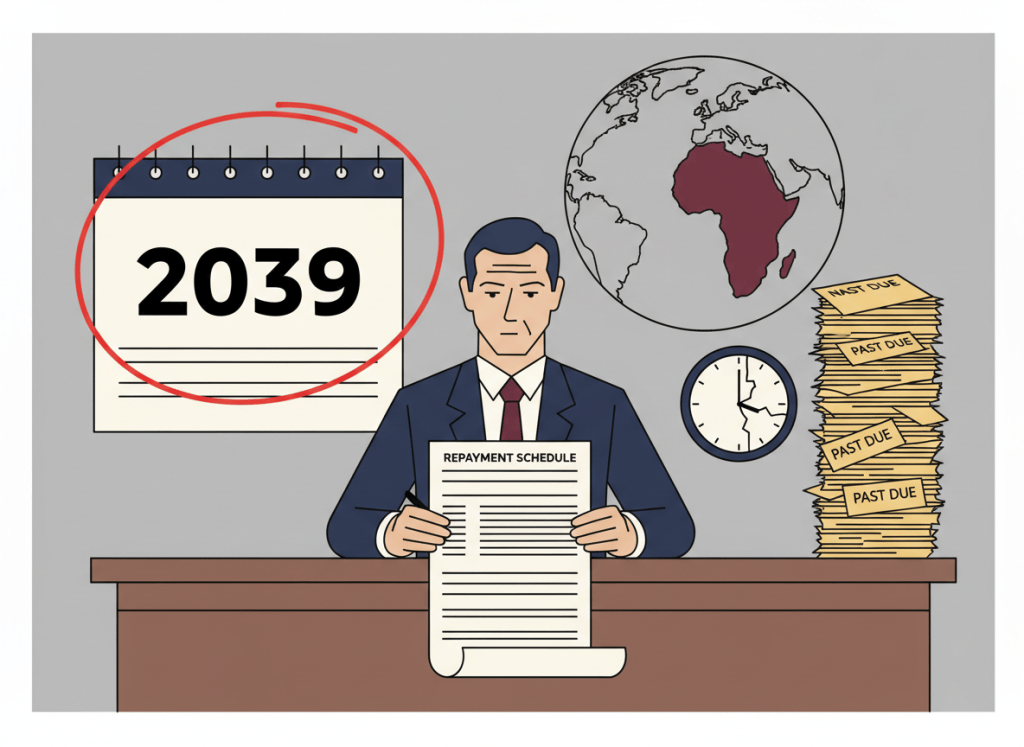
The United States has agreed not to collect roughly $131 million from Ghana until 2039. By the time the first installment comes due, a child born the week the deal was signed will be a teenager.
The agreement, Treaties and Other International Acts Series 26-812, was signed in Accra on May 6, 2026 and entered into force on August 12. It reschedules Ghana’s debts to the Export-Import Bank of the United States, the government’s export credit agency.
Thirteen Years of Grace, Priced at Two Percent
Ghana stopped paying most of its external debt in December 2022. The treaty carries out, for EXIM, a memorandum of understanding that Ghana and its official creditors finalized on June 11, 2024.
It covers payments due from 2023 through 2026 under three EXIM credit agreements dating to 2008, 2009 and 2013. Annex B lists $120.98 million in deferred principal and $9.71 million in deferred interest.
Interest accrues on those amounts at 2 percent and is capitalized, which adds another $50.59 million. The total is $181.29 million, paid in five installments from July 1, 2039 through July 1, 2043, peaking at $52.2 million in 2040.
In plain arithmetic, the deferral adds about 39 percent to the original sum. That is the price of time, and the treaty itemizes it.
The scale is modest. Ghana’s parliament was told the broader deal with 25 creditor countries delivers $2.8 billion in debt service relief, and EXIM’s slice is a small one.
The Fine Print Runs in One Direction
Only Washington gets an exit. Article VI lets the United States suspend or terminate all or part of the agreement on 60 days’ written notice, after which everything rescheduled becomes due under the original contract terms.
The text says the United States does not intend to do so unless it decides the creditor committee is unable or unwilling to act on a Ghanaian breach. The text gives Ghana no matching right.
Article V adds a second trapdoor. If the creditor committee declares the memorandum “ineffective,” the debt reverts to its old repayment schedules, and an extra 5 percent late interest runs from the original due dates.
Annex D lets EXIM sell the debt to anyone. It promises ten days’ notice, but calls that a courtesy that does not limit EXIM’s discretion, and the buyer must agree to honor the memorandum’s terms.
Ghana also acknowledges the activity is commercial and gives up immunity from suit. The carve-outs are diplomatic missions, military assets and Petroleum Assets as defined in the country’s Petroleum Revenue Management Act, and Ghana pays EXIM’s enforcement costs. New York law governs the annex.
Article IV, meanwhile, bars Ghana from paying other external creditors until they match the memorandum’s terms.
The Door That Reopened on August 12
In August 2025, the Millennium Challenge Corporation’s FY2026 report listed Ghana as ineligible for U.S. aid pending a debt restructuring agreement. The cited authority was the debt default restriction in Section 7012 of the FY2025 foreign aid appropriations act.
Citi Newsroom described that provision as covering countries in default on sovereign debt owed to or guaranteed by U.S. persons that have not reached a restructuring agreement. It named two defaults: the December 2022 external debt suspension and about $251 million owed to American companies.
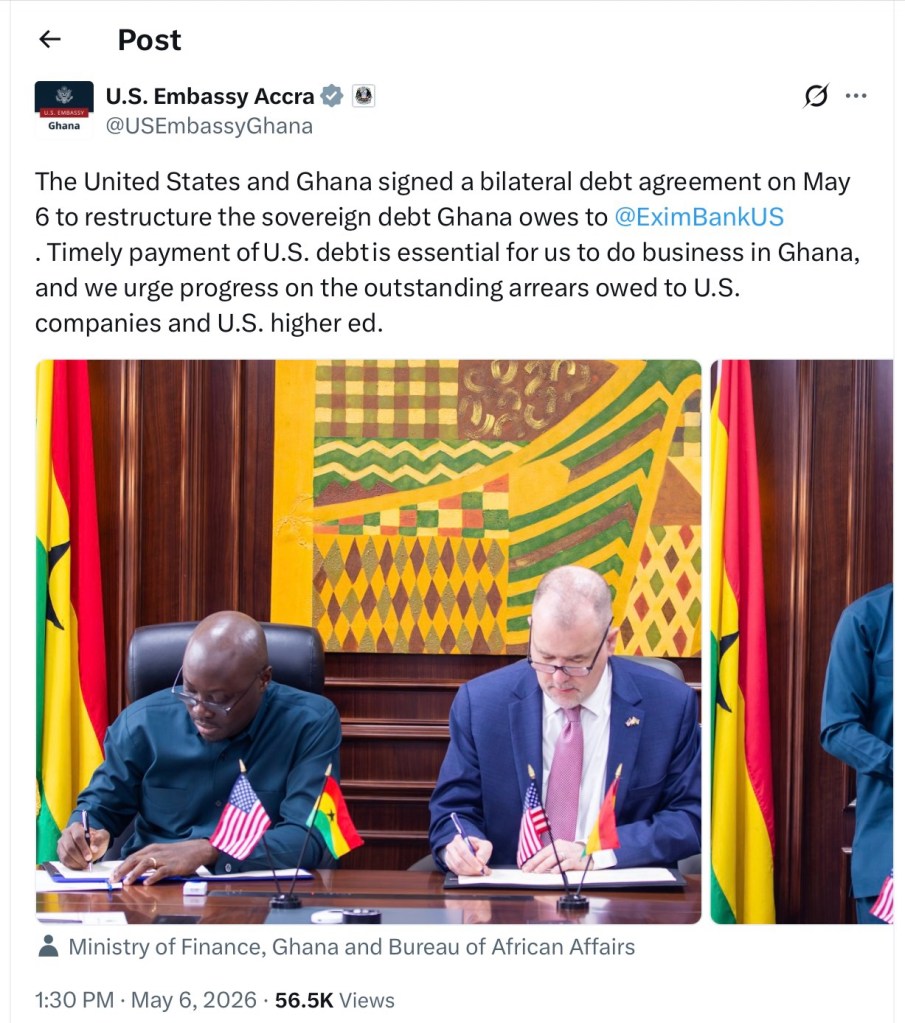
On the day of signing, the U.S. Embassy in Accra posted on X that “Timely payment of U.S. debt is essential for us to do business in Ghana,” and urged progress on the outstanding arrears owed to U.S. companies and U.S. higher education.
Then came the paperwork. MCC’s FY2027 candidate report, dated August 31, 2026, lists Ghana as a candidate country and leaves it off the prohibited list. That list reflects legal bars as of August 12, 2026, the day the treaty took effect. The report was also published in the Federal Register on September 3.
The connection is an inference. It rests on two sources, the FY2026 report tying Ghana’s ineligibility to the lack of a restructuring agreement and the FY2027 report’s August 12 cutoff.
The reasoning is that if the agreement was the condition, its entry into force is the obvious cure. Neither report says so, and chronology is not causation.
Candidate status is also not eligibility. The report is the first of three MCC must publish, and no compact has been offered.
The Receipts Nobody Has Shown
The treaty settles what Ghana owes EXIM. It does not settle the other default.
Senator James Risch’s January 2025 letter put arrears to U.S. companies at about $251 million. The firms named include Twin City Energy, American Tower, GSM, Chubb, Kosmos Energy and Zipline, and two of them have investments backed by the Development Finance Corporation.
That figure is nearly two years old, and no public update on what remains unpaid turned up. In May 2026, the IMF was still calling for legacy energy arrears to be cleared.
A second inference concerns a separate statute. Section 620(c) of the Foreign Assistance Act bars assistance to governments indebted to U.S. persons for goods or services under certain conditions. MCC candidacy requires that a country not be barred under that part of the law, and Ghana is listed.
The reasoning is that either the provision does not apply to Ghana’s arrears or something has waived it. The sources do not say which.
A third loose end is the IMF. The board approved the final review of Ghana’s lending program on July 27, sixteen days before the treaty took effect.
Article IV commits Ghana to the borrowing limit under that program “or as revised” by the IMF board. The program is over, and a non-financing successor was only requested. Which instrument now sets the limit is an open question, and that is my reading of the text.
Inquiries are being directed to the State Department, EXIM and MCC. The three most pressing unanswered questions:
- Did the treaty’s entry into force lift the Section 7012 restriction, and who made that determination?
- How much do Ghanaian entities still owe U.S. companies, and what is the DFC’s exposure?
- With the IMF program over, what sets the borrowing limit Ghana promised to observe?
One date is already fixed. EXIM must tell Ghana the final amounts within 135 days of entry into force, which lands around December 25. Nothing says goodwill like an itemized statement.

