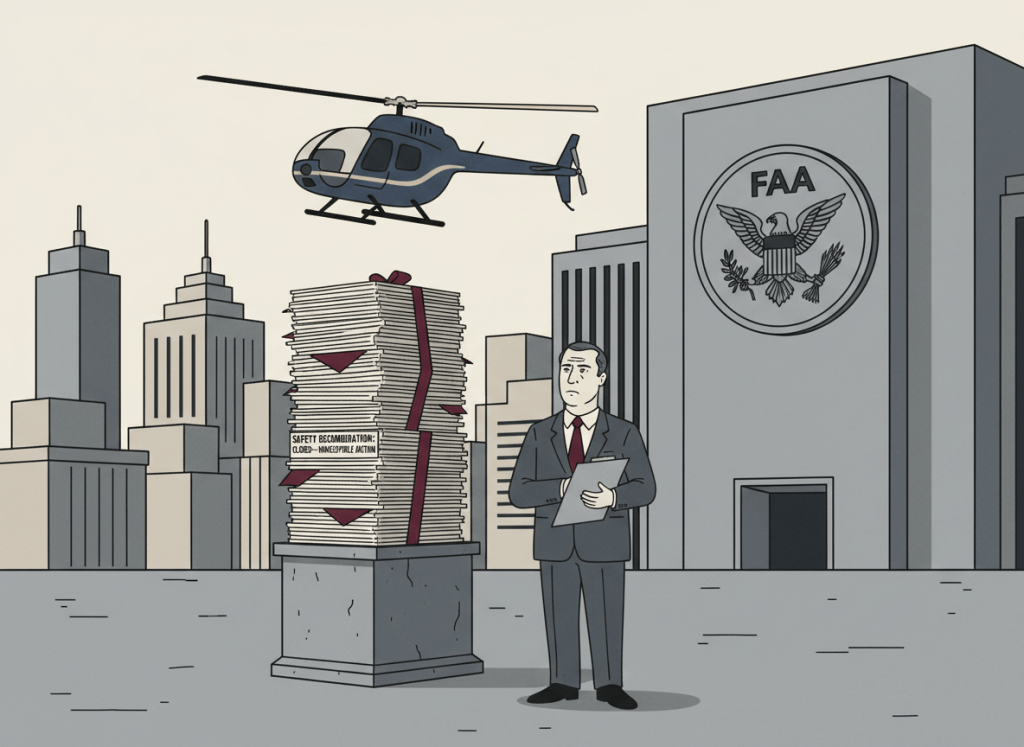
Federal Aviation Administration oversight is facing a new federal audit of commercial helicopter sightseeing operations, years after the National Transportation Safety Board warned that regulatory exemptions could expose paying passengers to safety risks and rejected the FAA’s response to recommended reforms.
The Department of Transportation Office of Inspector General announced the investigation November 3, 2026, following a congressional request prompted by fatal crashes and questions about operators using rules intended for other aviation activities. The audit announcement, project 27A3002A000, says auditors will examine FAA headquarters and selected Flight Standards District Offices.
A loophole with a fatal history
The regulatory concern centers on the distinction between commercial air tours and aerial-work operations such as photography. Some legitimate commercial air tours operate under Part 91; Part 135 generally imposes more extensive commercial operating requirements. Part 91 status alone is not evidence of wrongdoing. The concern is whether sightseeing operations are misclassified as photography to claim an exception.
On March 11, 2018, a FlyNYON-branded helicopter crashed into New York’s East River, killing five passengers. The NTSB accident report describes how a passenger’s restraint tether inadvertently activated the fuel shutoff lever and how the restraint system impeded escape after the helicopter overturned. Investigators also raised concerns about oversight of Part 91 revenue passenger-carrying operations.
The safety recommendations the FAA did not satisfy
Three NTSB recommendations, A-19-29, A-19-30 and A-19-31, were classified Closed—Unacceptable Action, according to the NTSB 2025 Annual Report to Congress. They sought clearer definitions of aerial photography and aerial work, better inspector guidance, and common national commercial air-tour standards. The FAA cited existing guidance and its expanded Safety Management Systems approach, but the NTSB did not consider those measures sufficient. Unacceptable closure does not mean implementation succeeded.
Another fatal crash and congressional intervention
On April 10, 2025, six people died when a sightseeing helicopter crashed into the Hudson River. The FAA issued an emergency suspension order against the operator’s air-carrier certificate on April 14. The accident flight was identified as a Part 91 air tour, not an established example of abusing the aerial-photography exception; its cause must not be inferred from the 2018 crash.
Seven members of Congress requested further scrutiny in an October 16, 2025 letter, asking whether the FAA knows how many operators use photography classifications and how effectively it inspects them.
The FAA’s own committee called for reorganization
A commercial air-tour rulemaking committee established under the FAA Reauthorization Act of 2024 proposed consolidating and modernizing relevant rules. Its November 2025 final report identified scattered and sometimes overlapping requirements, and proposed a more coherent framework for training, maintenance, operational safety and oversight. The recommendations are advisory, not binding rules; their implementation status remains a question for the FAA.
A question about the FAA’s data
An October 28, 2026 Federal Register information-collection notice for National Air Tours Safety Standards lists 12,834 responses, an average of five hours per response and 2,560 annual burden hours. On their face, those figures do not reconcile through simple multiplication. Differences in response categories or methodology could explain the numbers; clarification is needed before drawing conclusions about data reliability.
What the audit can establish
The inspector general has not yet found that the FAA violated oversight obligations, that a particular operator improperly claimed an exception, or that a regulatory classification caused the 2025 crash. The investigation may, however, establish how consistently the FAA identifies operators, applies requirements and directs inspection resources.
The documentary record already establishes a longstanding disagreement: federal accident investigators sought stronger standards, the FAA defended aspects of its existing approach, an advisory committee proposed restructuring the rules, and Congress requested scrutiny. The central question is whether the FAA’s measures have been sufficient to protect paying passengers.
Bureaucracy Times is seeking clarification from the FAA, DOT OIG and NTSB about inspection practices, regulatory implementation and the status of the safety recommendations.

