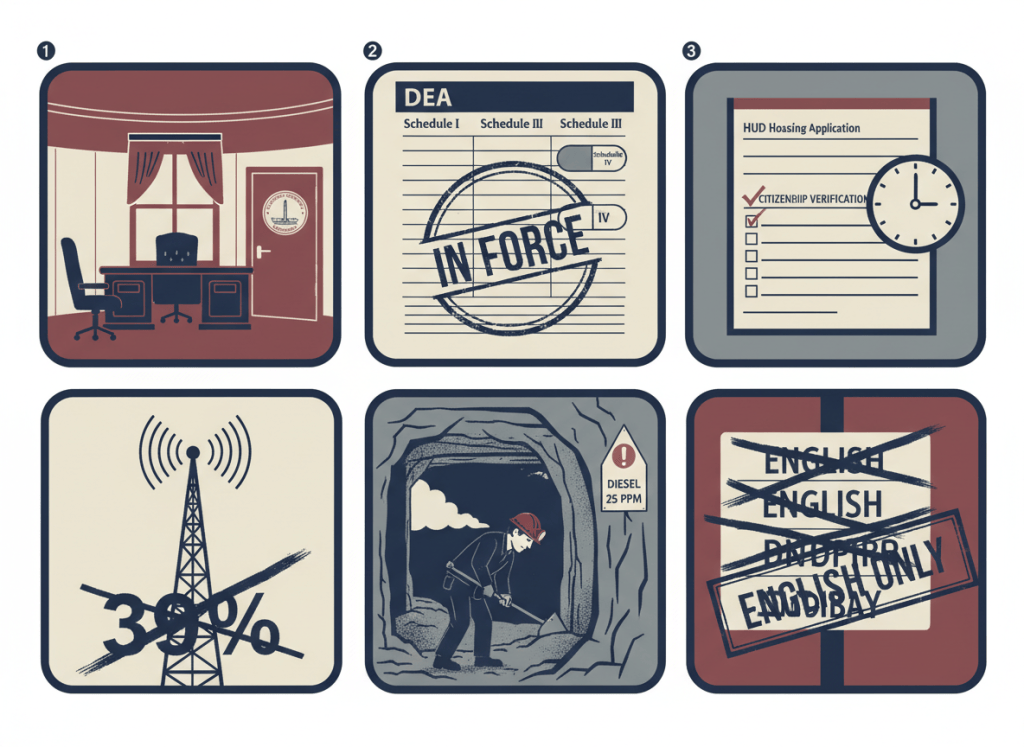
Today’s Federal Register, Volume 91, Number 217, carries a presidential proclamation that places three rooms of the White House West Wing under formal national monument protection, a status usually reserved for landscapes and historic sites outside the government’s own daily use.
- Executive Office of the President. Proclamation 11080 designates the Oval Office, the Outer Oval Office, and the Cabinet Room as the Oval Office National Monument, invoking the Antiquities Act, a law written to protect landscapes and historic sites that face some outside threat. The White House grounds already carry National Historic Landmark status, so the proclamation adds a second, narrower layer of protection over space the sitting president occupies, and it directs the National Park Service to draft a management plan limiting future changes to the rooms. That overlap is worth flagging because nothing in the document identifies a threat the existing landmark status didn’t already address.
- Drug Enforcement Administration. DEA placed oveporexton, a newly approved narcolepsy drug sold as Orzeyful, into Schedule IV of the Controlled Substances Act through an interim final rule that took effect the same day it was published. A 2023 law lets DEA schedule certain newly approved drugs this way without first showing the “good cause” normally required to skip proposed rulemaking, so the 32-day window for comments and hearing requests that follows November 12 operates after the rule is already binding rather than before. That sequencing matters because it means the public’s only say comes once the rule is already in force.
- Housing and Urban Development Department. HUD finalized a rule requiring every applicant and recipient of assistance under its Section 214 programs, regardless of age, to verify citizenship or eligible immigration status. It also ends the practice of letting mixed-status households receive reduced, prorated assistance indefinitely while that verification is pending, converting it into a temporary accommodation instead. That distinction matters for families already receiving housing aid, because an open-ended accommodation becomes a deadline to finish verification or lose the subsidy once the rule takes effect on December 14.
- Federal Communications Commission. The FCC eliminated the rule capping how much of the national television audience one company’s stations can collectively reach, a limit that had stood at 39 percent. Station deals the cap would previously have blocked outright will now go through case-by-case review for localism, competition, and viewpoint diversity instead, shifting the question from a fixed numeric ceiling to agency discretion exercised deal by deal. That shift matters because a bright-line cap is predictable and hard to negotiate around, while case-by-case review leaves more room for a future commission to approve larger station groups than the old rule allowed.
- Mine Safety and Health Administration. MSHA removed the personal exposure limit for diesel particulate matter, a recognized carcinogen, in underground metal and nonmetal mines, describing the existing numeric limit and its effective dates as outdated. When one commenter asked for a 60-day extension of the comment period, MSHA declined and called the change “non-substantive.” That label is worth a second look, since deleting an enforceable exposure ceiling removes the specific number miners and inspectors could otherwise point to in the enclosed, diesel-exhaust-heavy spaces the rule covers.
- Justice Department. DOJ opened a comment period on an Attorney General memorandum that directs federal agencies to conduct business in English only and to eliminate multilingual-assistance programs unless required by law, implementing the executive order that made English the official language and rescinded the prior language-access policy. Comments run through January 11, 2027, but the underlying memo is dated October 22 and is already guiding how agencies review their own language programs, so the comment period runs alongside implementation rather than ahead of it.
This edition is drawn from all 124 documents in today’s issue of the Federal Register (Vol. 91, No. 217, pages 72769-73136). Left out as routine: recurring information-collection and Paperwork Reduction Act notices, FAA airworthiness directives and instrument-approach-procedure amendments, Coast Guard safety zones, FERC combined filings and construction-extension notices, National Park Service inventory-completion and repatriation notices, SEC self-regulatory-organization filings, antidumping and countervailing-duty administrative reviews, and routine advisory-committee meeting notices.

