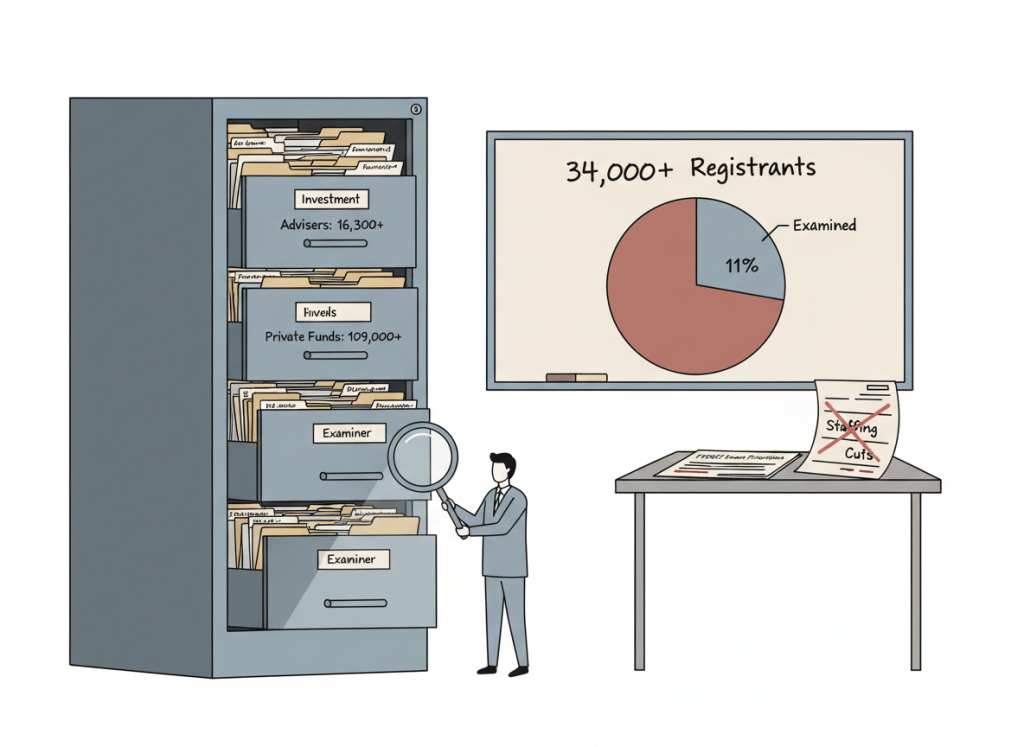
On October 23, the Securities and Exchange Commission announced its fiscal year 2027 examination priorities, a list covering more than 34,000 registrants and promising heightened attention to nearly everything a securities regulator could plausibly fret about.
The priorities document does not say how many of those registrants an examiner will actually visit. The agency’s budget request does, and the number is not large.
A Very Complete List
The priorities run from investment adviser conflicts and retail exposure to complex products, through private funds and private credit, broker-dealer anti-money laundering, cybersecurity, tokenization and Treasury clearing, to oversight of FINRA and the PCAOB. The Division of Examinations adds that the list is not exhaustive, and that the document is a staff statement with no legal force.
The universe being watched keeps growing. The SEC’s FY 2027 budget justification counts more than 16,300 investment advisers and says private funds have nearly tripled over the past decade, from about 38,000 to over 109,000.
The same document says the agency “will reassess private market rules to allow more investors access.” The priorities, meanwhile, flag private credit and illiquid products as risks to retail investors.
Open the door wider, then inspect the hallway.
One more oddity. The priorities contain no standalone crypto section, with tokenization appearing inside the clearing-agency and systems-integrity entries. The budget justification calls crypto and tokenization a key priority for FY 2027.
The Odds
Performance Goal 3 in the budget justification charts the percentage of investment advisers examined each year. It ran 15, 16, 15, 15 and 14 percent from FY 2020 through FY 2024. FY 2025 was planned at 12 percent and came in at 13.
The estimates for what follows are 9 percent in FY 2026 and 11 percent in FY 2027. Those are projections, not results, and the percentages are rounded. By simple arithmetic, 11 percent of 16,300 advisers is roughly 1,800 firms.
The page says the metric counts all types of examinations, including cause inspections that follow up on tips and limited-scope special inspections. It explains neither the drop nor the rebound.
It did not always work this way. A 2023 risk alert noted the registered adviser population had grown 13 percent in three years while the staff kept examining about 15 percent of advisers each year. Growth was matched. Now it is not.
The staffing figures sit in the same document. Examinations is shown at 1,066 full-time equivalents in FY 2025, 942 enacted for FY 2026 and 952 requested for FY 2027, with exam obligations of $499.9 million, $470.1 million and $468.5 million.
Agency-wide, FTEs go from 4,542 to 4,024, with 4,177 requested. A GAO report found about 18 percent of SEC employees left in fiscal 2025, including 14 percent of Examinations staff, while the budget document cites a 17 percent staff reduction.
Why does coverage matter? The SEC’s own June 9 risk alert says exam findings often led to advisers “returning money owed to clients” over fee billing and calculation errors.
Inference: fewer exams likely means fewer of those errors found in a given year. That rests on the June alert, and the reasoning is simple: if examinations are how billing mistakes surface, fewer examinations surface fewer. The alert does not quantify refunds.
Broker-dealers follow a similar path, from 53 percent examined in FY 2025 to an estimated 45 percent in both FY 2026 and FY 2027. That figure includes exams by self-regulatory organizations, so the SEC’s own share cannot be isolated.
The Sentence That Went Missing
The FY 2026 priorities, in the leadership message, described staff as operating with fewer resources and referred to the reshaping of the workforce. The FY 2027 message does not. It opens instead by noting growth in the number of registered advisers and the assets they manage.
Neither year’s priorities include coverage figures. The 2023 alert shows the Division has published a coverage figure before, in a footnote, so the practice is not unknown.
The numbers exist. They sit in a budget request, which the SEC describes as its annual presentation to Congress, rather than in the document aimed at registrants and investors.
The new Exam Handbook offers a list of factors that inform which firms are selected for exams. It includes prior exam history, tips, time since registration, and reporting by news and media. This publication notes the last one with interest.
For firms that are selected, the Handbook says the Division cannot estimate how long an exam will take. It does promise a disposition letter within 180 days of the on-site work or receipt of all records, whichever comes later.
The Machine in the Examiner’s Chair
The FY 2027 priorities swap “artificial intelligence” for “super intelligence,” and law firm summaries attribute the change to a September 29 executive order. The document says the Division is integrating SI into its own examinations and risk assessment “without displacing examiner judgment.”
What does that mean in practice? The SEC’s 2025 AI use case inventory, the latest listed on its SI page, has 60 entries, and 16 involve Examinations. Eight of those are deployed.
One is a model titled “Using Machine Learning/Artificial Intelligence Techniques to Predict Entities With Certain Risk Characteristics.” It has been operational since April 2015, was built with IBM, and is trained on filings and examination data. The entry says staff “may consider the results” in their exam work.
It is classed as classical predictive machine learning. The priorities do not distinguish between a decade-old model and the newer generative tools. The inventory does not say whether the model helps choose which firms get examined, and the Handbook’s selection factors mention no model at all.
Four generative tools tied to Examinations are listed as pre-deployment: an examiner note-taking assistant, a website summarizer, a chatbot for internal guidance, and an initial research tool. The last lists “improving risk identification” and “optimizing use of resources” among its expected benefits.
Inference: any productivity gain behind the 11 percent estimate would rest, at least in part, on tools that had not gone live as of that inventory. The sources are the inventory and the budget justification, which points generally to “leveraging technology to improve productivity” without naming a method for the coverage estimate.
The reasoning is that the Examinations tools listed as deployed are analytics, parsing and vendor search tools, while the generative ones are not yet live. Statuses may have changed since the inventory was compiled.
Inquiries are being directed to the SEC. Three questions stand out:
- What method produces the 11 percent estimate, and how much of it comes from limited-scope exams?
- What role does the Division’s risk-prediction model play in choosing firms for examination?
- Why do the priorities omit both coverage figures and the earlier acknowledgment of reduced resources?
The SEC describes its examination program as rigorous and analytically driven. It has not yet said how many firms that rigor will reach.


