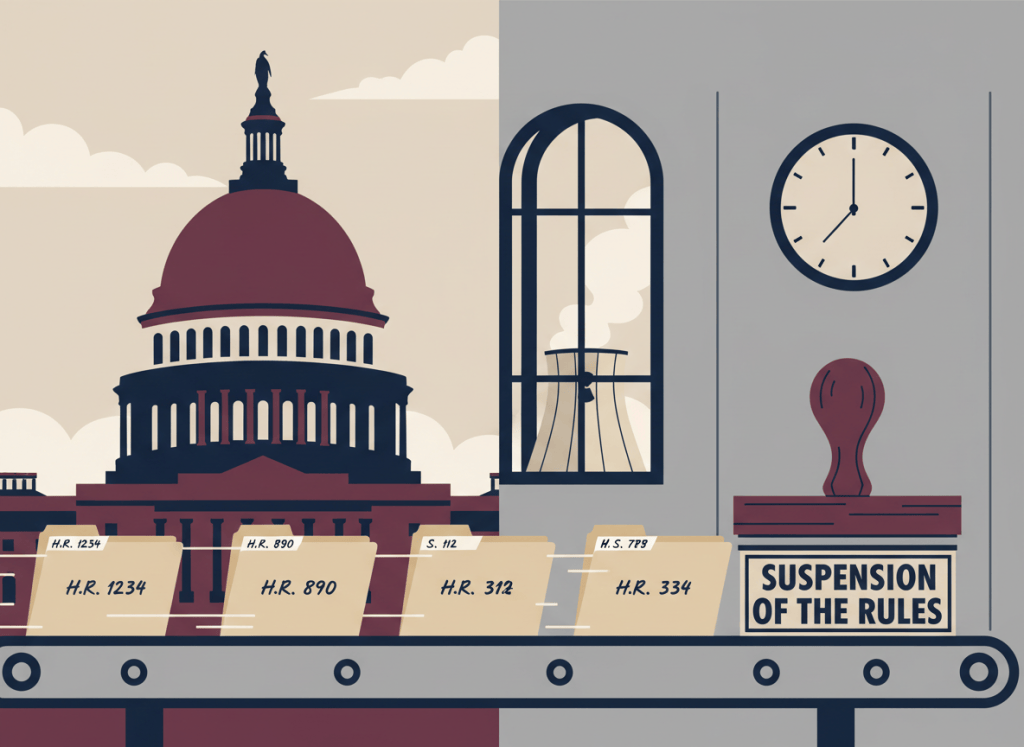
Six nuclear bills are scheduled for expedited House consideration Monday, including new disclosure requirements for Energy Department safety decisions and changes to federal licensing procedures. Congress can move quickly when agreement exists. The question is what receives scrutiny along the way.
WASHINGTON, Nov. 9, 2026 — Congress, an institution frequently slowed by partisan divisions, procedural disputes, and competing legislative priorities, is preparing to demonstrate how quickly it can operate when the necessary political agreement exists.
The House is scheduled to consider six nuclear-energy bills Monday under suspension of the rules, a procedure that limits debate, prohibits floor amendments, and requires a two-thirds majority for passage. The legislation addresses nuclear safety disclosures, licensing hearings, independent technical reviews, spent-fuel recycling, uranium enrichment, and compensation for senior regulators.
At the center is the Department of Energy Nuclear Transparency Act, H.R. 9084, which would require DOE to publicly disclose certain nuclear safety and authorization decisions within 72 hours.
The House schedule places the measures on Monday’s agenda, with votes postponed until 6:30 p.m. Eastern. The Congressional Budget Office’s November 4 assessment identifies 14 bills potentially considered under suspension this week, including the six nuclear measures.
When Congress Wants to Move Quickly, It Can
Congress is not generally known for its speed. Partisan disagreements, committee deliberations, procedural disputes, and competing priorities can leave legislation awaiting action for months or longer. Even bipartisan proposals can struggle to secure floor time.
Yet suspension of the rules is a routine House procedure designed to move legislation efficiently when sufficient agreement exists. It is neither unusual nor inherently controversial. The trade-off is procedural: debate is limited, amendments cannot be offered on the floor, and certain objections are waived.
Six measures addressing substantial questions of nuclear policy could advance through the House in one legislative day. That does not mean they escaped committee scrutiny, nor would House passage constitute enactment. But it places additional importance on the published texts, committee work, and public ability to evaluate the changes before voting.
DOE Transparency: A 72-Hour Window Into Nuclear Safety Decisions
H.R. 9084, introduced by Rep. Kathy Castor, D-Fla., would require the Energy Secretary to announce specified actions concerning covered nuclear facilities on a publicly accessible DOE website within 72 hours. Covered actions include changes to directives or safety standards, preliminary or final documented safety analyses, and agreements authorizing covered nuclear facilities.
Announcements of changes to safety directives would summarize those changes. For documented safety analyses, the bill would require publication of the underlying analyses, subject to protections for commercially sensitive, classified, unclassified controlled nuclear, and controlled unclassified information.
That distinction matters: notice that a decision occurred is different from access to the analysis behind it. The exemptions also raise an implementation question about how much information would remain available for independent examination.
The measure applies to specified Hazard Category 1, 2, and 3 DOE nuclear facilities, not every nuclear installation nationwide. It would require an annual report by January 31 to relevant House and Senate committees on facility authorization activities. A separate CBO estimate projects implementation costs below $500,000 over 2026–2031, subject to appropriations.
Faster Licensing, Fewer Automatic Hearings
The Efficient Nuclear Licensing Hearings Act, H.R. 5549, would allow the NRC to issue certain construction permits, operating licenses, combined licenses, and amendments without a hearing if no affected person requests one. It generally provides for 30 days’ notice, including Federal Register publication, while allowing exceptions for certain amendments involving no significant hazards consideration.
When hearings occur under the affected provisions, informal adjudicatory procedures would apply. The bill does not abolish public participation, but it makes effective notice and timely response especially important. Its changes would also apply to pending applications and proceedings.
Independent Safety Review Could Become More Selective
The Nuclear Advisory Committee Reform Act, H.R. 9613, would direct the Advisory Committee on Reactor Safeguards to focus, where practicable, on safety-significant, unique, novel, or noteworthy issues. The committee could decline some application reviews where it finds insufficiently unusual or significant questions.
The proposal retains the committee’s advisory functions but gives it more discretion. A narrower focus could reduce duplication; its effectiveness would depend on reliably identifying cases that warrant independent scrutiny. CBO’s October assessment notes that the committee already narrowed its focus under a 2025 executive order and anticipates no additional spending effect. The bill also generally limits future members to two four-year terms, with exceptions.
Nuclear Fuel Recycling and Domestic Uranium Enrichment
The Nuclear REFUEL Act, H.R. 3978, would change the Atomic Energy Act’s definition of a production facility to exclude certain equipment that reprocesses spent nuclear fuel without isolating plutonium. This is a defined statutory change, not a blanket exemption for all recycling or nuclear safety requirements.
The American Enrichment Deployment Act, H.R. 9612, would permit certain construction of uranium enrichment facilities before final licensing, effectively placing development risk on applicants. It preserves NRC authority to deny licenses, applicable environmental review, hearing rights, and inspection authority. It would require implementing regulatory action within 180 days.
The Regulators’ Workforce Is Part of the Equation
The NRC Staff Pay Alignment Act, H.R. 9614, would allow the NRC chairman to compensate qualifying senior career appointees at up to 110 percent of the maximum annual basic pay rate for Senior Executive Service positions within the commission. It would integrate that authority with existing reporting and oversight requirements, including GAO reporting under the ADVANCE Act of 2024.
Compensation flexibility matters to an agency whose regulatory performance depends on retaining technical expertise.
CBO’s Budget Findings Come With Important Limits
The CBO suspension-calendar assessment lists no direct-spending or revenue effects for H.R. 9084, H.R. 9613, and H.R. 9614. It estimates increases of less than $500,000 in direct spending for each of H.R. 3978, H.R. 5549, and H.R. 9612.
These figures are not comprehensive implementation budgets. CBO explicitly cautions that accelerated review may not permit full quantification and that direct spending differs from spending subject to appropriations. Its detailed H.R. 9084 estimate, for example, projects implementation costs subject to appropriations even though the summary lists no direct-spending effect. A zero in the table does not necessarily mean no federal resources would be needed.
Legislative Speed and Public Accountability
The six measures do not all move nuclear policy in the same direction. One expands DOE disclosure; others change hearing requirements, the scope of independent advisory review, construction timing, or compensation authority. None should be characterized as wholesale elimination of safety oversight.
Taken together, they raise a central question: Can Congress make nuclear regulation faster without making consequential decisions harder to examine?
Congress has procedures for moving legislation quickly, even when partisan disagreement slows other business. Monday’s package shows how those procedures can bring multiple substantive measures before the House in a single day. Whether the resulting policies deliver faster development alongside effective safety oversight and meaningful transparency will take considerably longer to determine.


