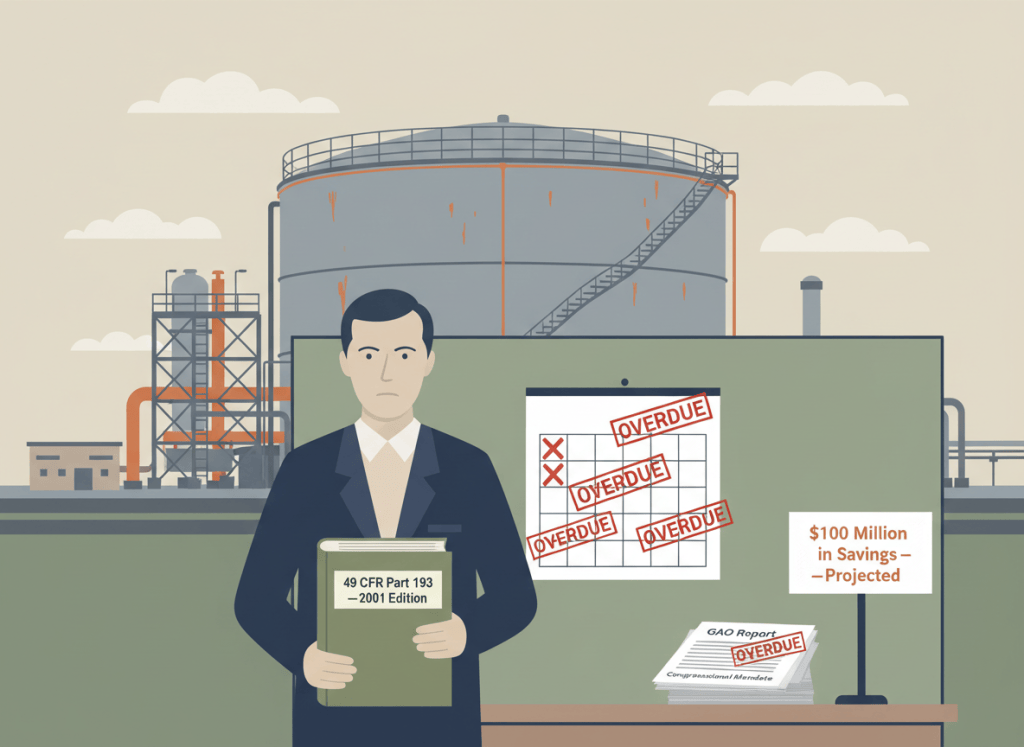
Federal regulators project nearly $100 million in annual savings from modernizing liquefied natural gas safety standards, but the proposal arrives years after congressional mandates and a federal watchdog’s warning.
WASHINGTON, Oct. 29, 2026 — The federal government has identified a familiar obstacle standing between American industry and economic prosperity. According to the Department of Transportation, that obstacle is the federal government’s own regulations.
Transportation Secretary Sean P. Duffy announced Wednesday that the Pipeline and Hazardous Materials Safety Administration (PHMSA) is proposing to modernize decades-old safety requirements for liquefied natural gas (LNG) facilities. The department estimates the changes could produce approximately $100 million in annual savings while accommodating newer technologies and supporting infrastructure development.
“The only thing standing in our way is outdated red tape,” Duffy declared in the announcement.
It is an unusually direct acknowledgment from the head of a federal department that government requirements may be obstructing the industry they regulate. The accompanying regulatory record, however, reveals another dimension to the story. Congress had already directed PHMSA to update portions of its LNG safety framework, the Government Accountability Office (GAO) had identified outdated standards, and the agency missed multiple projected rulemaking dates before releasing its latest proposal.
The question is not simply whether federal regulations have become obsolete. It is why the process for updating them has taken so long.
A Regulatory Framework From Another Era
PHMSA regulates the safety of onshore LNG facilities under 49 CFR Part 193, covering matters including facility siting, construction, equipment, operations, maintenance and fire protection.
The regulations continue to rely on technical standards developed more than two decades ago, including the 2001 edition of the National Fire Protection Association’s Standard 59A.
That reliance has become increasingly difficult to reconcile with an industry that has undergone significant technological development and expansion.
In its October 28 proposed rule, PHMSA seeks to incorporate the 2026 edition of NFPA 59A and recognize engineering approaches that have emerged since the existing requirements were established.
Among the technologies identified are pipe-in-pipe systems, single-walled containers designed to applicable American Society of Mechanical Engineers standards, and membrane storage tanks.
PHMSA argues that modernizing the rules would allow operators greater flexibility to employ contemporary designs without sacrificing safety.
Administrator Paul Roberti acknowledged the age of the regulatory framework in the department’s announcement, describing the proposal as long overdue and pointing to technological innovations that have transformed the industry over the past decade.
The difficulty is that the need for modernization was hardly a recent discovery.
Congress Had Already Ordered Changes
The PIPES Act of 2016 directed PHMSA to establish appropriate safety regulations for permanent, small-scale LNG facilities.
Four years later, Congress addressed another part of the industry.
Section 110 of the PIPES Act of 2020 directed the agency to develop alternative, risk-based operations and maintenance requirements for certain large LNG facilities.
Those requirements were not an invitation to eliminate safety protections. Congress required the alternative framework to provide an equivalent or greater level of safety than the existing minimum standards.
The 2020 legislation established a December 2023 deadline for the relevant regulatory amendments.
PHMSA’s October 2026 proposal acknowledges that deadline. The proposed rule arrived approximately 34 months after it passed, and a final rule has not yet been issued.
The agency now proposes separate provisions addressing small-scale LNG facilities and alternative risk-based programs for larger facilities.
Whether those provisions ultimately satisfy Congress’s requirements will depend on the final regulatory language and its implementation.
For now, the proposal represents progress toward obligations that have been outstanding for years.
The Federal Watchdog Was Already Watching
The delays were also documented outside the Department of Transportation.
In August 2020, GAO published Natural Gas Exports: Updated Guidance and Regulations Could Improve Facility Permitting Processes, examining federal oversight of LNG export facilities.
The report identified outdated technical standards incorporated into regulations administered by PHMSA and other federal agencies. GAO recommended that PHMSA conduct a standards-specific review and update its regulations where necessary.
PHMSA agreed.
According to GAO’s subsequent recommendation tracking, the agency originally anticipated publishing a proposed rule by September 2022.
That date passed.
PHMSA established a recurring standards-review process in January 2021, an action that satisfied a separate GAO recommendation. But establishing a process for reviewing regulations did not itself complete the review and regulatory updates GAO had requested.
By February 2025, PHMSA was still conducting its standards-specific review. In May 2025, the agency published an advance notice seeking public input on potential changes.
GAO’s records subsequently identified July 2026 as another anticipated publication date.
That date also passed.
The proposed rule finally appeared on October 28.
As of the latest publicly available GAO recommendation tracking reviewed for this article, Recommendation 5 remained open and designated a priority recommendation.
GAO has explained that PHMSA must complete and document its standards-specific review and make necessary regulatory updates to satisfy the recommendation.
The distinction matters. The watchdog was not merely asking the agency to acknowledge that its regulations were old. It was asking PHMSA to evaluate them and take appropriate action.
In a November 3 written response to Bureaucracy Times, GAO provided a sharper account of what remains unfinished. The watchdog said it has not yet reviewed PHMSA’s October 28 proposal and plans to examine the rulemaking before updating its public recommendation-tracking page.
GAO said PHMSA had previously indicated it intended to update all eight incorporated LNG technical standards identified by auditors. Given that approach, GAO explained, a final rule updating all eight standards would be necessary to close Recommendation 5. The proposed rule, GAO said, is a good first step, but it is not the completed action.
GAO also clarified that its recommendation allows another path in principle: PHMSA could review a standard and document a decision not to update it. That is different from the regulatory path PHMSA has told GAO it intends to follow.
Asked whether PHMSA had explained the earlier missed rulemaking dates, GAO replied: “PHMSA did not provide an explanation for the delays from earlier years.” That does not establish that PHMSA lacked internal reasons for the delays, but it does establish that those reasons were not furnished to the congressional watchdog.
GAO further said it has no current work examining PHMSA’s proposed alternative risk-based safety framework. Its planned follow-up is to assess the proposal against the outstanding standards recommendation, not to certify the safety or effectiveness of the broader modernization package.
The $100 Million Question
DOT’s announcement prominently advertises approximately $100 million in annual savings from the modernization effort.
The underlying proposal provides a more precise figure, estimating approximately $98 million in annualized savings using a 3% discount rate.
Those savings are projections, not realized reductions in costs.
PHMSA also acknowledges limitations in its economic analysis. Certain compliance costs and potential savings could not be quantified, while the future adoption of some newly recognized technologies remains uncertain.
The distinction becomes particularly important when considering the department’s claims about lower energy prices.
Reducing regulatory compliance or construction expenses can benefit facility operators and potentially improve the economics of new projects. Whether those reductions translate into lower prices for American households or businesses is a separate question.
LNG facilities operate within complex domestic and international energy markets, and the distribution of any savings depends on factors beyond the regulatory requirements themselves.
The proposal’s preliminary regulatory impact analysis is therefore essential to understanding which changes account for the projected savings, which businesses are expected to benefit, and what assumptions underpin the estimate.
The department’s announcement presents modernization as a path toward lower costs and expanded export capacity. The extent of those outcomes remains to be demonstrated.
Modernization Does Not Mean Abandoning Safety
There is another distinction that should not disappear beneath the political language surrounding the proposal.
PHMSA is not simply proposing to eliminate LNG safety regulations.
The rulemaking would update technical standards, establish alternative risk-based requirements for certain facilities, and revise reporting obligations.
Some changes would increase reporting coverage, including requirements concerning certain hazardous-fluid releases and facility startup incidents.
For qualifying larger facilities, operators seeking to use the alternative risk-based framework would be required to submit implementation plans for PHMSA approval.
Congress’s requirement that alternative approaches provide equivalent or greater safety remains central to the proposal.
The agency also anticipates safety improvements from the modernization effort, although it acknowledges that it could not quantify the expected reduction in LNG incident risk.
That limitation does not establish that the proposal would make facilities less safe. It does mean the anticipated safety benefits should be distinguished from demonstrated outcomes.
The relevant questions are how PHMSA will evaluate proposed alternatives, verify that they satisfy statutory safety requirements, and measure their performance after implementation.
The history of LNG regulation provides good reason for such scrutiny. The existing framework was developed in part around conservative safety assumptions reflecting the potential consequences of an accident involving large quantities of liquefied natural gas.
Replacing prescriptive requirements with more flexible engineering approaches may be justified by improved technology and risk assessment methods. Establishing that justification requires technical evidence, not simply an assurance that innovation and safety can advance together.
A Familiar Federal Problem
The irony in DOT’s announcement is not that federal officials recognize the economic costs of regulation. Agencies routinely evaluate those costs as part of rulemaking.
It is that the federal government is now promoting relief from outdated requirements after Congress and federal auditors had already identified the need for changes.
PHMSA’s proposal may ultimately provide a more effective safety framework, reduce unnecessary expenses, and accommodate technologies that were not contemplated when the existing standards were developed.
Those would be meaningful improvements.
But the regulatory history raises an equally important question about the machinery responsible for keeping federal requirements current.
Congress directed changes in 2016 and 2020. GAO documented the outdated standards in 2020. PHMSA established a recurring review process in 2021. The agency subsequently missed projected rulemaking dates, including a statutory deadline associated with the 2020 legislation.
Now, in October 2026, the government is announcing the economic benefits of reforms that have yet to become final regulations.
The rulemaking also remains subject to the federal regulatory process. Its eventual requirements, implementation schedule, and actual economic effects could differ from the proposal.
Bureaucracy Times submitted media inquiries to PHMSA and GAO on October 29 concerning the delays, projected savings, safety-equivalence requirements, and the outstanding GAO recommendation. GAO responded substantively on November 3, confirming that its review of the new proposal is still pending, that a final rule updating all eight identified standards would be necessary under PHMSA’s stated approach, and that PHMSA had not explained earlier delays to GAO. PHMSA’s response status had not been established for this update.
For an administration emphasizing regulatory efficiency, the proposal offers an opportunity to demonstrate whether longstanding requirements can be modernized without weakening public safety.
It also illustrates a less flattering characteristic of federal bureaucracy.
Sometimes the red tape is not merely the regulation itself. It is the years required for the government to update it.

