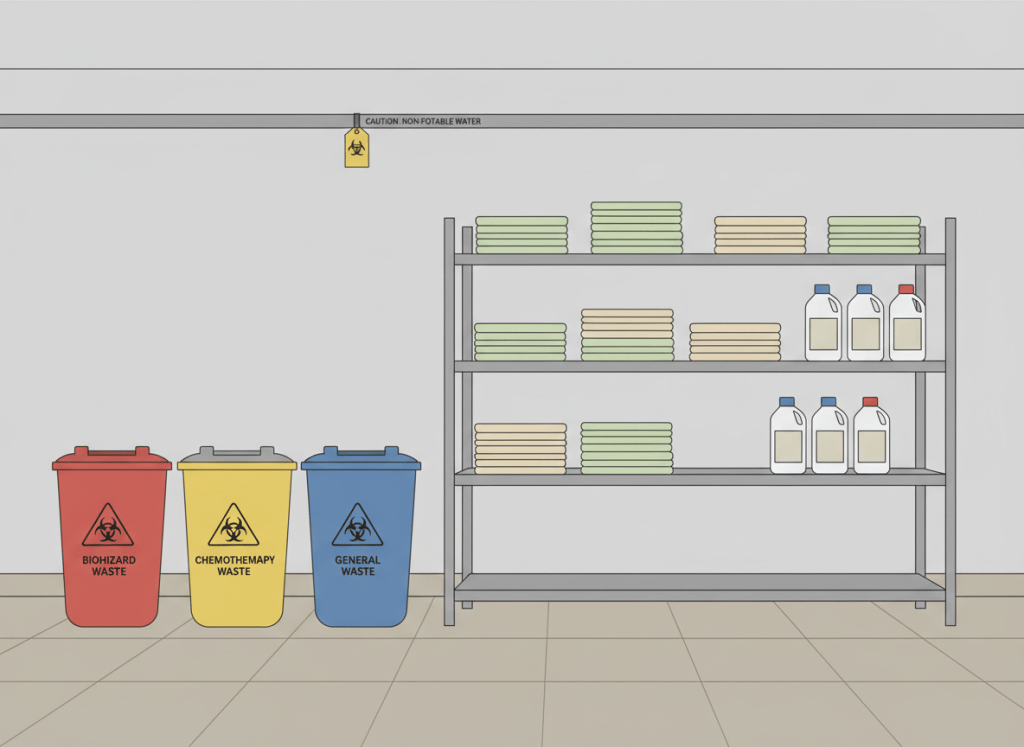
An October 9 watchdog report reveals that a VA nursing home was omitted from a required water-safety assessment, previously identified biohazard storage problems persisted, and some veterans waited nearly two months for primary care.
OMAHA, Neb. — A Department of Veterans Affairs nursing home where a patient contracted Legionella pneumonia was missing from a required annual water-safety assessment, according to a newly released VA Office of Inspector General report that also identified infection-control deficiencies, improper hazardous waste handling and significant delays in veterans’ access to medical appointments.
The October 9, 2026, report examines the VA Nebraska-Western Iowa Health Care System, a sprawling operation that provided direct care to approximately 62,370 patients in fiscal year 2025 and operated with a budget exceeding $2.2 billion.
Inspectors made four recommendations addressing environmental cleanliness, Legionella prevention, pharmaceutical waste management and procedures for communicating diagnostic test results.
But buried within the inspection’s findings is a particularly troubling administrative history: one infection-control problem had already been identified in 2023, supposedly corrected, and remained unresolved when inspectors returned nearly two years later.
The findings raise questions not only about the conditions inside VA healthcare facilities, but also about the effectiveness of the agency’s procedures for ensuring that corrective actions remain effective after officials declare them complete.
A Legionella Case and a Missing Assessment
In March 2025, a patient at the Papillion community living center, a VA nursing home operating in leased space at CHI-Midlands hospital, tested positive for Legionella pneumonia.
Legionella bacteria can cause a potentially serious form of pneumonia and are associated with building water systems, including plumbing and cooling equipment.
According to the OIG inspection report, page 9, the patient received treatment and was discharged.
VA personnel told inspectors that the nursing home’s leased status complicated water-safety management because staff had limited control over water management and Legionella testing.
Under Veterans Health Administration Directive 1061, VA facilities must conduct annual assessments to determine which buildings require inclusion in their Legionella prevention plans.
Inspectors discovered that the Papillion nursing home was missing from the healthcare system’s annual assessment.
The report does not establish that the nursing home’s water system caused the patient’s infection. Nor does it identify additional reported Legionella cases in the facility data reviewed after the September 2025 inspection.
Nevertheless, the omission meant that a facility housing vulnerable veterans had not been properly accounted for in a required preventive oversight process.
VA officials reported updating the healthcare system’s Legionella prevention plan on August 28, 2026, to include the Papillion nursing home.
Management considered the corrective action complete and requested closure of the recommendation. The OIG, however, kept the recommendation open pending supporting documentation, with a target completion date of January 30, 2027.
The distinction matters. An agency’s declaration that a problem has been corrected is not necessarily the same as independent verification that the correction has been implemented.
An Infection-Control Problem That Survived Its Own Correction
The inspection also uncovered deficiencies involving the Omaha VA Medical Center’s pneumatic tube system, which transports medications, laboratory specimens and biohazardous materials throughout the hospital.
Staff acknowledged using the same carriers for clean and potentially contaminated materials without a process ensuring that carriers were disinfected after transporting biohazardous substances.
Although personnel described an earlier system of red-colored carriers and biohazard labels, inspectors found that the practice was no longer consistently followed. They could not locate carriers specifically designated for biohazardous materials during their September 2025 inspection.
Improperly cleaned carriers create opportunities for cross-contamination, potentially exposing patients and employees to infectious material.
Inspectors also discovered that housekeeping supplies, linens and biohazardous materials were being stored in the same space in a medical and surgical inpatient unit.
That particular finding had a history.
According to the OIG, facility personnel identified the improper storage arrangement in October 2023 and developed a corrective action plan with regional VA officials. Staff subsequently reported that the plan had been completed.
Yet inspectors found housekeeping supplies still stored with biohazardous materials in September 2025.
The OIG concluded that the earlier corrective action plan was inadequate.
In other words, the healthcare system had already gone through the administrative process of identifying a deficiency, developing a correction and reporting completion, only for the underlying problem to remain.
The inspection also identified dusty storage shelves, debris on refrigerator seals, dead insects inside light fixtures near the emergency department entrance, and dirty sinks and microwaves at the Papillion nursing home.
VA management agreed to the findings and described corrective measures, including dedicated color-coded pneumatic tube carriers, updated cleaning procedures, staff education and additional inspections.
The healthcare system plans to monitor corrective actions through March 2027, generally targeting at least 90 percent compliance sustained over six consecutive months.
Chemotherapy Waste Found in Rooms Prepared for Patients
Another finding involved the handling of hazardous pharmaceutical waste.
At the Grand Island community living center, inspectors discovered chemotherapy waste containers in rooms that had already been cleaned and prepared for incoming patients.
Facility policy required hazardous waste containers to be removed from patient care units daily and transferred to designated waste holding areas.
Inspectors also found inconsistent pharmaceutical waste disposal practices at the Omaha VA Medical Center and Papillion nursing home, including the use of containers that did not comply with the facility’s established color-coding procedures.
The OIG warned that improper disposal practices could expose patients and employees to hazardous substances.
The report does not document an actual exposure or injury resulting from these conditions.
VA officials reported immediately removing the identified waste containers, retraining environmental services personnel and adding waste-removal verification to preoccupancy room inspections.
Additional compliance monitoring is scheduled through March 2027.
Veterans Waited 55 Days for Primary Care
While the inspection’s formal recommendations focused primarily on patient safety and facility conditions, its examination of healthcare access revealed another substantial concern.
At the North Platte community-based outpatient clinic, new patients faced an average appointment wait of 55 days in September 2025.
The clinic had lost a provider in May, leaving its remaining nonphysician provider responsible for approximately 1,700 patients.
Under VA primary-care guidance cited by the OIG, the expected patient panel was approximately 900.
The remaining provider was therefore managing nearly twice the expected workload.
The staffing difficulties extended across the healthcare system. As of September 2025, inspectors identified vacancies for seven providers, five registered nurses, seven licensed practical nurses, one clinical pharmacist and 15 medical support assistants across 51 primary-care teams.
Healthcare system leaders attributed recruitment difficulties partly to rural geography, statewide nursing shortages and compensation that was not competitive with community hospitals.
By June 2026, the North Platte clinic’s average new-patient wait had improved to 31 days, while the healthcare system’s overall average had fallen to 22 days.
Both figures remained above the 20-day wait-time threshold relevant to certain eligibility determinations for VA-funded community care under 38 C.F.R. § 17.4040.
The OIG acknowledged the improvements and issued no additional corrective recommendation.
Community Care Had Its Own Backlog
Sending veterans to private-sector providers does not necessarily eliminate administrative delays.
The OIG found that the healthcare system’s community-care program took an average of 14 days to schedule appointments with outside providers, compared with a VA procedural standard of seven days after referral.
Community-care staffing was also strained.
In September 2025, the program reported 19 vacancies. By June 2026, only 72 of its 91 authorized positions were filled, representing a vacancy rate of approximately 21 percent.
Staff described increased workloads, scheduling delays and declining morale.
Managers authorized overtime, explored automated scheduling assistance and pursued recruitment incentives. They also acknowledged that relying on overtime was not a sustainable long-term solution.
The report noted that some administrative vacancies could not be filled because of the federal hiring freeze in effect during the inspection period.
Despite the delays, inspectors did not issue a new recommendation, citing ongoing improvement efforts and work associated with a previous OIG recommendation.
The result is a curious distinction: problems substantial enough to document in an oversight report, but not considered to require another formal corrective action.
Test-Result Procedures Also Fell Short
Inspectors identified another administrative weakness involving communication of medical test results.
Although the healthcare system maintained an overarching policy for notifying patients and providers, it lacked separate service-level workflows defining which employees were responsible for receiving, reviewing, communicating and following up on results.
The OIG determined that this did not fully comply with VHA Directive 1088.
Facility leadership acknowledged the deficiency and reported developing the required workflows.
Importantly, inspectors found that the healthcare system met the applicable seven-day standard for communicating test results requiring action and outperformed regional and national averages on that measure.
The finding therefore concerns the reliability and documentation of administrative procedures, rather than a demonstrated pattern of patients failing to receive results.
The Larger Question: When Is a VA Problem Actually Fixed?
The Nebraska-Western Iowa findings do not portray a healthcare system uniformly failing its patients.
Inspectors documented successful practices, including improvements in appointment access, favorable test-result communication performance and progress in certain veteran support programs.
The healthcare system also received a Patient Safety Program of Excellence designation from VA’s National Center for Patient Safety in April 2025.
Nor is this the first recent examination of conditions within the system. A separate January 2026 OIG investigation addressed staffing, environmental safety and administrative processes in Omaha’s inpatient mental health unit. That investigation concerned different circumstances, but illustrates the breadth of ongoing oversight at the facility.
The October report nevertheless exposes a recurring challenge in federal healthcare administration: the difference between establishing a corrective action plan and demonstrating that the underlying problem has been permanently resolved.
At Papillion, a nursing home was omitted from a required Legionella assessment despite a patient having developed the disease.
At Omaha, an improper storage arrangement persisted after staff reported completing a corrective plan.
At North Platte, veterans faced lengthy waits while remaining providers managed unusually large patient panels.
And within community care, staffing vacancies and administrative delays continued even as management pursued improvements.
VA leadership concurred with all four recommendations in the October report and provided corrective action plans that the OIG considered acceptable.
Whether those measures produce sustained compliance remains subject to further verification.
For a healthcare system responsible for tens of thousands of veterans, the distinction between a completed action plan and a genuinely corrected problem is considerably more than a paperwork exercise.
It is a question of whether the next inspection will discover the same problem all over again.
Source: VA Office of Inspector General, Healthcare Facility Inspection of the VA Nebraska-Western Iowa Health Care System in Omaha, Report 25-00239-196, October 9, 2026. The recurring question of whether VA corrective actions hold is explored in a related inspection of the VA West Texas Healthcare System in Big Spring, where a test-results policy required by 2024 has a target date of 2027, and in a national roll-up finding that nine of ten inpatient mental health facilities failed to document informed consent discussions for new medications.

