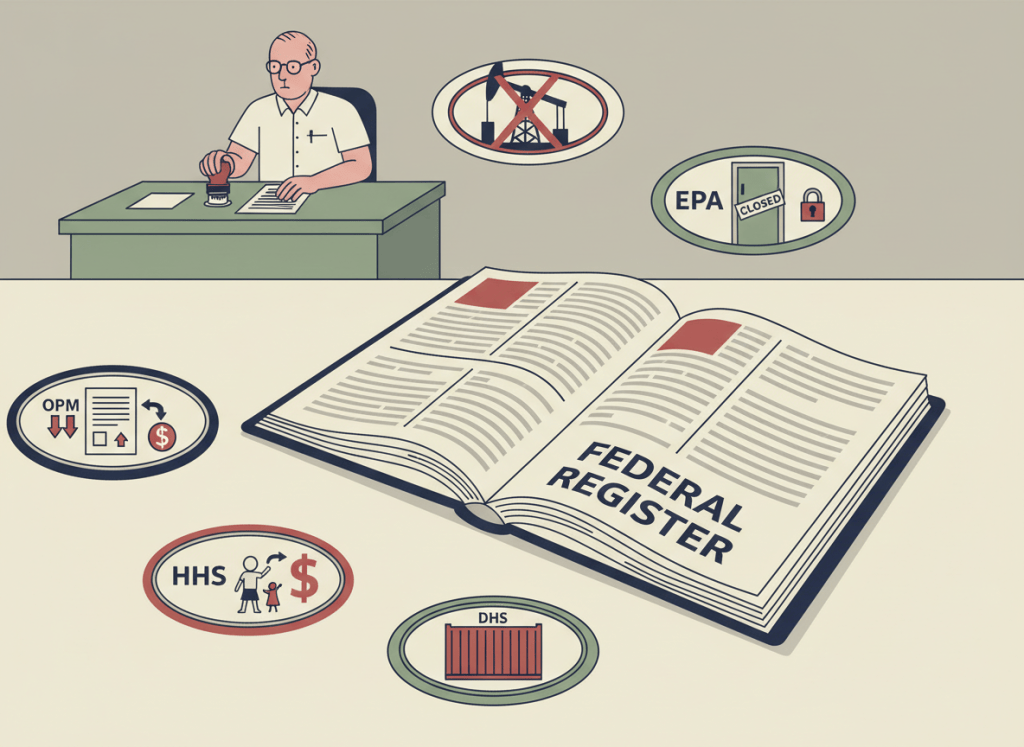
The Office of Personnel Management finalized a rule today that swaps out several of the federal government’s standard internal tools for planning and tracking its own workforce, in favor of new ones built around expanded authority for agency human-resources chiefs.
- Office of Personnel Management — OPM finalized Personnel Management in Agencies: Strategic Human Capital Management, effective November 30, following a proposed version it floated in July. The rule replaces agencies’ Human Capital Operating Plans with new “Annual Staffing Plans,” swaps Human Capital Reviews for “Annual Staffing Reviews,” retires the quarterly HRStat check-in for a “Quarterly Staffing Plan Performance Review,” trims the number of required questions on the government’s annual employee survey, and gives agency Chief Human Capital Officers more direct oversight of hiring and staffing decisions. Renaming a planning document can sound cosmetic, but these are the specific instruments OPM and individual agencies use to track vacancies, staffing risk, and hiring pace, so changing the template changes what gets measured and who has to sign off on it. Read the final rule.
- Environmental Protection Agency — EPA proposed rescinding its own Super Emitter Program, a mechanism added less than two years ago in the agency’s March 2024 oil-and-gas methane rule that let certified outside parties, including environmental groups, report major leaks detected by remote sensing directly to EPA and trigger a mandatory operator response. The agency attributes the move to “petitions for reconsideration” and a “change in policy direction,” language that describes an agency undoing its own recent enforcement tool rather than responding to a court order. Comments are due December 16, and EPA has scheduled a virtual public hearing, except the notice gives two different hearing dates in two different sections, November 13 and November 16, which matters because it is the date people planning to actually show up need to get right. Read the proposed rule.
- Administration for Children and Families (HHS) — ACF finalized a rule stripping what it calls “outdated or unnecessary” provisions from its child support enforcement regulations, effective November 30, and on the same day proposed doing the same to its block grant regulations more broadly, with comments due November 30 on that companion proposal. Both carry the identical “Reducing Bureaucracy and Burden” title, which suggests a coordinated sweep through ACF’s rulebook rather than two unrelated housekeeping actions, and is worth watching for whether “outdated” turns out to mean dead-letter text or provisions that states and tribes still rely on for accountability. Read the final rule and the proposed rule.
- National Labor Relations Board — NLRB is formally closing its Memphis, Tennessee subregional office, citing cost savings, though the notice discloses the office has had no actual staff there since 2023 because of attrition, meaning the paperwork is catching up to a vacancy that is already three years old. It is the latest in a recurring pattern of similar closures stretching back more than a decade (Anchorage in 2018, Des Moines in 2015, Jacksonville in 2014, Puerto Rico and Milwaukee folded into other regions in 2013), part of a slow, continuous shrinking of the field offices where workers file unfair-labor-practice charges and petition for union elections. Read the notice.
- Homeland Security Department — DHS added three entities to the Uyghur Forced Labor Prevention Act Entity List, which creates a legal presumption that goods made by listed companies involve forced labor and blocks their import into the United States unless an importer proves otherwise. Three is a notably small addition next to the task force’s last three updates, which added 43, 35, and 25 entities respectively; that alone proves nothing, but it is a pace worth tracking if the next update turns out just as small. Read the notice.
This edition draws on the full Federal Register docket for October 29, 2026 — 102 documents in all. Categories excluded as routine absent an anomaly: standard Paperwork Reduction Act and information-collection notices, agency meeting and Sunshine Act notices, SEC self-regulatory-organization filings, routine antidumping and countervailing-duty determinations, small-business disaster declarations, and standard Coast Guard safety-zone and FAA airport-property notices.

