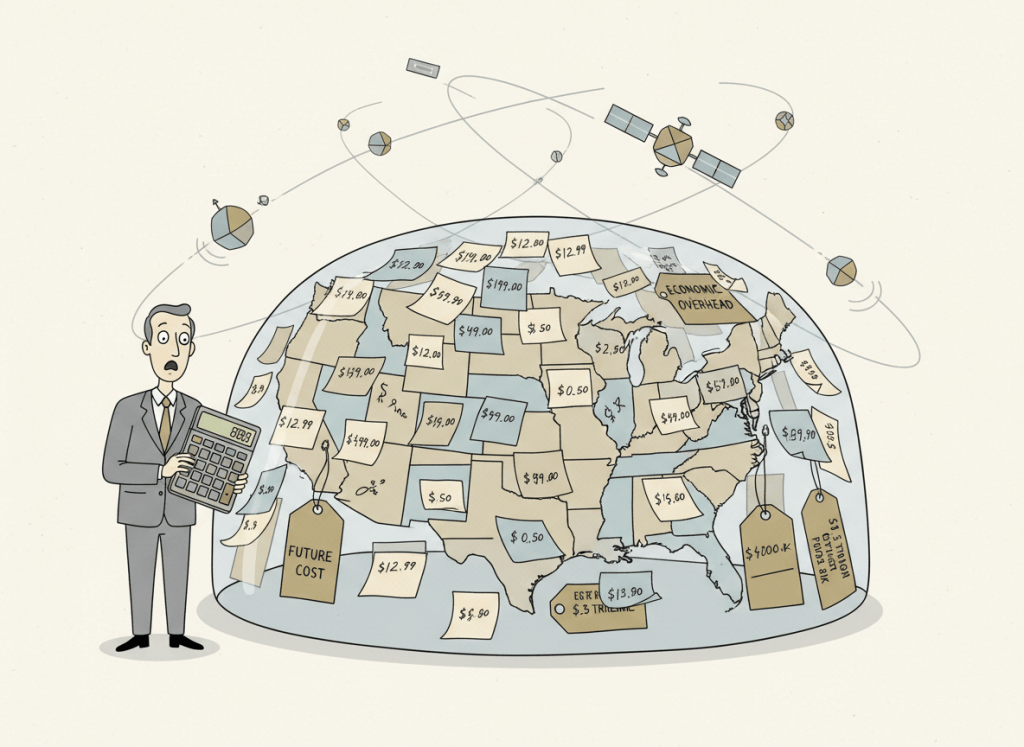
The Pentagon says its planned Golden Dome missile-defense architecture will cost roughly $185 billion.
The Congressional Budget Office recently calculated that a nationwide missile-defense system broadly capable of meeting the objectives laid out by the White House could cost nearly $1.2 trillion over 20 years.
Those numbers are dramatic. They are also not directly comparable.
CBO did not estimate the cost of the Pentagon’s actual Golden Dome architecture because, according to the congressional budget agency, the Defense Department has not publicly released enough information about that architecture for CBO to do so.
That leaves taxpayers with a somewhat unusual accounting problem for a project potentially costing hundreds of billions of dollars: The Pentagon has supplied a price tag, but not enough public information to independently determine precisely what the price tag buys.
And the Pentagon’s own fiscal 2027 budget documents make the accounting even more complicated.
They show that spending associated with supporting Golden Dome is not necessarily confined to the money explicitly labeled “Golden Dome.”
In other words, the $185 billion question may be less about whether the number is right or wrong than about what is actually inside it.
CBO Builds Its Own Dome
In testimony published September 29, CBO examined the potential cost of building a national missile-defense system capable of defending the United States against ballistic, hypersonic and cruise missiles.
Because the Pentagon’s actual Golden Dome architecture remains insufficiently detailed publicly, CBO constructed its own illustrative architecture based on the capabilities called for in the executive order originally establishing “Iron Dome for America,” later renamed Golden Dome.
The resulting system is enormous.
CBO’s illustrative architecture includes three upper-tier interceptor sites, four Aegis Ashore-style lower-tier sites, 35 regional defensive sectors, a space-based tracking constellation and approximately 7,800 space-based interceptors.
Its estimated 20-year cost: approximately $1.19 trillion in 2026 dollars.
About $1.025 trillion would go toward acquiring the system, while operations and support would cost approximately $8.3 billion annually.
The space-based interceptor layer is responsible for much of that bill.
CBO estimates that developing, deploying and maintaining those interceptors would cost roughly $720 billion over 20 years, plus about $1 billion annually to operate them.
But even 7,800 interceptors does not adequately describe the scale of the enterprise.
CBO assumes that satellites in the constellation would have approximately five-year service lives. Maintaining a constellation of that size for two decades would therefore require launching roughly 30,000 interceptor satellites over the life of the system.
Once operational, approximately 1,600 replacements would need to be launched every year.
All of that infrastructure, under CBO’s assumptions, would provide enough capacity for the space layer to engage approximately 10 nearly simultaneously launched intercontinental ballistic missiles from a regional adversary, assuming two interceptors were fired at each incoming missile.
CBO also makes an important distinction that tends to disappear whenever missile defense is described as a “shield.” Being capable of engaging an incoming missile is not the same thing as successfully destroying it.
Nor does CBO envision its trillion-dollar architecture as capable of stopping everything. The system could potentially handle attacks from regional adversaries or relatively small attacks from a peer power, according to CBO. A sufficiently large Russian or Chinese attack could overwhelm it.
The trillion-dollar shield, in other words, would still have limits.
Then There Is the Pentagon’s $185 Billion
Golden Dome officials have publicly placed the cost of the Pentagon’s objective architecture at approximately $185 billion.
Golden Dome director Gen. Michael Guetlein has pushed back against much larger outside estimates on the grounds that analysts are calculating the cost of systems different from the one the Pentagon intends to build.
That is an important distinction.
CBO’s $1.2 trillion architecture should not be presented as a CBO estimate of Golden Dome itself. The systems differ, the assumptions differ and the periods covered by the estimates differ.
But that distinction produces another question.
What, exactly, is the Pentagon building?
CBO says it cannot tell from publicly available information.
In its analysis, the agency offered several possible explanations for the enormous difference between its estimate and the Pentagon’s. Golden Dome might simply be a considerably less extensive system than the one CBO modeled.
But CBO also raised another possibility: Some of the systems supporting Golden Dome could be financed through other Pentagon accounts rather than appearing within the Golden Dome program itself.
The Pentagon’s fiscal 2027 budget documents show that possibility deserves attention.
Follow the Money, Then Follow the Other Money
The Defense Department’s fiscal 2027 budget identifies approximately $17.9 billion specifically for Golden Dome.
More detailed budget material places approximately $17.1 billion in the Golden Dome for America Fund, along with military construction funding associated with homeland-defense infrastructure.
But Golden Dome does not exist in an accounting vacuum.
The Missile Defense Agency is simultaneously requesting approximately $19 billion for fiscal 2027.
In its own budget justification, MDA says those expenditures will both defend against existing threats and provide “foundational support for Golden Dome for America” against peer and near-peer threats.
That does not make the entire $19 billion a Golden Dome expenditure. It does demonstrate that Golden Dome-related capability is being supported through accounts outside the $17.9 billion explicitly identified as Golden Dome.
Other Pentagon research and development accounts provide additional examples. Budget documents describe directed-energy research as advancing Golden Dome by integrating component technologies into weapons systems and platforms. Another funding line provides contractor support for major acquisition programs, including establishment of a Golden Dome program office.
Then there is the broader missile-defense budget.
The Pentagon’s fiscal 2027 weapons book identifies approximately $82.2 billion for “Missile Defense and Defeat.”
“The FY 2027 Golden Dome for America funding is $17.9 billion but is not included in this MDD funding.”
That means the Pentagon is proposing approximately $82.2 billion for its broader Missile Defense and Defeat portfolio while separately requesting another $17.9 billion explicitly for Golden Dome.
Together, those categories exceed $100 billion in fiscal 2027.
Again, the $82.2 billion should not be called Golden Dome spending. It encompasses a much broader collection of missile-defense and defeat programs.
But that is precisely the accounting problem.
Some of those programs support Golden Dome.
Which ones? And how much of their cost is included in the Pentagon’s $185 billion Golden Dome estimate?
The publicly available documents do not provide an easy answer.
The $185 Billion Question
This makes the headline Golden Dome price considerably more difficult to interpret.
If the $185 billion represents only spending assigned specifically to the Golden Dome architecture while supporting sensors, interceptors, satellites, communications networks and other capabilities continue to be funded through existing service and agency accounts, then $185 billion would not necessarily represent the total federal expenditure required to create and operate the system.
That does not mean the Pentagon is concealing hundreds of billions of dollars. There is currently insufficient public evidence to make such a claim.
It does mean that determining the actual cost of Golden Dome requires knowing where Golden Dome ends and the rest of the Pentagon’s enormous missile-defense enterprise begins.
CBO cannot currently make that determination. Neither can the public.
The problem becomes particularly important because Golden Dome is not being constructed from scratch. It is expected to draw upon existing missile-warning satellites, radars, command-and-control systems, interceptors, research programs and service infrastructure, while adding new capabilities on top of them.
From an engineering standpoint, that may make perfect sense. From an accounting standpoint, it makes the simple question “How much does Golden Dome cost?” surprisingly difficult to answer.
Thirty Thousand Satellites Later
CBO’s analysis also illustrates why defining the architecture matters so much.
The agency estimates that its space-based interceptor constellation alone would account for roughly 70 percent of acquisition costs and approximately 60 percent of the entire 20-year estimate.
Change that assumption and the price changes dramatically.
CBO examined what could happen if policymakers wanted substantially greater space-based capacity. Increasing the interceptor constellation fivefold, according to the agency, could push the 20-year cost of that component alone to approximately $3 trillion.
That does not mean Golden Dome will cost $3 trillion. It demonstrates something more useful: Small changes in what policymakers mean by a national missile shield can produce extraordinary changes in cost.
How many missiles must it defeat? Which countries must it defend against? How many simultaneous launches must it handle? How many interceptors must be fired at each target? How many satellites must remain in orbit? How frequently must those satellites be replaced?
Those are not minor technical details attached to a predetermined price. They largely determine the price.
Details Available Upstairs
There is one additional complication for anyone attempting to reconstruct Golden Dome from the federal budget.
Some of the details are classified.
The Pentagon’s Golden Dome budget material notes that additional program information is available “at a higher classification.”
There are obvious national-security reasons why the United States would not publish every technical characteristic, deployment location or operational capability of a missile-defense system.
But classification creates an unusual situation when combined with a public $185 billion price estimate.
The Pentagon knows what it intends to build. Members of Congress with appropriate access can review classified details. CBO, working from what has been publicly released, says it cannot independently estimate the cost of the actual architecture.
The American public is therefore left with a $185 billion number attached to a system whose complete architecture it cannot see.
Meanwhile, the Pentagon’s own budget documents show that programs outside the explicitly labeled Golden Dome account are already supporting the effort.
That does not prove the $185 billion estimate is wrong.
It makes it remarkably difficult to determine what “$185 billion” actually means.
And when the alternative architecture modeled by Congress’s budget analysts comes with a $1.2 trillion price tag, roughly 30,000 satellite launches over two decades and still cannot guarantee protection against a large-scale peer attack, that definition matters.
Before anyone can determine whether Golden Dome costs too much, too little or exactly what the Pentagon says it does, there is a more basic accounting question to answer.
What is actually inside the Dome?

