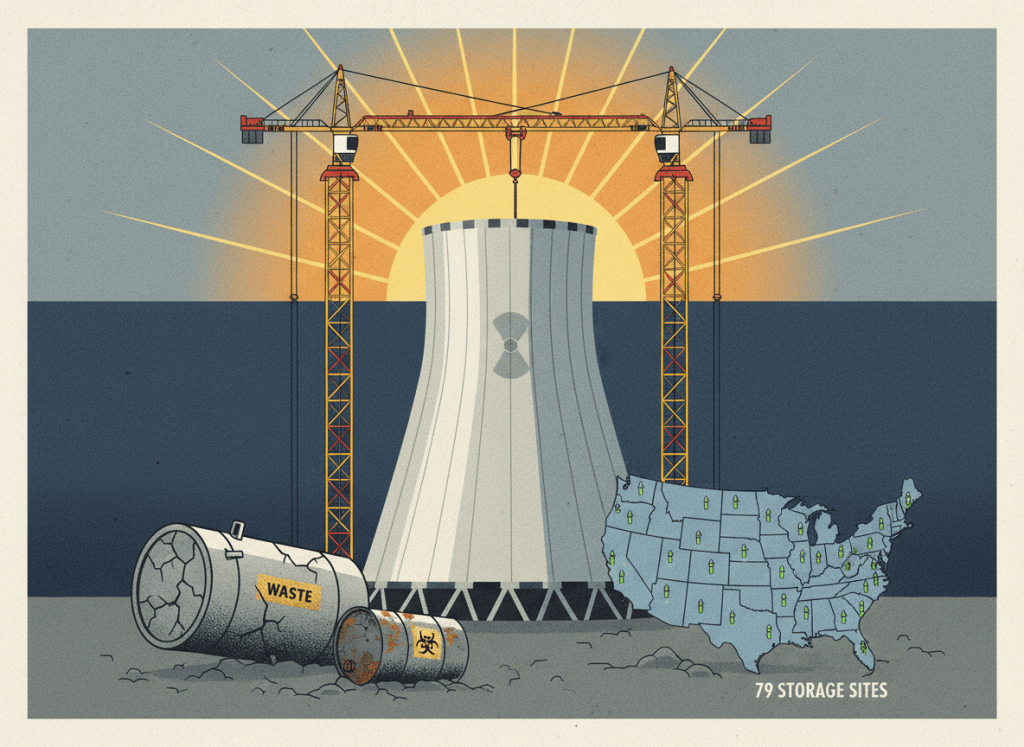
The United States has big plans for nuclear power.
Washington wants new large reactors, small modular reactors and microreactors. It wants nuclear power supporting military installations, national laboratories and artificial-intelligence infrastructure. It wants more domestic uranium enrichment, new fuel production and faster pathways for advanced reactor designs.
The Department of Energy calls it an American “nuclear renaissance.”
There is one stubbornly unresolved piece of that renaissance: what happens to the waste?
The United States still has no operating permanent repository for commercial spent nuclear fuel. Instead, fuel produced by the existing reactor fleet generally remains where it was generated—first cooling in pools and eventually, in many cases, moving into massive dry-storage casks at operating or former nuclear power plant sites.
The Nuclear Regulatory Commission considers those storage methods safe. But they are not supposed to be the final destination.
While the federal government accelerates nearly every other part of the nuclear-energy system, the country remains without the permanent repository that was supposed to complete the cycle.
The nuclear buildout is no longer theoretical
A federal nuclear deployment framework released in 2024 established a target of 200 gigawatts of net-new nuclear capacity by 2050, roughly tripling U.S. capacity from its 2020 level. The framework envisioned large reactors, small modular reactors and microreactors, along with uprates of existing plants and possible reactor restarts.
The Trump administration subsequently accelerated that policy. Executive orders issued in May 2025 directed the federal government to expand domestic nuclear deployment, rebuild the nuclear industrial base, accelerate reactor testing and use advanced nuclear technologies for national-security applications.
DOE testimony delivered to Congress in September 2026 described the current objective as increasing American nuclear generating capacity from approximately 100 gigawatts to 400 gigawatts by 2050. The administration has also directed DOE to facilitate five gigawatts of uprates at existing reactors and work toward having 10 new large-reactor designs under construction by 2030.
This is no longer simply a long-range planning exercise. DOE created a Reactor Pilot Program and selected advanced-reactor projects for accelerated development. It has also established programs intended to accelerate domestic production of advanced nuclear fuels.
The expansion is reaching into another rapidly growing federal priority: artificial intelligence. A May 2025 executive order directed DOE to facilitate privately funded advanced reactors on DOE-controlled property for AI infrastructure, national-security requirements and other federal needs.
Washington is not merely discussing another generation of nuclear power. It is building the administrative machinery to produce one.
Then there is the back end
Nuclear reactors produce spent nuclear fuel. That fuel does not disappear when it stops efficiently producing electricity.
At commercial reactors, newly removed fuel typically begins in spent-fuel pools. After sufficient cooling, utilities can transfer it into dry-storage systems consisting of sealed metal canisters protected by steel, concrete or other shielding.
The NRC says both methods provide adequate protection of public health and safety. Federal policy, however, calls for permanent disposal in a deep underground geologic repository.
There currently isn’t one.
Some storage sites no longer even have operating nuclear plants. The reactor is gone. The spent fuel isn’t. At former reactor locations around the country, dry-cask installations remain because there is nowhere else for the material to go.
Dry-cask storage has been used commercially in the United States since the 1980s, and NRC licenses and regulates the systems. But the Commission does not treat reactor-site storage as the intended permanent solution.
Washington has been here before
This is not a problem nobody saw coming.
Under the Nuclear Waste Policy Act, the federal government assumed responsibility for permanent disposal of commercial spent nuclear fuel. DOE entered contracts with nuclear utilities and was supposed to begin accepting spent fuel in 1998.
That didn’t happen.
Utilities sued. Taxpayers began paying.
The resulting litigation has produced billions of dollars in federal payments compensating nuclear utilities for storage costs incurred because DOE did not perform its contractual obligation.
That financial story is the subject of another part of this investigation. Bureaucracy Times has submitted a Freedom of Information Act request to DOE seeking records accounting for approximately $12.2 billion in Judgment Fund payments associated with spent-nuclear-fuel litigation.
The larger point is simpler: the United States did not suddenly discover in 2026 that nuclear reactors create material requiring long-term disposal. The federal government has been trying—and failing—to complete that system for decades.
Yucca Mountain was supposed to solve this
For years, the answer had a name: Yucca Mountain.
The Nevada site was designated under federal law for development as the nation’s geologic repository for spent nuclear fuel and high-level radioactive waste. The project stalled amid political opposition, litigation, regulatory disputes and shifting federal policy.
The result is a nuclear waste system with an unusually clear beginning and a remarkably uncertain end.
Fuel is fabricated. Reactors consume it. Spent fuel is removed. It cools. It goes into storage.
And then it waits.
Yucca Mountain deserves its own examination in this series because its history explains much of how the United States arrived here. But whatever one thinks of that particular site, the underlying problem remains: the federal government has not replaced the failed repository effort with an operating permanent disposal alternative.
There is an interim plan for the interim plan
DOE is pursuing another option: consolidated interim storage.
The concept would move spent fuel from numerous reactor locations to one or more centralized federal storage facilities while the government works toward permanent disposal. DOE has developed a consent-based siting process intended to identify willing host communities and has funded public outreach and community engagement.
But even the interim solution remains a siting effort rather than an operating federal destination.
Meanwhile, existing reactors continue generating spent fuel. Washington wants considerably more reactors.
The mismatch
There is nothing inherently contradictory about expanding nuclear power while developing a waste repository. A country could do both.
The striking part of the American approach is the difference in urgency.
On the reactor side, federal policy contains numbers and deadlines: hundreds of gigawatts of additional capacity, reactor uprates, new large-reactor construction, accelerated demonstrations, fuel-production programs and federal sites opened to advanced nuclear development.
On the waste side, the vocabulary changes: engagement, siting processes, interim storage, community discussions and, eventually, permanent disposal.
One side of the nuclear fuel cycle has deadlines.
The other has intentions.
That distinction becomes increasingly important as the reactor fleet grows. Every additional reactor may provide decades of reliable electricity. It also creates another stream of spent nuclear fuel requiring management long after the electricity has been consumed.
Advanced reactor designs may change the amount, form and composition of that waste. Some proposed technologies could recycle or reuse portions of spent fuel, and the administration has directed DOE to evaluate commercial recycling and reprocessing policies and more efficient uses of nuclear materials.
Those technologies deserve their own examination later in this series. But recycling does not make the disposal question disappear. Reprocessing itself produces radioactive waste streams requiring long-term management.
The nuclear renaissance meets the nuclear inheritance
America’s renewed interest in nuclear energy has identifiable drivers. Electricity demand is rising. AI data centers require large quantities of reliable power. Nuclear plants can provide substantial electricity without the direct carbon emissions of fossil-fuel generation, and advanced reactors could offer capabilities traditional gigawatt-scale plants cannot.
None of those arguments answers the disposal question.
The United States is entering its next nuclear era while still storing much of the physical inheritance of the last one.
Washington is designing new reactors, developing new fuels, accelerating deployment pathways and setting ambitious targets. At sites across America, meanwhile, spent fuel sits inside pools and concrete-and-steel casks waiting for the federal government to fulfill an obligation made decades ago.
The reactors of the future are coming.
The waste repository of the past still isn’t here.
And if the United States really intends to quadruple its nuclear capacity, eventually those two timelines are going to have to meet.

