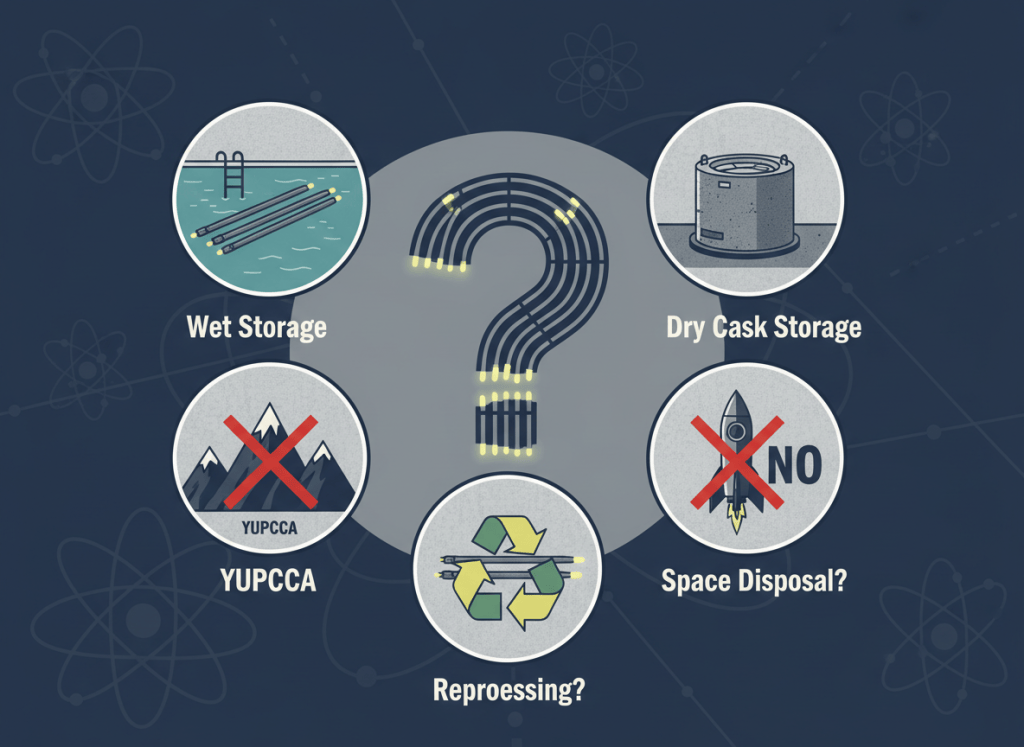
America has accumulated more than 95,000 metric tons of spent nuclear fuel, has no operating permanent repository for it, and is now reconsidering whether some of that “waste” should be recycled as the country prepares for another generation of reactors.
There are certain questions about nuclear power that become considerably more uncomfortable once someone actually asks them.
This is one of them:
What, exactly, do we do with the nuclear fuel after we’re finished using it?
The short answer is reassuring. We know how to store it safely.
The longer answer is considerably more bureaucratic.
The United States has spent decades accumulating spent nuclear fuel while developing increasingly sophisticated ways of storing it temporarily, debating where to put it permanently, paying damages because the federal government didn’t take possession of it when promised, and periodically reconsidering whether some of the material we call “waste” should instead be recycled.
And now the country wants more nuclear power.
So before getting into repositories, lawsuits, recycling plants, federal contracts and billions of dollars in taxpayer liabilities, it is probably worth establishing what we’re actually talking about.
First, “nuclear waste” isn’t one thing
The phrase conjures up glowing green barrels, which is unfortunate because radioactive waste comes in substantially more boring — and more complicated — forms.
Low-level radioactive waste can include contaminated protective clothing, filters, tools and other materials used around radioactive substances.
Spent nuclear fuel is something very different.
Commercial reactor fuel generally consists of uranium fuel pellets stacked inside metal rods, which are assembled into larger fuel assemblies. During operation, fission releases energy from the fuel and produces the heat ultimately used to generate electricity.
Eventually the fuel becomes less efficient at sustaining the reaction and is removed from the reactor.
But “spent” does not mean harmless.
The Nuclear Regulatory Commission describes spent fuel as both highly radioactive and thermally hot. It continues producing heat after removal from the reactor and must be shielded from people and the environment.
Which brings us to the first stop on America’s remarkably long nuclear-waste itinerary.
A swimming pool.
Step One: Put it underwater
When spent fuel comes out of a commercial reactor, it is transferred into a spent-fuel pool.
These are not recreational swimming pools with unusually strict lifeguards.
They are massive, reinforced structures containing enough water to leave roughly 20 feet of water above the fuel. The water simultaneously removes heat and provides radiation shielding. The pools have thick reinforced-concrete walls, stainless-steel liners and multiple means of maintaining their water supply.
The arrangement works.
It was also originally supposed to be temporary.
When America’s commercial nuclear plants were designed, spent fuel was expected to remain in pools for several years before being shipped somewhere else for reprocessing. The usable portions would be recovered and the remaining material disposed of.
That commercial reprocessing industry never materialized on a sustained basis.
So the pools started filling up.
The nuclear industry responded with another interim solution.
Step Two: Put it in a really big thermos
After spent fuel has cooled sufficiently underwater, it can be transferred into dry-cask storage.
The basic concept is remarkably straightforward.
Fuel assemblies are placed inside a sealed steel container filled with inert gas. That container is then surrounded by additional steel, concrete or other shielding material. Depending on the design, the resulting casks can stand vertically on concrete pads or sit horizontally inside concrete structures.
There are no giant refrigeration systems required. The casks can shed heat passively.
The NRC licensed the country’s first dry-storage installation at Virginia’s Surry Nuclear Power Plant in 1986. Since then, dry-cask storage has become a standard feature of the American nuclear landscape.
And that brings us to an important distinction.
Storage is not disposal.
Dry casks are engineered to safely contain spent fuel while somebody figures out what happens next.
The federal government’s longstanding answer to “what happens next” is eventual disposal in a deep underground geologic repository. NRC says permanent geological disposal remains U.S. policy and specifically does not consider permanent storage at current or former reactor sites to be the ultimate solution.
Yet the ultimate solution has remained elusive.
DOE reported in 2025 that more than 95,000 metric tons of spent nuclear fuel were stored across 79 sites in more than 30 states. By the time the nation’s existing reactors reach the ends of their operating lives, DOE estimates that inventory could reach approximately 180,000 metric tons.
We have therefore become very good at the middle part.
The ending remains under construction.
Can’t we just bury it?
Basically, yes.
Just not in the sense of digging a particularly deep hole behind the power plant.
Deep geologic disposal is intended to isolate high-level radioactive material underground using engineered barriers combined with stable geology. The concept is hardly exotic in nuclear-waste policy; decades of research support geologic repositories as a means of permanently isolating spent fuel.
For the United States, the most famous proposed answer has been Yucca Mountain in Nevada.
DOE’s own environmental documentation describes the proposed Yucca Mountain project as a geologic repository intended for spent nuclear fuel and high-level radioactive waste transported from commercial and federal sites around the country.
But Yucca Mountain never became an operating repository.
Which is why spent fuel remains distributed around the country rather than disappearing into the federal disposal system originally envisioned for it.
DOE is also pursuing another possibility: consolidated interim storage.
Instead of leaving spent fuel scattered among dozens of reactor and former-reactor sites, the federal government could move it to one or more centralized locations while the permanent-disposal question remains unresolved. DOE determined in 2024 that such a federal consolidated interim storage facility is needed and has been pursuing a consent-based process intended to involve potential host communities.
Notice the recurring word, though.
Interim.
We are still talking about somewhere to put the fuel while waiting for somewhere else to put the fuel.
Fine. Can’t we recycle it?
Now things get interesting.
Spent nuclear fuel is called “spent” because it is no longer efficient for continued use in its existing reactor configuration — not because everything useful inside it has vanished.
DOE says more than 90 percent of the potential energy remains in spent fuel after approximately five years of reactor operation. Reprocessing can separate usable materials from the fuel so that some can potentially be fabricated into new fuel. Other countries, including France, already recycle spent nuclear fuel.
The United States has done it, too.
From 1966 to 1972, a commercial reprocessing plant operated at West Valley, New York. The facility recovered reusable uranium and plutonium from irradiated nuclear fuel and processed roughly 640 metric tons of it.
It also produced more than 600,000 gallons of liquid high-level radioactive waste.
That last part is rather important.
Recycling nuclear fuel does not cause the waste problem to evaporate.
It can recover valuable materials and change the amount and composition of material requiring disposal, but reprocessing itself produces radioactive waste streams that still must be managed.
West Valley provides a particularly American illustration of the problem.
Congress eventually directed DOE to undertake a high-level waste management and cleanup project there. Decades later, DOE’s Office of Environmental Management was still dismantling the contaminated infrastructure left behind by America’s only commercial spent-fuel reprocessing plant.
And while one part of DOE has been cleaning up America’s previous commercial reprocessing experiment, another part is preparing for the possibility of doing it again.
In February 2026, DOE’s Office of Nuclear Energy awarded more than $19 million to five companies developing technologies to recycle used nuclear fuel.
Then things became considerably more concrete.
DOE’s Office of Environmental Management solicited a private-sector partner to design, build and operate a commercial-scale demonstration recycling and conditioning facility at Idaho National Laboratory. The application period closed in June, and DOE announced in July that the initiative had entered the review and selection phase.
America is therefore simultaneously cleaning up the remains of its previous commercial nuclear-fuel recycling venture and considering construction of the next one.
There may be no sentence more perfectly suited to federal nuclear-waste policy.
What about shooting it into space?
Technically?
Sure.
In much the same sense that technically we could solve municipal trash collection by firing garbage trucks toward Venus.
The problem isn’t whether humanity can launch objects into space. Obviously we can.
The problem is what happens when a launch carrying highly radioactive material experiences the unfortunate tendency rockets occasionally have to stop behaving like rockets.
Putting thousands of tons of spent nuclear material aboard launch vehicles would introduce an entirely new accident pathway during launch while requiring an enormous number of missions. Sending material toward the Sun is also considerably harder than the phrase “shoot it at the Sun” suggests: an object leaving Earth already shares Earth’s enormous orbital velocity around the Sun, which has to be substantially altered to make the object fall inward rather than simply enter another solar orbit.
Deep geological disposal may lack the cinematic satisfaction of firing nuclear waste into the Sun.
It has the advantage of not requiring us to place the nation’s radioactive inventory on top of rockets.
So what do we actually do with it?
For now, mostly this:
We remove spent fuel from reactors.
We cool it underwater.
We transfer older fuel into heavily shielded dry-storage systems.
And we wait.
The technology for safely storing spent nuclear fuel exists. That is not the same problem as establishing a permanent national disposal system.
That distinction becomes increasingly important because the United States is now simultaneously contemplating expanded nuclear generation, consolidated interim storage and renewed commercial-scale fuel recycling.
Every new reactor that operates within the conventional once-through fuel cycle will eventually produce additional spent fuel. Every recycling proposal raises another set of questions about economics, security, waste streams and what ultimately happens to the material that cannot be reused.
And behind all of this sits another unfinished piece of federal business.
The federal government was supposed to begin accepting commercial spent nuclear fuel under the system established by the Nuclear Waste Policy Act. That didn’t happen.
Utilities sued.
Taxpayers started paying.
And decades later, spent fuel is still sitting at reactor sites while the federal government continues working toward an answer for where it ultimately goes.
That financial story — how a failure to dispose of nuclear waste became a multibillion-dollar federal liability — deserves its own examination.
We have already asked the Department of Energy for the records.
For now, the important thing to understand is simpler.
America does have a system for dealing with spent nuclear fuel.
It is just largely a system for safely waiting for the permanent system.
And after several decades, the waiting has become part of the system itself.

