A Minimum With Missing Pages
Executive Order 14238 handed the U.S. Agency for Global Media a tidy assignment. It was to eliminate its non-statutory functions and shrink the statutory ones to the “minimum presence and function required by law”, then report to the Office of Management and Budget within seven days on what the law actually demanded. This is a sentence that presumes somebody has read the law.
The State Department’s Office of Inspector General, in a September 2026 evaluation, found that the agency’s hunt for its legal floor centered on one statute, the International Broadcasting Act of 1994, while the general laws that bind every federal agency “do not appear to have been considered” (page 20). That would be a respectable failure on its own. The appendices show it was a more interesting one.
USAGM’s own report to OMB, reprinted in Appendix B, acknowledged that FY 2025 appropriations carried forward prior-year broadcasting levels for Tibet and North Korea. The same passage observes that the International Broadcasting Act sets no minimum broadcast commitments. Both statements can be true. Only one of them is a floor.
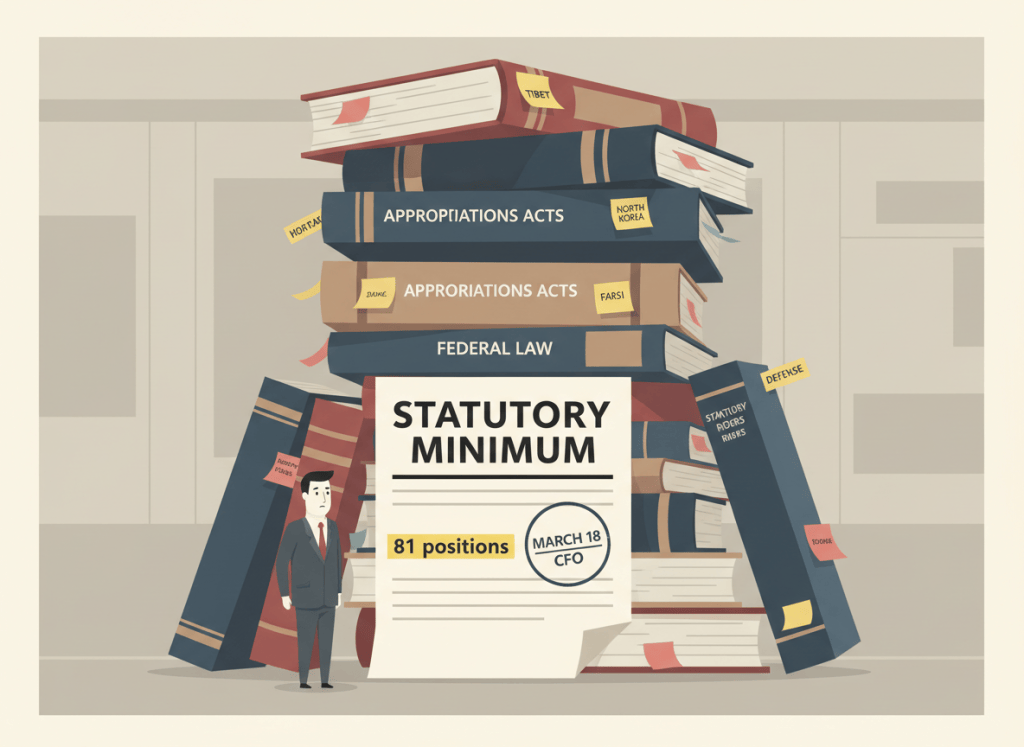
The statutory minimum memorandum that followed, reprinted in Appendix C, lists what the agency decided it had to keep. That means 33 positions for Cuba, two each for Farsi, China and Afghanistan, eleven for VOA, engineers, and 15 back office jobs, which totals 81 once senior executives are added. There is no line for Tibetan or Korean broadcasting. The CFO’s digital signature on the memo is stamped March 18, 2025 (page 35), three days after the agency had put 994 of its 1,147 employees on leave.
Riders Are Not Optional Reading
Congress has written some of its broadcasting floors into appropriations riders, which agencies ignore at their peril. In a set of August 2025 answers to appropriators, reproduced in Appendix D, Senate minority staff cited Section 7043(e)(2) in Division F of the Further Consolidated Appropriations Act, 2024. They described it as requiring funds to maintain North Korea broadcasting hours “at levels not less than the prior fiscal year” (page 40), and noted that the provision was carried forward by the fiscal year 2025 continuing resolution.
That resolution, Public Law 119-4, was signed on March 15, 2025. The Congressional Research Service notes that it generally continued FY2024 funding under the same authorities and conditions. It became law on the same day USAGM sent termination letters to its grantees, ordered them to stop spending, and shut down relevant radio transmissions (pages 29 and 30). A statute preserving last year’s broadcasting was signed the day the agency began switching it off.
The agency was not unaware of the constraint. Its own report to OMB warned that Congress appropriates specific funding levels by grantee, so terminations “may need to be linked to a rescission package” or another legal mechanism (page 30). According to the inspector general, Radio Free Europe/Radio Liberty and Radio Free Asia resumed service only after federal courts ordered USAGM to disburse their congressionally appropriated funds for FY2025 (footnote 26, page 8).
The agency’s answer to the North Korea question was blunt. It was “not broadcasting any content via any medium” into the country, though it had decided to take steps to restart. In a neighboring answer it reported that the Kuwait transmitting station, which carried about 100 hours of programming on a typical day in July 2024, now broadcasts 30 minutes a day into Afghanistan (page 41).
Ask OMB, Says the Agency
Minority staff also wrote that, at a July 2 briefing, USAGM said OMB had directed it to ignore requirements in appropriations law when developing its statutory minimums, and that the agency chose not to consult the committees before its June 3 documents. That is the staff’s characterization, not a finding by anyone. The agency’s written reply (page 39) neither confirmed nor denied it. It explained that OMB holds primary responsibility for presidential budget priorities and encouraged staff to contact OMB directly.
An agency asked whether it was told to disregard the law, and which answers with a referral, has at least been consistent about where it thinks the answers live.
The same page records a smaller omission. Section 1113 of the FY2025 continuing resolution required operating plans by April 29. Staff said they had asked on June 2 and June 11 without receiving one, and USAGM replied that a summarized program plan had been attached to a June 20 notification.
Congress Rounds Up
We covered the funding fight in September, but the inspector general adds a finding that sharpens it. USAGM’s own goal was not the statutory minimum at all. According to the agency’s FY2026 budget justification, the goal was an “orderly shutdown” (page 21). USAGM requested $153 million to carry it out, and Congress appropriated $643 million for the agency’s operations instead (page 22). The House Appropriations Democrats’ summary of the bill puts that figure $490 million above the administration’s request, and the Congressional Research Service places it in Division F of Public Law 119-75, the Consolidated Appropriations Act, 2026.
The “minimum” also proved to be more of a suggestion. In its August 2025 answers, USAGM told appropriators that it may carry out programming above statutory minimum levels as needed, using employees or contractors, and reported about 216 full-time employees and 75 contractors, roughly 291 people, against the 81 positions in its memo (pages 36 and 37). The floor was doing very little bearing.
Meanwhile, the inspector general reports, actions taken in 2025 to dismantle the agency impaired its ability to meet its mission. Two grantees began auctioning equipment needed to keep broadcasting, and USAGM has since been reinstating contracts, recalling employees and buying replacement equipment.
USAGM’s formal response to the report, reprinted in Appendix F, offers one line of defense. Compliance with an executive order, it says, is required in the executive branch. That is true. The inspector general’s report quotes the order as applying “consistent with applicable law and subject to the availability of appropriations” (page 20), and appropriations acts have the awkward distinction of being law.
The first recommendation, which USAGM accepts, tells the agency to weigh the laws specific to it and the laws that apply to everyone, and to seek input from Congress when choosing languages (pages 24 and 49). It amounts to a homework assignment to read the whole statute book before deciding what it requires. The minimum required by law, it turns out, is a document that has to be read in full.

