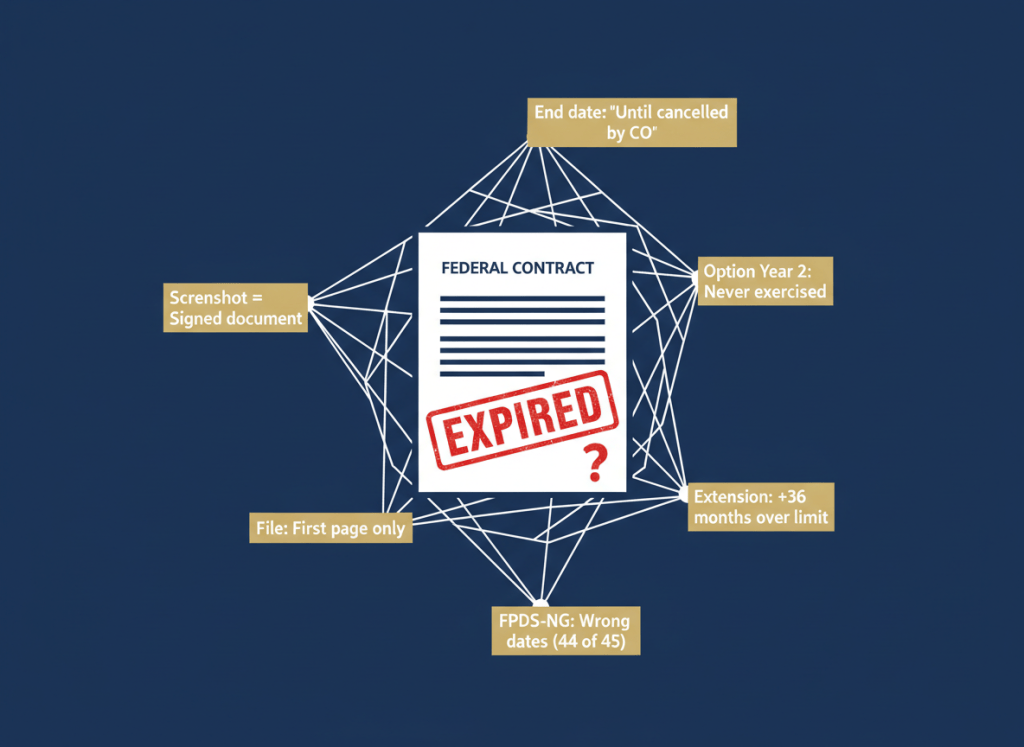
A Department of Justice watchdog went looking for contracts that appeared to have outlived their expiration dates. What it found was a procurement system where dates were wrong, options had not been properly exercised, contract extensions exceeded their limits and, in some cases, the paperwork needed to determine what happened could not be found.
The DOJ Office of Inspector General released an audit in September examining orders that appeared in federal procurement data to have been awarded after their underlying procurement vehicles expired. Auditors initially identified 5,601 orders totaling $548 million awarded from fiscal years 2021 through 2023 that appeared to have been placed against parent contracts that had expired, in some cases as long as 26 years earlier.
That alarming number did not mean DOJ had actually spent $548 million through expired contracts.
The OIG selected a judgmental sample of 45 orders worth more than $39 million for closer examination. Because the sample was not statistical, auditors cautioned that their findings cannot be projected across the entire universe of 5,601 orders.
Once auditors started opening the files, however, the apparent expired-contract problem turned into something considerably messier.
Of the 45 orders examined, the OIG found performance-period irregularities in 37. Those included an order issued roughly 23 months after its parent procurement vehicle expired, orders placed during option periods that had not been properly exercised, and orders issued under contracts whose expiration dates had been improperly extended.
And then there was the federal government’s own procurement data.
Contracting officials failed to update the Federal Procurement Data System-Next Generation, or FPDS-NG, for modifications affecting the performance periods of 44 of the 45 orders reviewed. That included changes involving option years and contract extensions.
Those errors matter because FPDS-NG supplies federal contract information used in public reporting and feeds spending information into USAspending.gov. The inaccurate dates also helped create the SAM.gov anomaly report that prompted the OIG examination in the first place.
In other words, auditors went looking for apparently expired contracts and discovered that much of the public data describing those contracts could not be trusted without examining the underlying files.
Unfortunately, the underlying files occasionally had problems of their own.
A $65 Million Agreement With No End Date
Perhaps the audit’s most striking example involved the Federal Bureau of Prisons.
In fiscal year 2012, BOP awarded a blanket purchase agreement for comprehensive medical services. The agreement did not contain a performance-period end date. Instead, according to the OIG, it said it would remain open “Until cancelled by the CO.”
Over the life of the agreement, BOP issued 256 orders totaling more than $65 million, with the last order issued in September 2023.
At least eight contracting officers were involved with the agreement during its existence, with responsibility changing hands on average every 2.4 years. Auditors found that BOP had reassessed the purpose or usefulness of continuing the agreement only twice. BOP solicited new contractors once, in 2014, but canceled that procurement.
The result was more than a decade without the contract being recompeted.
Then the auditors asked whether the agreement had actually been closed.
When the OIG interviewed two responsible contracting officers in September and October 2024, both said the agreement was closed or inactive. BOP subsequently supplied de-obligation records, but auditors said those documents did not contain enough information to verify the closeout.
In July 2025, the OIG asked again.
BOP then provided a letter sent to the contractor showing that the agency had formally closed the agreement five days after the OIG’s second request for closeout documentation.
The agreement had lasted 13 years.
The OIG concluded that operating without a definitive end date created legal ambiguity and potentially deprived other contractors of opportunities to compete for the work as market conditions changed.
Options That Weren’t Options Yet
Federal Prison Industries supplied another collection of contracting irregularities.
For one parent contract, FPI exercised Option Years 1, 3 and 4, but apparently skipped the paperwork for Option Year 2. An order was nevertheless issued during that unexercised period.
For two other sampled orders, FPI awarded work before properly exercising the applicable options. One modification exercising an option was signed nearly five months after that option’s effective date. Another was signed approximately 11 months late.
FPI officials attributed the delays in part to staffing shortages and contracting officials sometimes lacking the necessary warrant authority to sign modifications.
Contract extensions presented another problem.
One FPI contract contained a clause limiting its total duration to 24 months. FPI nevertheless modified it to add another 36 months and issued four sampled orders during that extension.
Another FPI contract was limited to 60 months but was extended to 63 months.
The contracting official responsible for the first could not explain the deviation. For the second, the official could not provide justification for extending the contract past its stated limit.
The FBI had a similar problem. Auditors found that it effectively gave one contract a second six-month extension despite a provision limiting the total extension to six months, then issued an order during that additional extension.
And Sometimes the Paperwork Wasn’t There
Auditors also found incomplete official contract files for eight of the 45 sampled orders.
For one FPI order, the agency’s file contained only the first page of the parent contract. The full contract was not available in FPI’s legacy system, leaving auditors unable to determine its performance-period end date and therefore unable to determine whether the order had actually been issued against an expired contract.
The file also lacked a signed copy of the order.
In another case, the FBI could not produce a signed copy of either the sampled order or its parent contract. The bureau instead provided an unsigned order and a screenshot from its financial system as evidence of when the transaction had been signed and processed.
There was one complication: the date in the screenshot differed from the date on the unsigned order.
Without the signed document, auditors said they could not verify when the order had actually been approved.
The OIG ultimately issued eight recommendations to the FBI, BOP, Federal Prison Industries and U.S. Marshals Service covering contract expiration monitoring, contract extensions, option exercises, record retention and the accuracy of procurement data.
The audit did answer the question that prompted it. DOJ did not have 5,601 confirmed orders improperly issued under expired contracts. Among the 45 examined, auditors identified only one order definitively awarded under an expired procurement vehicle.
But answering that question exposed another problem.
The public procurement data contained enough errors to make thousands of orders appear suspect. When auditors went behind those numbers, they found improperly exercised options, contracts extended beyond their stated limits, a $65 million medical-services agreement without an end date and official files that sometimes could not establish what had happened.
The expired contracts were not quite what the database suggested.
The paperwork was arguably the more interesting story.

