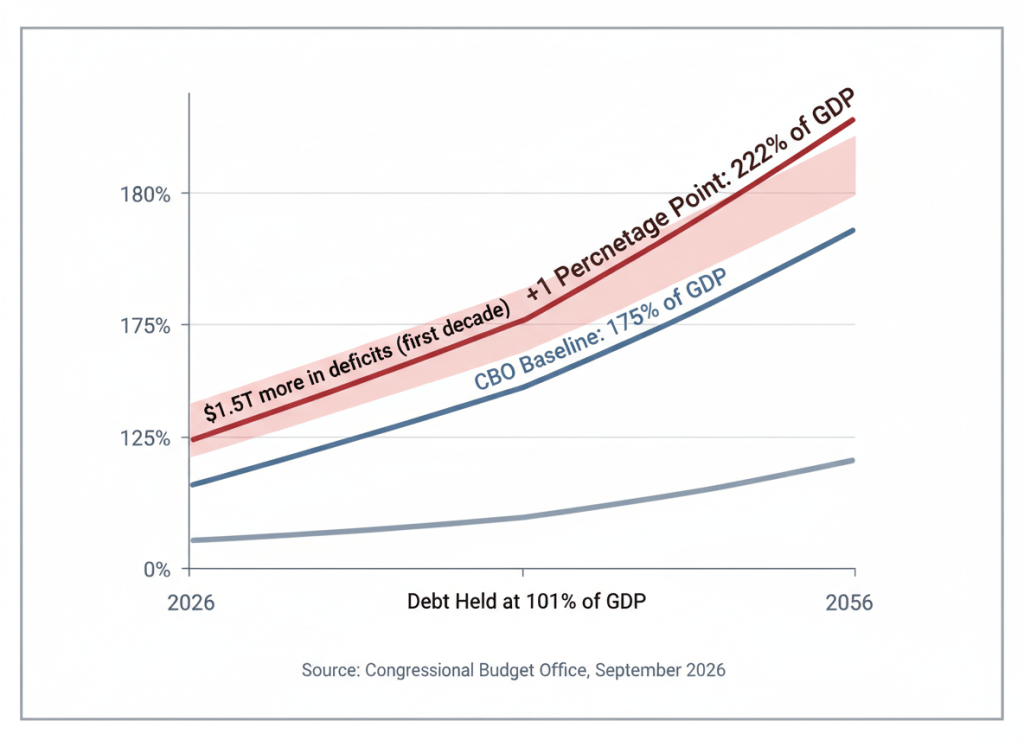
Federal debt does not need a dramatic new spending program or a financial crisis to move substantially beyond an already historic trajectory. According to a new Congressional Budget Office analysis, a sustained increase of just one percentage point in federal borrowing rates would be enough to push debt held by the public to 222 percent of gross domestic product by 2056.
That is 47 percentage points above CBO’s already formidable extended baseline, which projects federal debt rising from 101 percent of GDP in 2026 to 175 percent by 2056.
The September 24 analysis, prepared in response to a request from Sen. Jeff Merkley, examines two alternative paths for the federal budget: one in which interest rates gradually rise above CBO’s baseline assumptions, and another in which Washington somehow manages to hold the debt-to-GDP ratio at its 2026 level for the next 30 years.
The distance between those two lines is considerable.
One Percentage Point
Under CBO’s extended baseline, primary deficits — deficits excluding net interest costs — average 2.1 percent of GDP from 2026 through 2056. Debt held by the public reaches 175 percent of GDP by the end of that period, while the average interest rate on federal debt is 4 percent.
CBO then modeled what happens if the average interest rate on federal debt begins rising above that baseline in 2026, with the initial difference increasing by about five basis points per year until reaching one percentage point.
The result is not merely a larger interest bill.
Over the 2026–2036 period, CBO estimates primary deficits would be about $178 billion larger than under its baseline. But total deficits, which include interest costs, would be about $1.5 trillion larger.
By 2056, the total deficit would reach 14 percent of GDP, nearly five percentage points above the extended baseline. Debt held by the public would reach 222 percent of GDP.
And the higher rates begin feeding the very conditions that make the debt more expensive.
The Feedback Loop
CBO describes a fiscal feedback loop in which higher borrowing costs increase total deficits, requiring additional federal borrowing. That borrowing reduces resources available for private investment, which reduces the amount of capital in the economy and slows economic growth.
As debt grows relative to the economy, CBO projects additional upward pressure on Treasury interest rates. Those higher rates then make the government’s existing debt still more expensive to finance.
In other words, the one-percentage-point increase is the starting assumption, not necessarily the end of the story. Once CBO incorporates the broader economic effects, it estimates average annual GDP growth over the 30-year period would be about 0.1 percentage point slower than in the extended baseline.
CBO also cautions that the exercise does not identify what might cause interest rates to rise. Any real-world cause would bring its own economic and budgetary effects, which are not included in the scenario.
What Would It Take Just to Stop the Climb?
The second scenario may be the more revealing comparison.
Rather than asking what happens if borrowing becomes more expensive, CBO calculated what would have to happen to keep federal debt at 101 percent of GDP — its projected 2026 level — all the way through 2056.
Doing that would require primary deficits to average just 0.2 percent of GDP over the period, compared with 2.1 percent under the extended baseline.
During the first decade alone, primary deficits would need to be about $7.3 trillion smaller than CBO currently projects. Total deficits would be approximately $9.1 trillion smaller.
By 2056, the total deficit would be 3.5 percent of GDP instead of the 9.1 percent implied by the extended baseline. Federal debt, by design, would remain at 101 percent of GDP rather than climbing to 175 percent.
The smaller debt burden would also work in the opposite direction from the higher-rate scenario. CBO projects lower borrowing costs, greater private investment and slightly faster economic growth. By 2056, the average interest rate on federal debt would be 0.7 percentage points below the extended baseline.
There is, however, a rather large blank space in that scenario: how to get there.
CBO Doesn’t Pick the Medicine
CBO does not prescribe the policies necessary to produce those smaller deficits. The agency notes that the reduction could come from lower noninterest spending, higher revenues, or some combination of the two.
Those choices would have different effects on households’ incentives to work and save, and CBO did not attempt to model them. The analysis therefore is not a proposal for balancing the federal books. It is an illustration of the scale of the arithmetic required merely to prevent the debt burden from growing relative to the economy.
That arithmetic produces three markedly different versions of 2056.
Under the extended baseline, debt reaches 175 percent of GDP. Under the higher-interest-rate scenario, it reaches 222 percent. Holding the ratio at today’s level would leave it at 101 percent.
Perhaps the most striking feature of CBO’s exercise is how little has to change to produce the highest of those numbers. Washington does not need to discover an entirely new category of federal spending. It does not require CBO to assume a recession or some other fiscal calamity.
It takes one percentage point.

