The National Labor Relations Board published its weekly summary of decisions for September 14 through 18, and buried in the usual parade of unremarkable case dispositions sits a policy that quietly answers “not yet” to nearly every worker who wants to vote a union out. It is called the blocking charge rule, and this week’s docket offers two examples of what it actually does to a bargaining unit, plus a data point on how long the Board takes to answer questions with a lot less nuance attached.
A Question the Rulebook Refuses to Answer
Start in Washington, DC, where 680 registered nurses at George Washington University Hospital voted in 2023 to join the District of Columbia Nurses Association by a comfortable 310 to 207 margin. Since then the hospital’s operator, District Hospital Partners, has accumulated a string of unfair labor practice charges filed by that same union, the most recent submitted in January, alleging the hospital repudiated or modified the contract it had signed. This week the Board denied both the hospital’s and the petitioner’s requests for review of a Regional Director’s decision to block a decertification petition, on the theory that the pending charges have to be resolved first.
The Board’s own summary describes this as raising “no substantial issues warranting review,” which is one way of saying the rule worked exactly as designed. Nobody gets to ask whether the union still has majority support until the union’s own complaints against the employer are settled, a timeline the union does not control but very much benefits from, since every month the petition sits in abeyance is a month the union keeps its recognition without having to defend it at the ballot box.
Thirty Seven Signatures Against a Plant That No Longer Exists
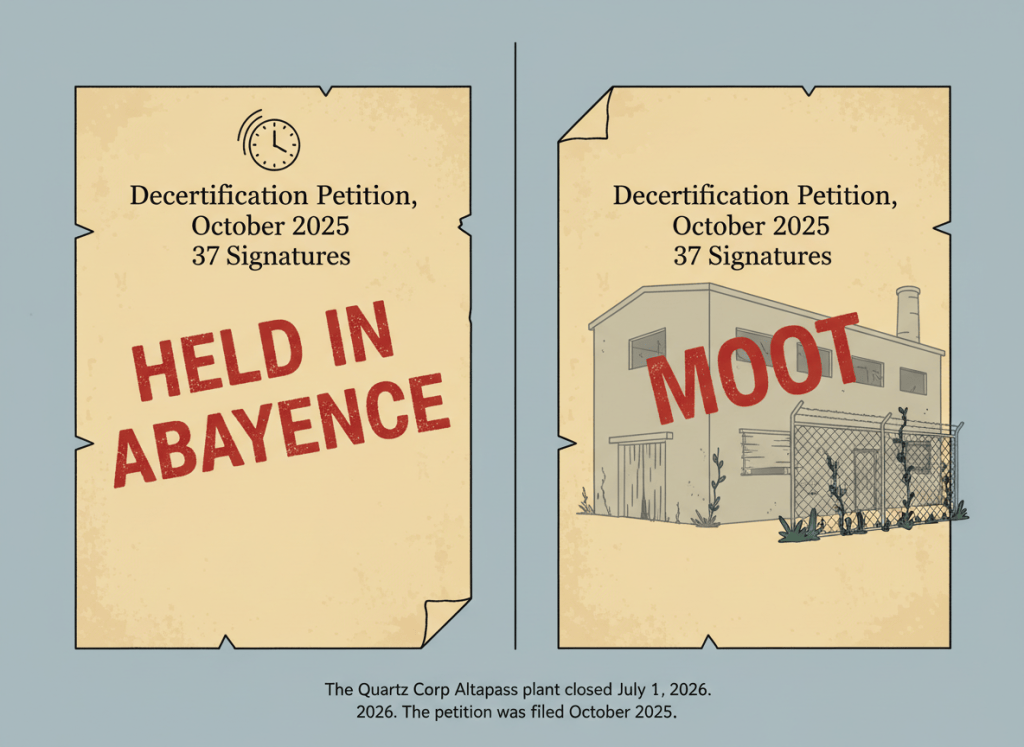
The starker version of the same mechanism sits with a mica processing outfit in Spruce Pine, North Carolina, where 37 workers at the Quartz Corp tried to decertify United Mine Workers Local 140 in October 2025. More than 30 percent of the unit signed the petition, which is the statutory threshold needed to force a secret ballot election.
A government shutdown delayed the region from even processing the petition until the following month, and once it was processed, Region 10 placed it in “abeyance,” citing a set of unfair labor practice charges the union had filed against the company. Petitioner Blake Davis, backed by the National Right to Work Legal Defense Foundation, told the Board in his request for review that the region blocked his petition “not because it found misconduct, but because the union filed” the charges, which is a fairly precise summary of how the rule is designed to work.
This week the Board denied both the employer’s and the petitioner’s requests for review, while Member Mayer used the occasion to note, on the record, that the Board “should consider in re-evaluating its policy whether the passage of time is given sufficient weight.” He also urged the region to prioritize the one remaining unfair labor practice charge standing between Davis and his election. Six weeks later, on July 1, the Quartz Corp closed its Altapass plant entirely, and the union filed a new charge the following day alleging the shutdown itself was an unfair labor practice, on top of accusations of bad faith bargaining and unlawful discharge.
The decertification question these 37 workers wanted answered in October 2025 is now moot in the most complete way a labor question can become moot, because there is no longer a bargaining unit left to represent, and no plant left to house one.
Five Years to Decide What Happened in a Single Afternoon
If the blocking charge rule delays the front door, the Board’s own backlog closes the back one. Snowflake, Inc. was charged in March 2021 with firing an employee over protected concerted activity. An administrative law judge ruled against the company in September 2023, the case was transferred to the Board that same month, and briefing on the company’s exceptions wrapped up in March 2024.
The Board did not issue its decision affirming the judge until September 16 of this year, a wait of roughly two and a half years after the last brief landed and five and a half years after the original charge was filed. Nothing about an 8(a)(1) retaliatory termination case is conceptually difficult, and the judge’s original ruling was adopted with no apparent dissent or complication.
The delay is not analytical, it is simply the queue. A Board that takes half a decade to confirm a straightforward firing is not obviously the same Board that can be expected to move quickly on a blocking charge review either, and the two problems compound each other rather than existing separately.
The Rule Outlasts Whoever Objects to It
None of this is new, exactly. The blocking charge policy dates back to 1937, and it has been rescinded and reinstated along partisan lines more than once. The Board eliminated most of its bite in 2020, only for the Fair Choice, Employee Voice rule to bring it back in 2024, effective that September, on the argument that the earlier version left employees too exposed to employer misconduct during an organizing drive.
What is notable this week is how durable the underlying mechanism turns out to be regardless of who is nominally in charge of applying it. A three member Board, the statutory minimum quorum under the Act, still managed to issue rulings affirming both the GW Hospital block and the Quartz Corp block, applying a rule that has survived at least two changes of administration intact in substance if not always in name.
This publication has written before about how thin that three-member quorum really is, and how the removal of a single member can freeze the Board’s ability to decide anything at all. What this week’s summary adds is a quieter and arguably more damning observation, which is that even when the Board is fully staffed and functioning exactly as intended, the machinery it runs still defaults to inertia rather than resolution.
A hospital in the nation’s capital and a shuttered mica plant in the Blue Ridge foothills got the same answer this week, and it was the same one American workers have been getting since long before most of the current Board members were born, which is simply to wait.

