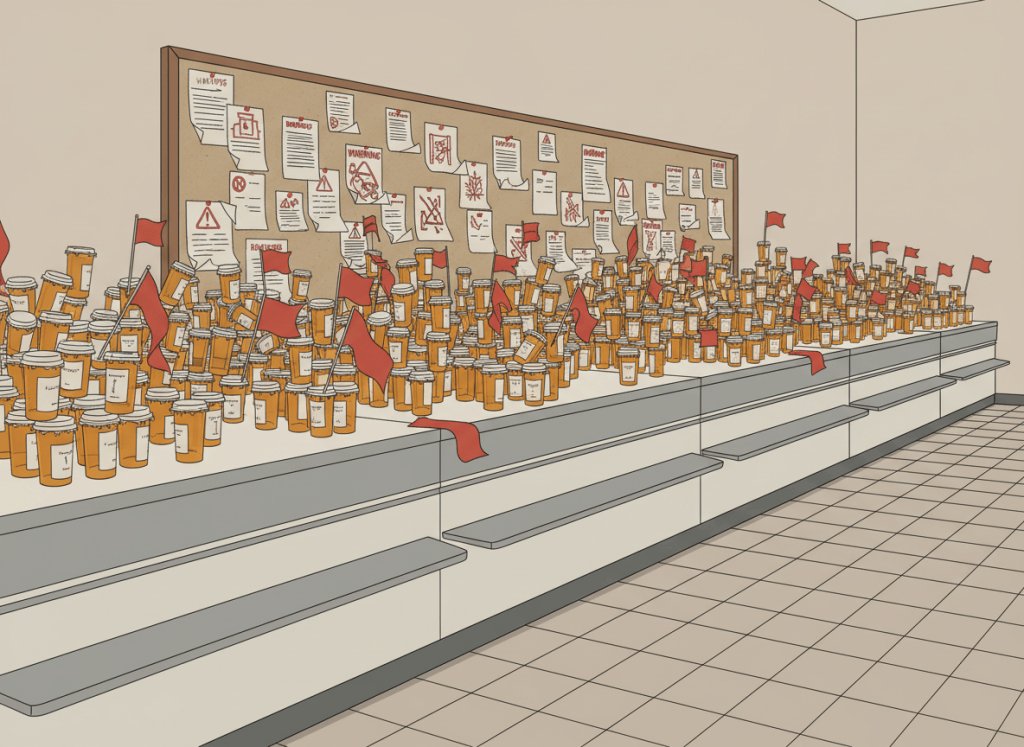
The pharmacy giant will pay $315 million to settle federal allegations spanning twelve years. But court records reveal a more troubling history of convicted prescribers, ignored warnings, abandoned safeguards, and regulators who had been confronting similar problems for years.
On October 13, 2026, the Department of Justice announced that CVS Pharmacy and related corporate entities had agreed to pay $315 million to resolve allegations that the company unlawfully dispensed opioids and other controlled substances, then submitted improper reimbursement claims to federal healthcare programs.
The alleged conduct stretched from October 17, 2013, through December 2, 2025. More than twelve years in which federal prosecutors contend that one of the nation’s largest pharmacy chains repeatedly filled prescriptions that should never have been dispensed.
The settlement sounds like another familiar chapter in America’s long-running opioid litigation. Another pharmaceutical company, another enormous payment, another announcement promising stronger safeguards.
But the underlying court records tell a considerably more complicated story.
The prescriptions did not simply materialize at CVS pharmacy counters. They were written by medical practitioners, some of whom were subsequently convicted of federal drug offenses. In certain instances, pharmacists reportedly recognized the danger and warned their colleagues. Corporate compliance personnel allegedly possessed information about suspicious prescribers. Other pharmacies sometimes refused prescriptions that CVS continued filling.
And federal authorities had confronted CVS over similar controlled-substance dispensing problems years before the latest settlement.
The question is not merely how CVS allegedly filled unlawful prescriptions for more than a decade. It is how so many warning signs could accumulate across pharmacies, corporate compliance departments, medical licensing authorities, and federal law enforcement without bringing the underlying problems to a more decisive end.
The Prescriptions Had to Come From Somewhere
The federal government’s December 2024 complaint identifies seven prescribers whose conduct illustrates the allegations against CVS: Howard Diamond, Robert Ritchea, Raymond Kraynak, Gurpreet Bajwa, Randall Wade, Mark Lipetz, and David Betat.
Their circumstances varied, but the government described recurring warning signs involving excessive opioid prescribing, suspicious patient behavior, dangerous drug combinations, and pharmacists questioning whether prescriptions served legitimate medical purposes.
Some of these cases progressed far beyond professional disagreements over prescribing standards.
In Pennsylvania, physician Raymond Kraynak became the subject of repeated concerns about his opioid prescriptions. According to the government’s complaint, CVS received seventeen internal escalations concerning Kraynak, more than for any other prescriber nationally.
By 2016, CVS personnel were reporting that other pharmacies had stopped filling his prescriptions and that patients were consequently arriving at CVS.
Kraynak pleaded guilty in 2021 in a federal prosecution involving unlawful opioid prescribing that resulted in five patient deaths. He was sentenced to fifteen years in prison.
The significance of this episode extends beyond one physician’s criminal conduct. The complaint suggests that warnings from competing pharmacies and CVS’s own personnel did not immediately translate into an effective company-wide response.
In Virginia, Fairfax physician Gurpreet Bajwa presents another troubling chronology.
CVS allegedly identified concerns about Bajwa in 2012, the same year Virginia’s Board of Medicine suspended his medical license over inappropriate opioid prescribing. His license was subsequently reinstated, but internal warnings about his prescriptions continued.
According to the federal complaint, CVS did not block his prescriptions until June 2018.
Bajwa later pleaded guilty to six counts of unlawful distribution of controlled substances and received a ten-year federal prison sentence in 2020.
These were not necessarily forged prescriptions presented by people pretending to be patients. In the cases described by federal prosecutors, the prescribing practitioners themselves were central to the unlawful conduct.
That distinction matters because the regulatory system is designed to place responsibilities on both sides of the pharmacy counter.
A medical license and controlled-substance registration authorize a practitioner to prescribe within legal limits. They do not automatically make every prescription legitimate. Pharmacists retain an independent responsibility to determine whether controlled-substance prescriptions satisfy applicable legal requirements.
The government alleges that CVS repeatedly failed to discharge that responsibility.
A Doctor Who Picked Up His Own Patients’ Drugs
Perhaps the most revealing example comes from Hawaii.
According to the complaint, physician Mark Lipetz personally collected prescriptions supposedly written for his patients from a CVS pharmacy on Maui.
Between 2014 and 2018, federal investigators identified at least 217 prescriptions associated with 66 patients that Lipetz personally picked up and paid for.
Prosecutors alleged that some of the medication was diverted into Lipetz’s own stockpile rather than delivered to the patients for whom it had supposedly been prescribed.
The allegations describe something substantially different from an individual patient seeking additional pain medication. Here, the physician who wrote the prescriptions allegedly controlled the collection and disposition of the drugs.
The complaint also describes an extraordinary concentration of prescribing activity at the pharmacy, attributing more than 60 percent of its prescription activity during the relevant period to Lipetz.
CVS’s internal review personnel had reportedly raised concerns about him as early as March 2012.
Lipetz pleaded guilty in 2019 and received a six-month prison sentence.
This example exposes a central weakness in the assumption that a valid-looking prescription represents an ordinary transaction between a physician, a patient, and a pharmacist.
A licensed physician can be the source of the unlawful conduct. The person collecting medication may not be its intended recipient. And a pharmacy can become a recurring distribution point without every participant belonging to one organized criminal enterprise.
The federal complaint does not establish that the seven identified prescribers operated a single nationwide conspiracy. It instead describes separate prescribing operations that allegedly exploited recurring weaknesses within the same national pharmacy system.
That may be the more consequential institutional problem.
The Warnings Were Coming From Inside the Pharmacies
Federal prosecutors did not limit their allegations to suspicious physicians.
They also accused CVS of maintaining corporate policies that interfered with pharmacists’ ability to identify and respond to unlawful prescriptions.
According to the complaint, pharmacists raised concerns about particular prescribers, sometimes in unmistakable language.
One internal warning concerning Robert Ritchea instructed colleagues not to fill his prescriptions. Similar warnings concerned Bajwa and Randall Wade.
Yet the government alleges that CVS’s corporate policies prevented pharmacists from effectively sharing certain information or establishing broader restrictions against problematic prescribers.
The complaint further alleges that staffing levels, productivity measurements, and incentive compensation policies encouraged pharmacies to process prescriptions without providing sufficient time to investigate warning signs.
That allegation is particularly significant because it shifts attention from individual professional judgment to the conditions under which pharmacists were expected to exercise it.
A pharmacist may be legally responsible for investigating suspicious prescriptions. But what happens when the employer measures productivity by prescription volume, limits staffing, or restricts how information about questionable prescribers circulates?
The government contends that CVS created conditions in which compliance responsibilities and corporate operating expectations came into conflict.
CVS disputes that characterization.
In its December 2024 response to the federal lawsuit, the company argued that the government was attempting to impose unclear and changing standards on pharmacies. CVS emphasized that the prescriptions involved FDA-approved medications written by practitioners whom government authorities had licensed and authorized to prescribe controlled substances.
That defense raises a legitimate question about the division of responsibility between medical licensing authorities, controlled-substance regulators, prescribers, and pharmacists.
But it does not resolve the separate allegation that CVS possessed specific information about suspicious prescribing and failed to respond adequately.
The Compliance Measures That Allegedly Went Nowhere
Among the complaint’s most consequential allegations are those involving CVS’s own compliance systems.
Federal prosecutors described internal efforts to identify high-risk prescribers and suspicious dispensing patterns, including a pharmacist-risk algorithm developed in 2016 and a proposed checklist for investigating high-risk opioid prescriptions.
The government alleged that CVS abandoned or declined to implement certain controls.
One proposed checklist reportedly carried an estimated additional labor cost of approximately $11 million, a figure the government connected to CVS’s decision not to proceed with the measure.
If substantiated, the allegation raises questions about how corporate management evaluated the financial cost of compliance against the risks of unlawful dispensing.
It also raises a question about the distinction between possessing information and acting upon it.
A national pharmacy chain generates extensive prescription records. It can identify repeated transactions, unusual concentrations of controlled substances, prescribers associated with multiple locations, and other patterns that may warrant investigation.
Such patterns do not automatically prove unlawful prescribing. They can, however, provide the basis for additional review.
The government’s complaint alleges that CVS had both information and proposed compliance mechanisms that could have addressed certain risks, but failed to use them effectively.
The precise internal decision-making behind those choices remains an important unresolved issue.
The Federal Government Had Been Here Before
The latest settlement’s twelve-year period might suggest that federal authorities only recently discovered a longstanding problem.
The historical record tells a different story.
In a 2016 Justice Department speech to healthcare compliance professionals, then-Assistant Attorney General Leslie Caldwell described earlier settlements involving CVS pharmacies in Maryland and Florida.
Those settlements, reached in 2015 and 2016, totaled approximately $30 million and resolved allegations that CVS pharmacies dispensed controlled substances pursuant to prescriptions lacking legitimate medical purposes.
According to Caldwell, CVS acknowledged that its pharmacies had dispensed controlled substances, including oxycodone, fentanyl, and hydrocodone, in ways inconsistent with its compliance obligations.
This is a particularly important piece of the chronology.
The federal government was not merely investigating CVS for unrelated inventory discrepancies or technical recordkeeping failures. It had already confronted the company over dispensing prescriptions that allegedly lacked legitimate medical purposes, the same fundamental category of misconduct at issue in the newly announced settlement.
Separately, DEA investigated controlled-substance losses and recordkeeping problems involving California CVS pharmacies, leading to a $5 million settlement and administrative compliance measures in 2017.
The California case involved different allegations and should not be treated as proof of the conduct described in the latest lawsuit. Nevertheless, it demonstrates that federal regulators had imposed controlled-substance compliance requirements on CVS during the broader period now under scrutiny.
By December 2024, when the government publicly pursued the nationwide case, CVS acknowledged that it had cooperated with the Justice Department’s investigation for more than four years.
These proceedings do not establish that federal authorities possessed all the evidence necessary to prove the latest allegations in 2015, 2017, or 2020.
They do establish that the government’s regulatory relationship with CVS was not beginning from scratch.
The more important question is what earlier enforcement actions accomplished and whether their corrective measures addressed the practices subsequently identified in the nationwide complaint.
Who Was Watching the Watchers?
The federal government’s oversight structure is divided among multiple agencies and authorities.
DEA regulates controlled substances and investigates diversion. State medical boards license physicians and can discipline practitioners. State pharmacy boards oversee pharmacy practice. Prescription drug monitoring programs collect dispensing information under state laws. Federal healthcare programs and their contractors process claims and conduct program-integrity reviews.
Each system possesses different information, exercises different authority, and operates under different legal constraints.
That fragmentation can complicate enforcement.
A physician may retain a medical license while facing prescribing complaints. A pharmacy may observe suspicious dispensing patterns without having access to every relevant medical record. A federal healthcare program may reimburse a claim without determining whether the underlying prescription was medically legitimate.
And investigators may possess credible evidence of wrongdoing long before they can assemble a legally sufficient civil or criminal case.
None of these limitations excuses unlawful dispensing. Nor does the length of an investigation, by itself, establish government negligence.
But the CVS litigation presents a concrete opportunity to examine whether information and enforcement authority were effectively connected.
When DEA identified questionable prescribing activity, what information was shared with pharmacy operators?
When state medical boards disciplined practitioners, were pharmacies promptly notified?
When federal healthcare programs reimbursed prescriptions associated with suspicious prescribers, did those transactions trigger additional review?
And when CVS faced earlier federal enforcement actions, who verified that the required corrective measures remained effective?
The public settlement announcement does not provide a complete accounting of those decisions.
That absence matters because the latest agreement requires safeguards that bear directly on the weaknesses identified in the complaint.
The Safeguards Arrive in 2026
Alongside the $315 million payment, CVS has entered into a new memorandum of agreement with DEA.
According to the Justice Department’s October 13 announcement, the agreement requires CVS to establish a hotline through which employees and members of the public can report suspected unlawful dispensing.
The company must also proactively monitor dispensing patterns across its pharmacies and establish procedures for evaluating prescribers suspected of illegal prescribing.
These are meaningful requirements. Their effectiveness will depend on implementation, oversight, and whether identified problems produce timely corrective action.
They also invite an uncomfortable comparison with the government’s earlier allegations.
If CVS previously possessed monitoring tools, received pharmacist warnings, and considered additional high-risk prescription controls, what specifically will the new requirements accomplish that those earlier systems did not?
The answer may lie in differences in reporting obligations, management accountability, monitoring standards, documentation, and DEA oversight.
But the Justice Department’s announcement does not establish that the earlier systems were entirely absent, nor does it explain why the new safeguards should succeed where previous compliance efforts allegedly failed.
The agreement’s practical significance will therefore depend on more than its existence.
It will depend on whether regulators can demonstrate that suspicious dispensing is detected, investigated, and stopped before it becomes another prolonged enforcement case.
A Settlement Is Not a Verdict
CVS has not admitted liability under the new settlement.
The Justice Department expressly states that the claims resolved are allegations and that there has been no judicial determination of liability.
CVS has maintained that its pharmacists receive training in appropriate dispensing practices and that the company operates compliance programs intended to support patient safety.
The distinction is essential. Criminal convictions involving individual prescribers establish misconduct in those particular cases, but they do not automatically establish that CVS violated federal law in every associated dispensing transaction.
Likewise, the government’s allegations about corporate staffing, performance incentives, and rejected compliance controls remain allegations resolved through settlement rather than findings after trial.
The $315 million payment resolves substantial legal exposure. It does not produce a complete public account of every internal decision, regulatory communication, or enforcement opportunity during the twelve-year period.
That leaves several questions worth pursuing independently.
The government has not publicly established in its settlement announcement exactly when federal investigators first identified each suspicious prescriber, what interim actions were taken against associated dispensing operations, or how previous CVS compliance agreements were evaluated against later conduct.
Nor does the announcement explain how many prescriptions associated with the broader allegations were actually dispensed, what proportion involved federal reimbursement, or the full financial consequences of the allegedly unlawful transactions.
Those details would help distinguish the size of the legal settlement from the scale of the underlying activity.
The Price of Knowing and Not Acting
The CVS settlement is likely to be remembered as another expensive resolution in the federal government’s campaign against unlawful opioid distribution.
But its most revealing feature may be the sequence of events preceding it.
Licensed physicians wrote prescriptions that federal prosecutors later characterized as unlawful. Some were criminally convicted. Pharmacists allegedly warned their colleagues. Corporate compliance personnel reportedly identified risks. Earlier federal enforcement actions addressed related dispensing violations. And a nationwide investigation continued for years before the latest agreement was reached.
This is not proof of one grand conspiracy linking every prescriber, patient, pharmacist, and corporate executive.
It is evidence of a regulatory problem that deserves a more detailed explanation than a settlement announcement provides.
A system can generate warnings without producing effective intervention. It can collect prescription data without connecting the relevant information. It can impose compliance requirements without establishing whether those requirements prevent future violations.
And it can announce another round of safeguards years after identifying the dangers those safeguards are intended to address.
The Justice Department says the new agreement will strengthen CVS’s controlled-substance dispensing practices.
Perhaps it will.
But after more than a decade of alleged violations, repeated internal warnings, criminal prosecutions of prescribers, and earlier federal enforcement actions, the central question remains unanswered.
If the warning signs were visible for years, what prevented the people and institutions responsible for acting on them from bringing the problem under control sooner?
For patients, pharmacists, taxpayers, and the federal agencies charged with protecting them, that question deserves more than another settlement check.
Source documents: DOJ settlement announcement; federal complaint; DOJ 2016 remarks on prior settlements.

