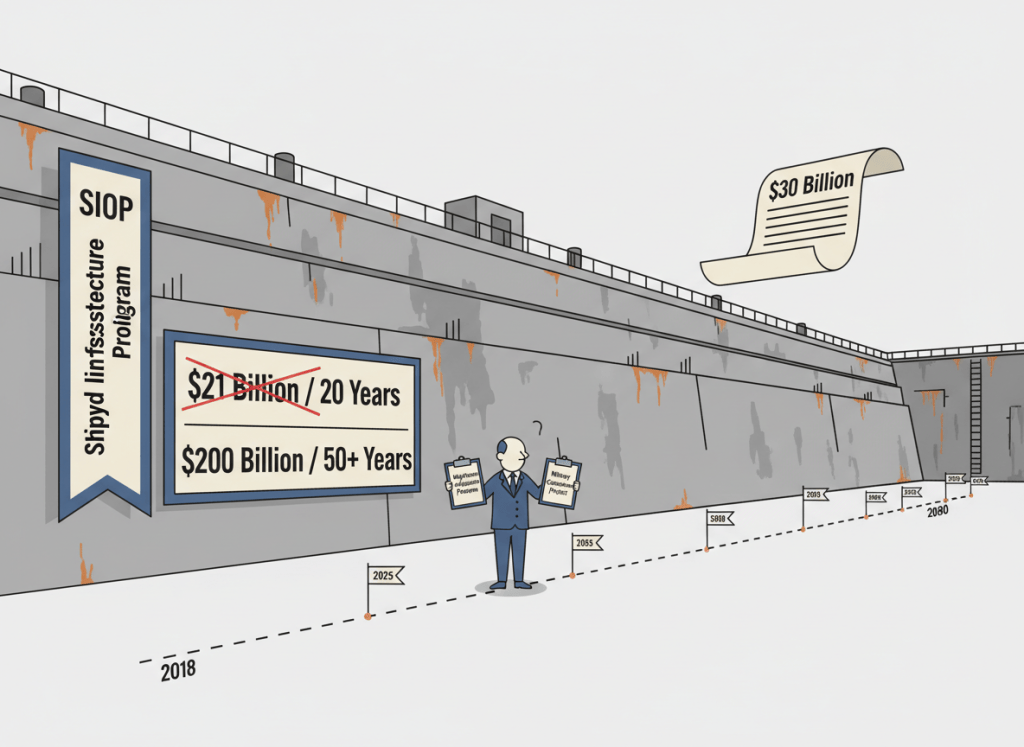
In 2018 the Navy announced a plan to rebuild its four public shipyards for at least $21 billion over 20 years. In September 2026 the Government Accountability Office reported that the same plan will surpass $200 billion and run more than 50 years longer, with the last projects on the current list not finishing until after 2080. Few of the officials who signed the original estimate will attend the final ribbon cutting, which at least spares them the questions about the overrun.
The Arithmetic of Optimism
The jump from $21 billion to $200 billion is not quite the scandal it sounds like, and it is worth being fair about why. GAO warned in 2019 that the original figure left out utilities, environmental remediation, program activities, and inflation. The new number is escalated across five decades and rests on completed cost analyses for only three of the four shipyards. A 20-year sprint priced in 2018 dollars was never the same object as a 50-year march priced in future ones.
The trouble is that the parts you can measure have misbehaved too. By 2023 the Pearl Harbor plan alone was estimated at about $16 billion, up roughly 162 percent from the 2018 figure. GAO reports that the Portsmouth and Pearl Harbor dry docks together have grown by more than $2.5 billion since Congress was first asked to fund them, and that since 2023 the Navy has identified over $1 billion in unplanned seismic work at Puget Sound. Navy officials say the work proved more extensive than anyone planned for, which is a polite way of saying that a century of deferred maintenance was not a rumor. GAO also notes the familiar tendency of large public works to be underestimated, whether by honest error or to win early support. The planning alone took more than eight years.
Weapon System Rules on Weapon System Days
The Navy has chosen to oversee this program as though it were a major defense acquisition program, with gate reviews, a milestone decision authority, and the rest of the apparatus that governs carriers and submarines. Officials describe it as the equivalent of one. But because SIOP is not formally designated a weapon program and is technically military construction, it does not owe Congress the annual status report that real weapon programs do, the one listing total spending to date, original and current baselines, and schedule risk. GAO observes that the largest naval infrastructure effort ever undertaken, one costlier than many of those programs, is reported on with less consistency than a missile.
The same selective borrowing shows up inside the Navy. Its own guidance calls for annual sufficiency reviews of readiness, affordability, and sustainability, and the SIOP process left them out. The requirements document governing the whole enterprise was approved in 2023 using data from 2017 through 2022, before the cost growth and before anyone wrote “50 years” on a slide. GAO recommends that Congress require annual, standardized reports and that the Navy build in the missing reviews. The Navy concurred, which costs nothing.
Eighty-Six Projects Nobody Has to Itemize
The reporting gap has a specific address. Of the 100 SIOP construction projects completed or underway as of April 2026, 86 were paid for from Operation and Maintenance accounts, totaling about $2.5 billion, more than a fifth of the cost. The 14 Military Construction projects, worth about $8.7 billion, get individual budget lines with full cost and schedule detail. The O&M projects, which make up the vast majority of SIOP work, do not carry the same authorization and reporting requirements. The pipeline looks the same, with 31 of the 40 projects now in design slated for O&M money, and at least 10 O&M projects at or above roughly $100 million.
Fairness again requires noting that Congress has not been left in the dark. GAO counts at least 15 legislative provisions with reporting requirements touching SIOP, including briefings for projects at $250 million or more and notifications for repairs above $7.5 million. The problem is not darkness but confetti. None of the reports GAO reviewed gave total costs to date, and one year’s depot report covered five years of estimates while the next covered a single year. Congress can read every page and still be unable to answer how much this has cost so far.
The Contract Leaves Before the Baseline Arrives
Timing is where this turns from a management story into a news story. The Navy planned a combined Gate 5 and Milestone B-C review for late fiscal year 2026 to approve an overall cost estimate and set the program’s first baseline, covering projects through fiscal year 2042. As of this writing I have found no public announcement that it has happened.
Meanwhile the Navy’s presolicitation notice for the Multi-Mission Dry Dock describes a contract vehicle worth up to $30 billion over as long as ten years, with roughly five awardees competing for task orders typically between $2 billion and $6 billion, a request for proposals slated for September 2026, and awards in May 2027. The work centers on Puget Sound, where the Navy’s fiscal year 2027 budget asked for $14.76 billion in authorization for the dry dock project, and where GAO counts about $17 billion in military construction projects in design.
A ceiling is not an obligation, and GAO notes the milestone review will not endorse a single solicitation or a full funding commitment, so nobody should claim the Navy has spent $30 billion it has not. The point is sequence. The contract vehicle, the baseline, and the reporting fix are all arriving in the same season, and the reporting fix is last in line, optional, and dependent on Congress. Underneath it all, the organizations managing the work remain thinly documented. The program’s concept of operations has not been updated since October 2022, and the new SIOP Integration Team exists on paper only as a brief reference in a larger document.
The Navy needs these shipyards fixed, and nobody serious disputes it. Ships that cannot be maintained cannot deploy. But a program of this size deserves standing accountability, not ceremonial accountability. The first annual report, if Congress orders one, should begin with what has been spent, because everything else on the list is a promise.

