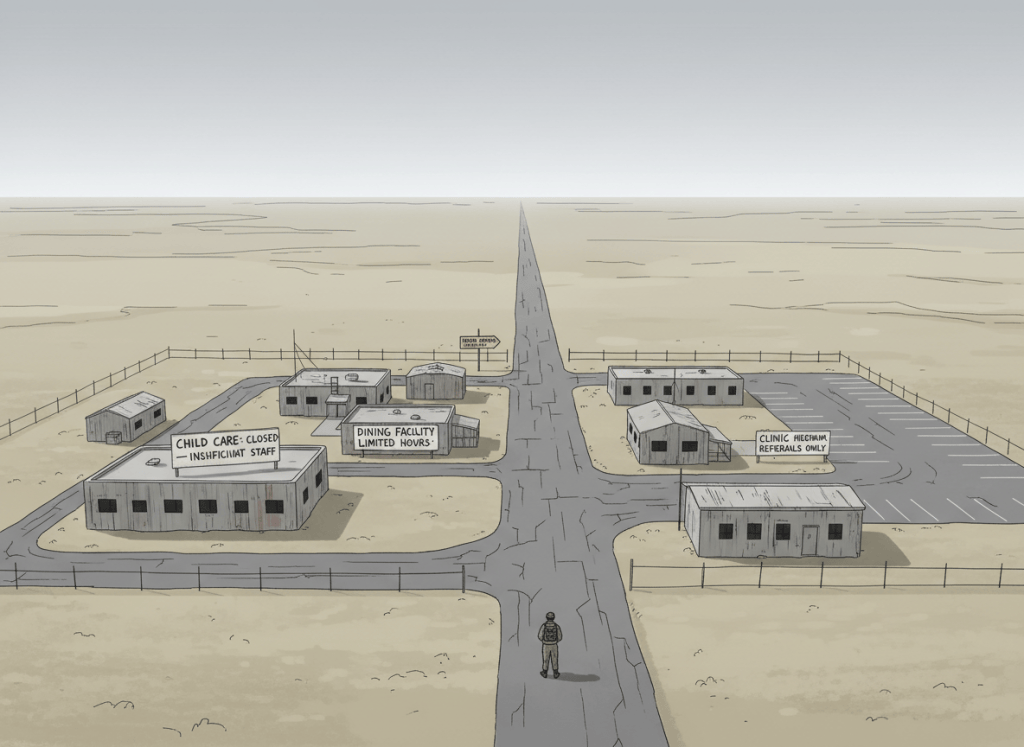
The Pentagon spent much of 2025 reducing its civilian workforce. At some of the military’s hardest places to staff, the consequences included closed youth programs, reduced services, depleted housing offices and positions that could already take more than a year to fill.
There is just one problem.
According to a new Government Accountability Office report, the Department of Defense has not specifically assessed what those workforce reductions did to critical services at remote and isolated military installations.
GAO examined civilian staffing and services including health care, housing, child care, education, morale and recreation, and military-spouse employment at nine installations. The audit found that remote installations already faced substantial recruiting and retention problems before the latest workforce reductions.
Then came 2025.
GAO identified three major federal workforce actions affecting the installations it examined: the federal and DOD hiring freezes, the Deferred Resignation Program and DOD-directed staffing reductions. Installation officials told auditors those actions affected their ability to hire and retain workers needed to provide critical services.
The numbers suggest DOD was hardly beginning with an abundance of spare personnel.
Across the nine installations examined, GAO counted 624 vacant critical-support positions during fiscal years 2023 through 2025. Eielson Air Force Base in Alaska accounted for 428 of them. Naval Air Station Key West had 95 vacancies, while the Marine Corps Air Ground Combat Center at Twentynine Palms had 83.
Filling those jobs could take considerably longer than ordering the furniture for their offices.
DOD had established a baseline of 98 days for hiring civilian personnel. GAO found that Eielson averaged 407 days. White Sands Missile Range averaged 212 days, Cannon Air Force Base 199, Fort Wainwright 194 and Holloman Air Force Base 158.
All but one of the installations for which GAO could calculate hiring times exceeded DOD’s 98-day baseline.
The reasons are not particularly mysterious.
Officials told GAO that remote installations compete against private employers offering better wages and must convince prospective employees to move somewhere with fewer services and amenities. Alaska installations reported losing prospective engineers and cooks to higher-paying oil and gold-mining jobs. At NAS Key West, officials said child-care job announcements remain continuously open because workers are constantly needed.
DOD installations have tried bonuses and other incentives to compensate. That produces its own peculiar arithmetic.
At some installations, recruitment and retention incentives come from the same account used for civilian salaries. Cannon officials told GAO that an installation with enough funding to hire 10 workers might be able to hire only six or seven after paying the incentives necessary to attract them.
Then the workforce reductions arrived.
GAO found tangible consequences across the installations it visited. Staffing shortages contributed to reduced morale, welfare and recreation programs, shortened operating hours and facility closures. At Fort Greely, officials planned to close the dining facility for certain meals because there weren’t enough employees to operate it full time. GAO noted that alternatives both on and off the installation were extremely limited.
Child care took a hit as well.
Officials at Holloman, Fort Wainwright, NAS Key West and Twentynine Palms told GAO that staffing shortages resulted in closures or reduced hours for child-care or youth programs. The DOD Inspector General had already identified the department’s difficulty providing quality child care as one of its top management and performance challenges for fiscal 2026.
Housing and medical services present another problem because there may be no practical alternative outside the gate.
At NAS Key West, anything beyond basic medical care can require a trip to Miami, more than 150 miles away and more than three hours by car. Officials told GAO that staffing at the installation clinic is thin enough that when personnel are sick or on leave, services can shut down.
At Fort Greely, insufficient primary care means referrals to Bassett Army Hospital, requiring a one-way trip exceeding 100 miles, including during an Alaska winter that officials noted lasts more than six months.
The consequences can reach beyond inconvenience.
GAO found that inadequate medical services can cost military personnel duty time and therefore affect operational readiness. At Cannon Air Force Base, officials reported approximately 12,400 referrals outside the military health system in fiscal 2025 alone and about $587,000 in reimbursable patient travel expenses. The Defense Health Agency spent $28 million for medical care outside Cannon during fiscal years 2024 and 2025.
Against that backdrop, GAO found DOD has not collected specific lessons learned about how its recent civilian workforce reductions affected remote and isolated installations.
That matters because DOD doesn’t even have a settled enterprise-wide picture of which installations belong in that category. The Army and Navy completed new remote-and-isolated designation lists in May 2026. The Air Force did not, arguing that designation without additional resources or authorities would provide little benefit and that critical-service shortages were systemic throughout the service.
GAO made two recommendations. One calls for DOD to establish a clear definition of a remote and isolated installation. The other calls for the department to specifically examine lessons learned from civilian workforce reductions at those locations.
DOD concurred with both.
The larger problem documented by GAO is therefore fairly simple.
Remote installations were already difficult to staff. Some civilian positions already took months, or more than a year, to fill. Medical care could require hundreds of miles of travel. Child-care programs were vulnerable to shortages. And some bases had few alternatives when an on-base service disappeared.
DOD then reduced the civilian workforce.
Now GAO is asking the department to determine what happened next.

