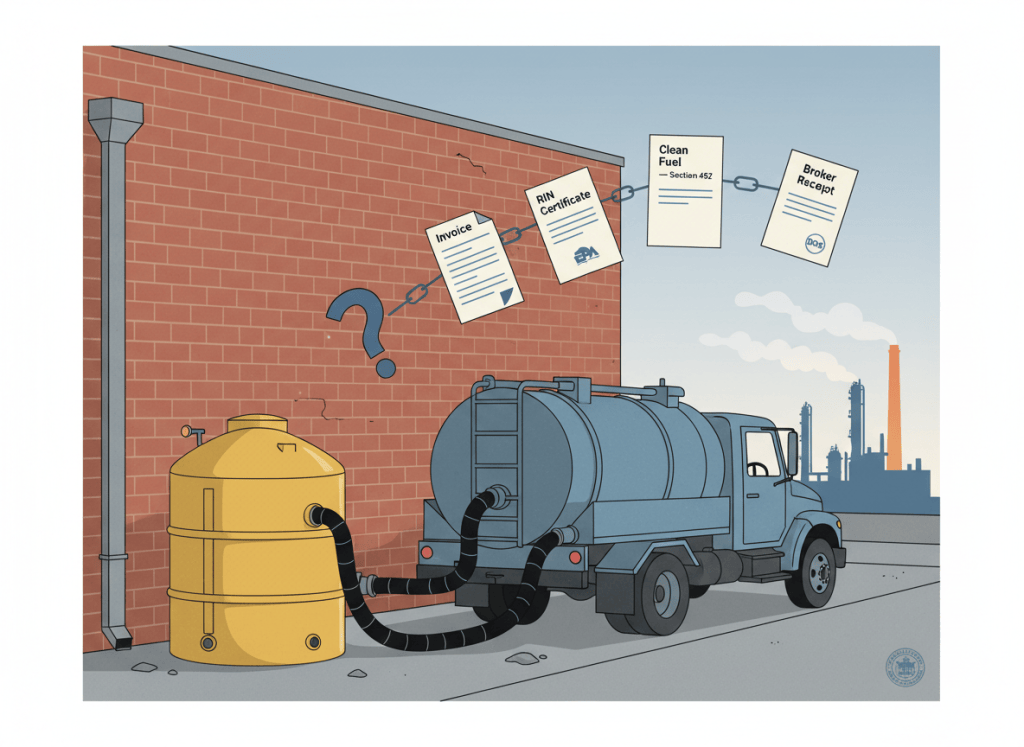
Behind countless American restaurants sits a container filled with something most customers would reasonably consider garbage.
It is the exhausted remnant of the fryer: old cooking oil that has already performed its useful service producing french fries, chicken wings and whatever else emerged from the kitchen before being poured, pumped or otherwise banished into a collection tank out back. To the casual observer, its commercial life would appear to be over.
The federal government, the renewable-fuels industry and a surprisingly industrious collection of thieves would disagree.
Used cooking oil has become a valuable commodity in the American renewable-fuels economy. It can be collected from restaurants, aggregated at warehouses, sold through brokers, transported across state lines and ultimately refined into biodiesel or renewable diesel. Once incorporated into that system, the humble vat of restaurant grease enters a regulatory and financial world involving federal renewable-fuel mandates, tradable compliance credits, detailed recordkeeping requirements and, under the right circumstances, federal tax incentives.
This is how we arrived at the peculiar modern circumstance in which people are stealing used cooking oil by the truckload.
Federal prosecutors have spent the past several years pursuing cases involving organized thefts of restaurant grease across multiple states. Those prosecutions initially look like colorful additions to the endlessly inventive catalog of things Americans will steal when sufficient money is attached to them. Look more closely, however, and they present a more interesting question.
The government has developed elaborate systems for determining what qualifies as renewable fuel, what feedstocks can be used to make it, how environmental attributes are calculated and how the resulting compliance credits move through the market.
What is considerably less clear is who, somewhere along this highly regulated journey from deep fryer to diesel tank, is responsible for establishing that nobody stole the grease.
That question is now the subject of a Bureaucracy Times investigation.
The $60,000 Grease Run
One of the clearest examples comes from western New York, where federal prosecutors have been unraveling an interstate used-cooking-oil theft operation.
In September, Guodeng Chen and Didi Huang pleaded guilty to transporting stolen goods in interstate commerce. According to the U.S. Attorney’s Office for the Western District of New York, the two men caused approximately 45,000 pounds of stolen used cooking oil to be transported from western New York to a refinery in Erie, Pennsylvania, on April 8, 2022.
The shipment brought in $29,433.60.
Twenty days later, another approximately 45,000 pounds traveled to the same destination. That load brought $30,618.
In less than three weeks, the two shipments represented roughly 90,000 pounds of stolen fryer oil worth more than $60,000.
Earlier filings in the prosecution help explain how something extracted from restaurant grease tanks managed to arrive at a refinery hundreds of miles away. Prosecutors described an operation in which participants drove trucks to restaurants, pumped used cooking oil from privately owned collection tanks and transported the material to a warehouse. From there, the oil could be sold through a broker and shipped across state lines to a refinery.
When authorities announced arrests in the broader case in 2023, prosecutors noted that used cooking oil could be refined into biodiesel and resold for approximately $4 to $5 per gallon.
Suddenly, stealing grease from behind a restaurant begins to look somewhat less eccentric.
The important feature of the New York case, however, is not simply that the oil was stolen. Theft requires little regulatory analysis. The interesting part is what happened afterward.
The stolen commodity moved from restaurant tanks into a warehouse, through a commercial intermediary and eventually to a refinery.
Somewhere along that journey, stolen property entered an otherwise legitimate industrial supply chain.
Iowa, and the Industrialization of Grease Theft
The New York prosecution might be dismissed as an unusually ambitious local theft operation were it not for what federal authorities have been prosecuting elsewhere.
In Iowa, the Justice Department has brought a sprawling case involving what prosecutors allege was an organized enterprise devoted to stealing and reselling used cooking oil. The prosecution eventually grew to include 19 defendants.
According to the government, members of the alleged operation stole or attempted to steal used cooking oil from restaurants across Iowa, Tennessee, Minnesota, Indiana, Ohio, Alabama, Illinois, Nebraska, Missouri and Kentucky. The material was allegedly transported to warehouses in several states, consolidated and resold.
Two defendants, Tianzhu Chen and Yong Chen, pleaded guilty in September to racketeering conspiracy charges. Tianzhu Chen also pleaded guilty to money laundering. Other defendants remain scheduled for trial in April 2027, and the allegations against those who have not pleaded guilty remain precisely that: allegations.
What the Iowa case adds is scale.
This was not a matter of somebody occasionally discovering that a restaurant had neglected to lock the grease tank. Prosecutors describe an alleged network involving vehicles, warehouses, interstate transportation and resale operations spread across a substantial portion of the country.
The existence of such infrastructure tells us something about the underlying commodity.
Nobody builds an interstate logistics network around something that has no value.
Used cooking oil has value because the substance restaurants are finished with is something the renewable-fuels industry still wants.
And that is where a curious theft story becomes a regulatory story.
Washington Discovers the Fryer
Used cooking oil is among the feedstocks that can be converted into renewable transportation fuels. Once that happens, it enters one of the more intricate corners of federal energy policy.
Under the Environmental Protection Agency’s Renewable Fuel Standard, qualifying renewable fuels can generate Renewable Identification Numbers, commonly known as RINs. EPA itself describes RINs as the “currency” of the Renewable Fuel Standard program.
The system exists because certain refiners and importers have renewable-volume obligations. RINs are generated in connection with qualifying renewable fuel, transferred through the market and ultimately retired by regulated parties to demonstrate compliance.
Naturally, there is a federal electronic system for this.
The EPA Moderated Transaction System, or EMTS, records transactions involving RINs. Renewable-fuel producers operate under registration, reporting and recordkeeping requirements, and federal regulations specify which feedstocks and production pathways qualify for the program.
Used cooking oil therefore does not wander casually into the federal renewable-fuels regime. There are rules.
Those rules include documentation concerning the feedstock itself. A renewable-fuel producer using used cooking oil or certain other waste materials must maintain records from suppliers certifying information relevant to whether the material qualifies as renewable biomass, including descriptions of the material and the process that generated it.
The federal government, in other words, has developed mechanisms for establishing that the grease really is the correct kind of grease.
Our investigation has encountered a more elementary problem.
Suppose the material unquestionably originated in a restaurant fryer. Suppose it satisfies the relevant federal definition. Suppose its chemical and environmental characteristics make it perfectly acceptable as renewable-fuel feedstock.
Suppose, however, that somebody stole it.
The oil has not undergone a molecular transformation during the theft. It remains exactly the same renewable biomass it was before somebody arrived behind the restaurant with a pump.
Its legal provenance is another matter entirely.
So far, Bureaucracy Times has not identified a nationwide federal Renewable Fuel Standard requirement specifically requiring a renewable-fuel producer to establish that used cooking oil was lawfully acquired from the restaurant or other original generator.
That finding requires an important qualification.
It does not mean no safeguards exist.
Companies may impose contractual requirements on suppliers. Brokers may conduct due diligence. State property laws still apply. Industry auditing programs, fraud controls, supplier certifications and private compliance systems may provide additional layers of protection. A refinery receiving stolen material unknowingly is in an entirely different position from somebody knowingly trafficking stolen goods.
Our question is narrower.
Within the federal renewable-fuels system itself, where is lawful ownership established?
So far, that answer has proved surprisingly difficult to locate.
Then There Is the Tax Code
As often happens when Washington creates a sufficiently complicated regulatory system, eventually the Internal Revenue Code arrives.
Section 45Z created the Clean Fuel Production Credit for qualifying transportation fuels produced in the United States beginning in 2025. The credit covers qualifying sustainable aviation fuel and other clean transportation fuels, with its value tied in part to emissions characteristics and other statutory requirements.
Producers seeking the credit must satisfy federal eligibility and registration requirements.
Here, too, provenance matters.
Treasury and IRS have grappled explicitly with the origin of used cooking oil in the context of imported feedstocks and concerns about distinguishing UCO from substances such as palm oil. Beginning with fuel produced after Dec. 31, 2025, qualifying fuel generally must be derived exclusively from feedstocks produced or grown in the United States, Mexico or Canada.
The government therefore cares where the feedstock came from.
It cares what the feedstock is.
It cares how the resulting fuel was produced.
It cares about emissions calculations, producer registration and eligibility for federal tax benefits.
This represents a considerable amount of institutional curiosity about a substance that began its life bubbling beneath a basket of potatoes.
Which brings us back to the comparatively unsophisticated question at the center of this investigation:
Does anybody have to prove that it wasn’t stolen?
We Asked the Government
On Sept. 23, Bureaucracy Times sent the Environmental Protection Agency seven questions about the provenance of used cooking oil entering the Renewable Fuel Standard system. EPA acknowledged the inquiry the following day, later requested additional time, and supplied substantive written answers on Oct. 7.
The response clarified what the federal program follows, and what EPA did not establish that it follows. EPA described existing RFS records addressing feedstock identity, renewable-biomass eligibility and point of origin. But in its answers, the agency did not identify a specific nationwide requirement to document that the restaurant or other original generator authorized the removal of the oil.
That distinction matters. A record showing where grease originated is not necessarily a record establishing that its owner agreed to surrender it. The two questions can be related without being interchangeable.
We also asked what would happen if stolen cooking oil made its way into renewable fuel and associated RINs. EPA did not provide a categorical ruling that such fuel would qualify or be disqualified. Its answer depended on the particular facts and records. Nor did the agency suggest that theft is outside the government’s reach: it said unlawful acquisition of UCO may be investigated by EPA’s Criminal Investigation Division, while declining to comment on enforcement matters involving the Iowa prosecution.
There is a revealing regulatory footnote. In a June 17, 2025 proposal published at 90 FR 25784, EPA contemplated expanded point-of-origin documentation. The agency told Bureaucracy Times that the additional documentation was not finalized in the Set 2 final rule. Even such documentation would not, by itself, necessarily amount to proof of authorization by the original owner. But the proposal shows that EPA has considered how much more of the feedstock’s journey should be documented.
Asked about a national chain-of-custody system comparable to California’s controls for inedible kitchen grease, EPA offered a general statement about program integrity without confirming an equivalent nationwide requirement.
None of this establishes that a particular producer violated RFS rules, that stolen oil generated RINs, or that EPA lacks enforcement authority. It establishes a narrower and more consequential reporting point: when asked directly about proof of lawful acquisition from the original generator, EPA’s response did not identify that safeguard as an explicit federal RFS documentation requirement.
Bureaucracy Times also sent questions to Treasury and IRS concerning Section 45Z, including whether substantiation for the Clean Fuel Production Credit establishes lawful acquisition of used cooking oil. We have not received a substantive answer to that inquiry as of this article’s preparation.
The U.S. Attorney’s Office for the Southern District of Iowa declined to provide additional responses beyond the public record. Open-records requests and other follow-up inquiries may yet clarify how regulators and investigators approach the movement of stolen feedstocks into otherwise lawful markets.
But the existing public record already demonstrates the problem: organized theft occurs, interstate resale networks exist, and in the New York prosecution stolen cooking oil passed through commercial intermediaries to a refinery.
Following the Grease
There is a temptation in stories involving federal subsidies, environmental regulations and criminal enterprises to leap directly from correlation to scandal. That would be premature here.
We have found no evidence that the Pennsylvania refinery identified in the New York prosecution knew the oil was stolen.
We have found no evidence establishing that the stolen shipments generated RINs.
We have found no evidence that those shipments resulted in Section 45Z tax credits or any other federal financial benefit.
Nor does the existence of federal incentives for renewable fuels somehow explain the criminal conduct of people stealing restaurant grease.
Those are distinctions worth maintaining, particularly because the question we can document is interesting enough without embellishment.
Federal prosecutors have demonstrated that stolen used cooking oil can leave a restaurant, pass through warehouses and brokers, cross state lines and reach the renewable-fuels industry.
At the same time, the federal government operates an elaborate regulatory structure concerned with the identity, origin, environmental characteristics and ultimate disposition of renewable-fuel feedstocks.
Somewhere between those two realities lies the provenance problem.
EPA has now described the feedstock records the RFS requires, without identifying a specific requirement to prove that the original generator authorized removal. Treasury or IRS may yet identify additional substantiation relevant to clean-fuel tax credits. Records obtained through FOIA may reveal enforcement practices not readily apparent from the regulations themselves.
We will report those findings as they emerge. For now, the EPA response leaves open whether the United States has constructed a regulatory system capable of following the environmental attributes of a gallon of renewable fuel with considerable precision while remaining remarkably incurious about who owned the raw material before it entered the system.
Either answer is worth knowing.
For now, the trail begins where the thieves apparently discovered it long ago:
behind the restaurant, next to the dumpster, in a tank full of something that turns out not to be garbage at all.

