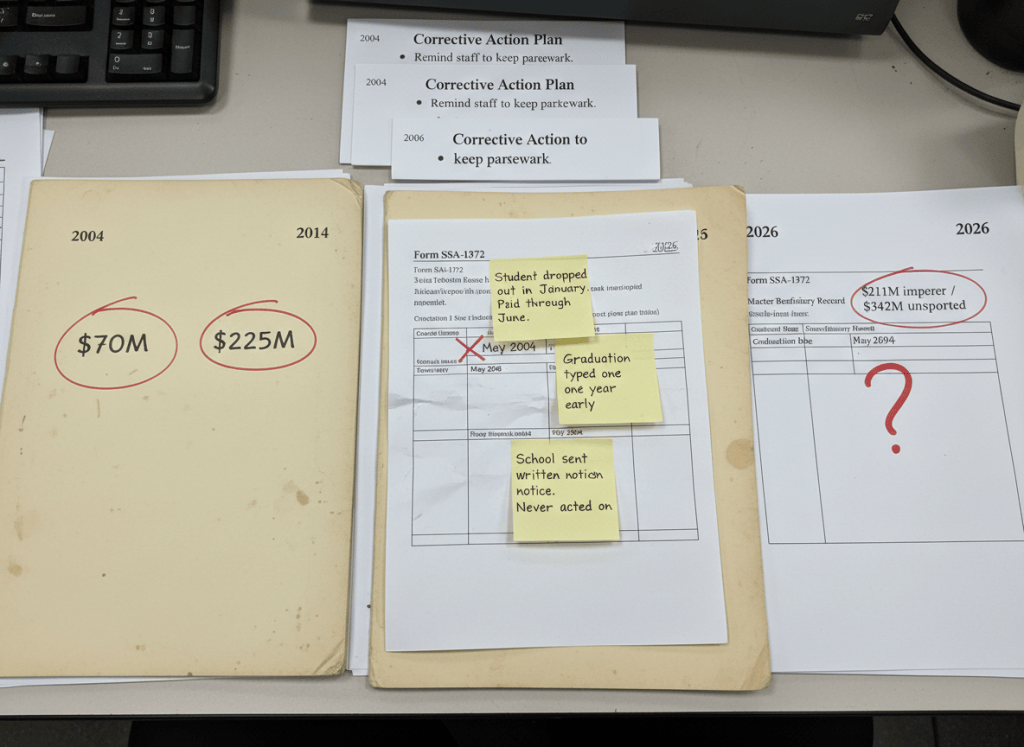
The Social Security Administration runs a program that pays benefits to the teenage children of dead, disabled, and retired workers, provided those teenagers are still in high school. The mechanism that decides whether the checks keep coming is a single form, filled out by the student, certified by a school official, and reviewed by an SSA employee who is trusting both of them to be right. It is not a complicated system. It has also failed the same audit three separate times since 2004, for the same three reasons, with SSA agreeing to fix it on all three occasions.
A Teenager’s Signature Is Still the Control
Under the Social Security Act, a minor child of an insured worker loses benefits at 18 unless they qualify as a full time student, in which case payments continue until they graduate or turn 19, whichever comes first (42 U.S.C. §§ 402, 423). The instrument that governs this is Form SSA-1372, Advance Notice of Termination of Child’s Benefits. The student states their school, their attendance dates, and their expected graduation date; a school official signs off; SSA takes it from there.
There is no automated feed from any school system telling SSA when a kid drops out, transfers, or graduates a semester early. There is no real time check against enrollment records. There is a piece of paper, filled out months in advance, describing a future the student is predicting rather than reporting. The Office of the Inspector General’s newest audit (report 022515, released September 2026) exists because that paper, and the employees who process it, keep getting it wrong the same three ways, and this is the third time OIG has documented it happening.
2004: The Original Diagnosis
In an August 2004 review titled School Attendance by Student Beneficiaries over Age 18 (A-09-04-14013), OIG sampled 300 students out of a population of 254,121 and found $202,917 in incorrect payments and $56,065 in unsupported payments among them. Projected to the full population, that came to about $70 million in incorrect payments to 32,839 students and $39.5 million in unsupported payments to 10,312 students. The stated causes were that students and schools did not promptly report attendance changes, and that SSA did not retain the documentation needed to prove eligibility either way. SSA’s response was to promise additional employee training and a systems modification to stop paying benefits past the maximum age of entitlement, a related failure mode significant enough that OIG had already given it a separate audit of its own the same year.
2014: The Same Chart, Bigger Numbers
A decade later, OIG returned with Payments to Student Beneficiaries (A-09-13-13059, December 2014), sampling 275 students out of 1,539,078 who had received student benefits between 2007 and 2013. The estimate had grown to $225.3 million in overpayments to about 106,000 beneficiaries and $968 million in unsupported payments to roughly 246,000. The trade press covered it as a program in disarray, and the underlying diagnosis had not moved an inch from 2004. Students and schools were still not reporting attendance changes. SSA employees were still failing to retain evidence, and the agency’s own systems still weren’t recording graduation dates on the Master Beneficiary Record where an employee could see them. SSA’s corrective action, according to the background section of this year’s report, was to notify schools and organizations about the importance of timely reporting and remind its own staff to keep the paperwork. In practice, that was a memo.
2026: Reading the Same Homework Back to Itself
The current audit sampled 100 of 521,393 beneficiaries entitled to student benefits from January 2022 through December 2024. SSA correctly paid 71 of them. It got 17 wrong and could not document eligibility at all for 12 others, a documentation gap that on its own accounts for more projected dollars than the confirmed errors sitting next to it, an estimated $342 million in unsupported payments to 63,000 beneficiaries against $211 million in confirmed improper payments to 89,000.
Split the 17 error cases and the causes fall into the same two buckets OIG has now written up three times. Nine cases trace back to students or schools handing SSA outdated or simply wrong attendance information, the kind of error where a beneficiary reports an expected June graduation and then quietly leaves school the previous January, collecting five months of benefits nobody was still entitled to. The other eight trace back to SSA itself. In one, an employee typed a graduation date into the Master Beneficiary Record a full year earlier than what the student had actually reported, cutting off seven months of benefits the student should have received. In another, a beneficiary attending a full year school got their benefits terminated a month early because an employee applied the rules for a quarterly academic calendar instead, a distinction the agency’s own manual spells out clearly enough (SSA, POMS, RS 00205.325, C). In a third, SSA received written notice from a school that a student had graduated a month ahead of schedule and simply never acted on it.
The report closes with three recommendations. Fix the eight remaining attendance error cases. Fix the six remaining duration miscalculations. Identify why any of this keeps happening at all. SSA’s Chief Risk Officer replied that the agency agrees. That sentence, or one close enough to it, is now sitting in the file from 2004, from 2014, and from 2026.
What has never been sitting in that file, across three audits and twenty two years, is a system that checks a school’s actual enrollment against what a form predicted six months earlier, or a Master Beneficiary Record built so a graduation date gets flagged rather than typed in by hand and trusted. The dollar figures keep climbing because the beneficiary population keeps climbing, not because anyone at SSA found a new and interesting way to get this wrong. The agency has spent over two decades photographing the same crack in the same wall, filing the photograph, and calling the filing a corrective action plan.

