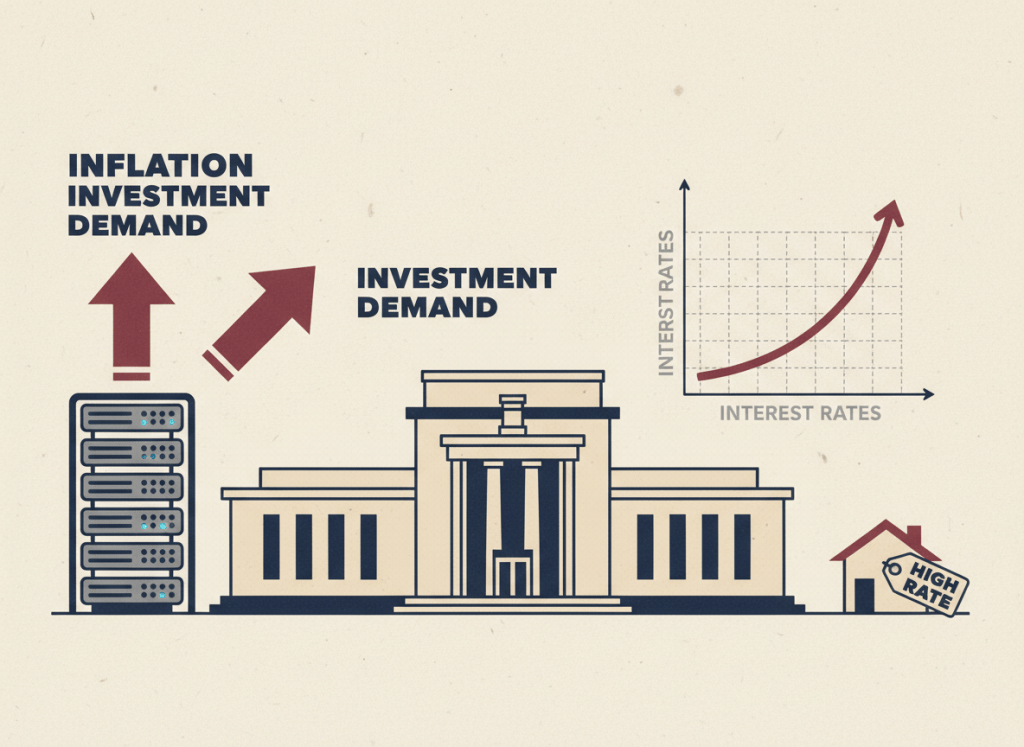
The Federal Reserve once viewed artificial intelligence primarily as a potential productivity engine. Its latest meeting minutes show policymakers confronting another side of the boom: AI investment is contributing to inflationary pressures, enormous borrowing demands and higher costs across the economy.
The artificial-intelligence boom has grown large enough that the Federal Reserve is no longer merely wondering how much more productive it might make the American economy.
Officials are now considering how much inflation it might create along the way.
Minutes from the Federal Open Market Committee’s September 15–16 meeting show artificial-intelligence investment threaded through the Fed’s assessment of inflation, business investment, wages, corporate borrowing and even Treasury yields. Most significantly, some policymakers explicitly connected AI-related demand with the case for higher interest rates.
The committee unanimously raised the federal-funds target range by a quarter percentage point to 3.75 to 4 percent at the September meeting. All participants supported the increase, citing inflation that remained elevated, a labor market near full employment and an economy continuing to expand at a solid pace.
The rate increase itself was already known.
The minutes reveal considerably more about what was happening underneath it.
An AI boom with an inflation bill
Fed staff estimated that headline personal consumption expenditures inflation reached 3.8 percent in August, while core inflation remained at 3.4 percent.
The causes were not confined to the familiar suspects.
Staff attributed the increase largely to previous tariff increases, higher energy and input costs resulting from geopolitical developments and an increase in prices for technology-related consumer goods associated with the AI buildout.
FOMC participants went further.
They said surging AI-related investment was contributing to inflationary pressures and noted that effects from the AI buildout appeared to be increasing in core goods even as the effects of earlier tariff increases faded.
Businesses were also encountering higher transportation and input costs. Some policymakers warned that AI investment could become large enough for aggregate demand to outpace aggregate supply, creating additional upward pressure on prices.
That concern matters because the Fed is confronting an economy that has stubbornly refused to provide the traditional justification for easier monetary policy.
Unemployment fell to 4.1 percent in July and August. Payroll gains accelerated in August. Consumer spending strengthened. Business investment remained robust.
And once again, AI was part of the explanation.
Fed staff said the AI buildout was supporting substantial increases in business investment and fueling imports of high-tech capital equipment.
In other words, the same investment boom promising greater productive capacity tomorrow is adding demand to an already strong economy today.
From productivity story to policy consideration
That tension has become progressively more visible in the Fed’s public record.
Earlier this year, AI frequently appeared in Fed discussions as a source of potential productivity growth and economic disruption. By June, policymakers were discussing strong demand for AI infrastructure as a source of upward pressure on technology and electricity prices and considering whether unusually strong investment could contribute to persistent inflation.
By July, the Fed’s Monetary Policy Report was documenting rising prices for semiconductors and other data-center components alongside growing demand for industrial metals and AI-related manufactured goods.
The September minutes move the discussion another step forward.
Some participants worried that the longer inflation remains above the Fed’s 2 percent target, the greater the possibility that higher inflation becomes embedded in expectations and wage and price decisions. Others were concerned that AI-related demand could produce broader price pressures rather than remaining confined to technology markets.
Then comes perhaps the most consequential passage in the minutes.
A couple of participants said a higher policy rate would help prevent sector-specific price increases caused by energy disruptions and AI-related demand from spreading into more persistent inflation.
That does not mean AI caused the September rate hike. The minutes provide no basis for such a conclusion. Persistent underlying inflation, energy prices, geopolitical instability, tariffs and continued economic strength all figured into the committee’s deliberations.
But the minutes establish something more subtle and potentially more important: Federal Reserve policymakers are now explicitly considering AI-generated demand when determining how restrictive monetary policy needs to be.
AI is competing for capital, too
The effects are not confined to consumer prices.
The Fed’s market discussion points toward another consequence of the enormous sums being spent on AI infrastructure: competition for capital.
Treasury yields rose about 35 basis points across the two- to 10-year portion of the yield curve during the period between meetings. Higher expectations for monetary policy and strong economic data accounted for part of that increase.
But market commentary identified another factor: heavy private-debt issuance being used to finance AI infrastructure.
According to the minutes, that borrowing was contributing to competition for capital and was among the factors associated with higher Treasury term premiums and yields.
The scale is significant enough that the Fed separately discussed the corporate debt issued by AI “hyperscalers.” Yield spreads on that debt remained wide because of the large volume being issued and the relatively long duration of the securities.
At the same time, companies benefiting directly from AI infrastructure investment were outperforming the broader stock market.
The result is an unusual economic feedback loop.
AI companies and their partners spend heavily on data centers, chips, electricity infrastructure and other equipment. That investment supports economic growth and corporate earnings, but also increases demand for goods, skilled labor, energy and capital. Those pressures can raise prices and borrowing costs. Persistent inflation then gives the Federal Reserve reason to keep interest rates higher.
Higher rates, in turn, raise borrowing costs throughout the rest of the economy.
Housing provides a particularly stark contrast. While financing remained broadly available to larger businesses, the Fed described conditions as restrictive for mortgage borrowers and small businesses. Home-purchase borrowing remained depressed.
The AI investment boom, in other words, is occurring in an economy where access to capital is far from uniform.
Pay now, productivity later
None of this means the Federal Reserve believes AI will ultimately be bad for the economy.
Quite the opposite.
Participants generally expect AI investment to increase productivity and potential economic output in coming years. But they also acknowledged considerable uncertainty about the size and timing of those benefits. Some additionally warned about cybersecurity and other risks associated with rapid AI adoption that could offset productivity improvements in certain circumstances.
That creates the central paradox buried in the September minutes.
The American economy may eventually receive a substantial productivity dividend from artificial intelligence. But building the infrastructure necessary to produce that dividend requires enormous amounts of capital, equipment, energy and skilled labor today.
And the Fed has to conduct monetary policy in today’s economy, not the economy AI proponents expect several years from now.
Fed staff now expects inflation to decline gradually and finally reach the central bank’s 2 percent objective in 2029. Its inflation forecast for 2026 through 2028 was revised upward from July, while its outlook for economic activity and the labor market strengthened. Staff also concluded that inflation risks remained tilted to the upside.
Most FOMC participants consequently believed another rate increase would probably be appropriate before the end of the year, although they emphasized that future decisions would depend on incoming economic data.
The committee’s September statement summarized the situation much more simply: economic activity remained solid, capital investment was robust and inflation remained elevated.
The minutes released weeks later supply a detail missing from that abbreviated public account.
Artificial intelligence is no longer sitting somewhere off in the Fed’s economic forecast as a hypothetical future productivity revolution.
It is already showing up in prices, investment, corporate borrowing and financial markets.
And now it is showing up in the interest-rate discussion.
Sources
- FOMC Minutes — September 15–16, 2026 Meeting, Federal Reserve
- Federal Reserve — Monetary Policy, Federal Reserve
- Gov. Cook — An Update on AI and the Economy, Federal Reserve, Sep. 28, 2026


