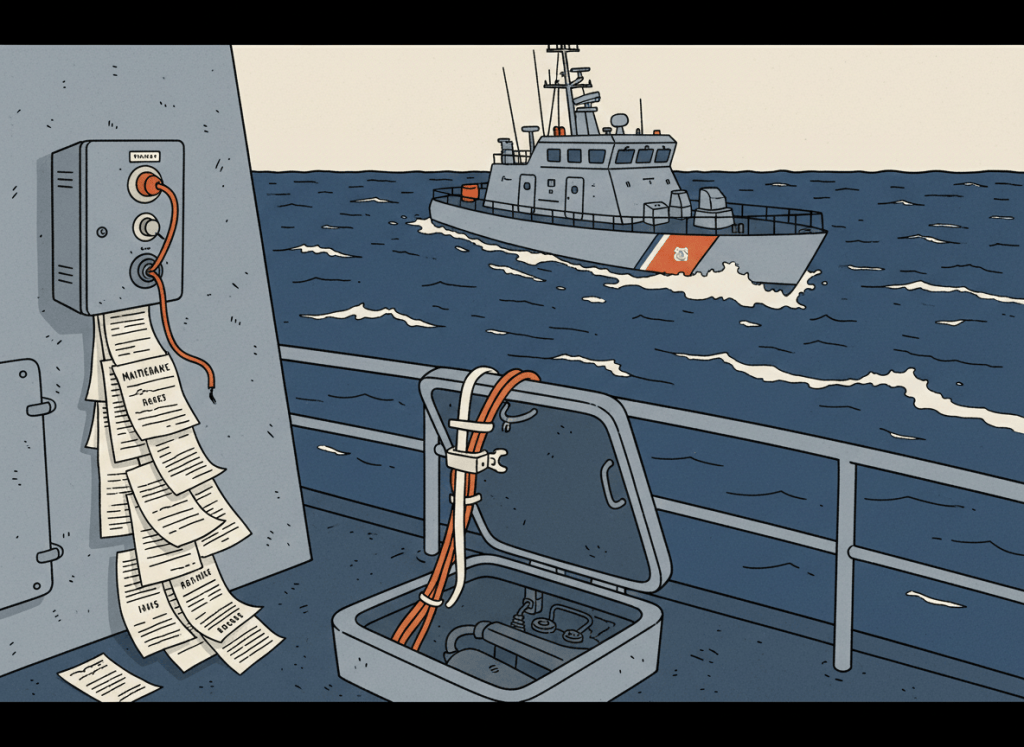
DHS inspectors found a known fire-suppression defect, more than 9,000 delayed maintenance items and a fleet falling well below readiness requirements even as the Coast Guard continues buying new Fast Response Cutters.
A fire in the engine room of a Coast Guard Fast Response Cutter is precisely the kind of emergency for which an automatic fire-suppression system exists.
On some of those cutters, however, the automatic feature has been deliberately disabled.
After repeated malfunctions caused firefighting agent to discharge unexpectedly and shut down cutter engines, the Coast Guard’s solution was to disconnect components of the system and secure a discharge pin with a zip tie. The workaround stopped the accidental activations, but it created another problem: in an engine-room fire, a Coast Guardsman may have to travel to the back of the vessel, descend through a hatch and manually activate the suppression system.
The Department of Homeland Security Office of Inspector General says those additional steps would delay the release of firefighting agent and increase the danger to the crew. Its conclusion is unusually direct for a federal audit: failure to resolve the problem “could also lead to injury or death.”
The finding is part of a broader September 28 audit of the Coast Guard’s Sentinel-class Fast Response Cutter fleet, a growing force of 154-foot patrol vessels used for missions ranging from search and rescue and drug interdiction to maritime security and defense readiness. The auditors found a fleet struggling with maintenance backlogs, escalating funding shortfalls and operational availability far below Coast Guard requirements.
The fire-suppression problem, however, provides perhaps the clearest example of what those readiness problems mean for the people aboard the cutters.
And the problem has been known for years.
A Fire System That Could Shut Down the Ship
According to DHS OIG, Fast Response Cutters experienced at least 22 random discharges of firefighting agent into their engine rooms between 2017 and 2023.
The consequences were more substantial than an inconvenient false alarm.
Activation of the suppression system shuts off engine-room ventilation, closes fuel valves and turns off the engines. Whether the system activates because of an actual fire or a malfunction, the cutter loses propulsion and cannot restart its engines until faults in the suppression system are cleared.
The Coast Guard traced the failures to environmental degradation caused by moisture accumulating in a remote station box. The suppression system had complied with applicable requirements when the cutters were constructed, according to the audit, but responsibility for maintaining and replacing the equipment subsequently passed to the Coast Guard during the vessels’ sustainment phase.
By April 2023, the Coast Guard had issued an engineering advisory addressing the recurring problem.
Its interim solution was decidedly low-tech.
Crews were directed to disconnect electrodes associated with the automatic suppression system and secure the discharge pin with a zip tie to prevent another accidental release. OIG inspectors photographed the arrangement aboard the Fast Response Cutter Paul Clark. The report includes images of both the zip-tied pin and disconnected electrodes.
The modification worked in one important respect. OIG said it prevented additional random discharges.
But disabling the electrodes also disabled the suppression controls in the pilothouse.
That means a crew confronting an actual engine fire cannot simply activate the affected system from the vessel’s control station. Instead, according to OIG, a Coast Guardsman would have to move aft and climb down a hatch to manually discharge the firefighting agent.
“These extra steps would delay immediate release of the firefighting agent,” the auditors concluded.
The Coast Guard estimated that resolving the problem across the fleet would cost approximately $40 million. Yet as of fiscal 2025, according to OIG, replacement of the suppression system had not been included in the Coast Guard’s formal budget request. Officials told auditors that the project would, at best, receive a Tier II designation, which carried a low probability of funding.
The Coast Guard has since begun moving toward a permanent solution, but that solution will not arrive quickly.
Newer cutters are already being delivered with changes. According to the Coast Guard’s response to OIG, FRC #59, delivered in March 2025, and subsequent cutters receive different fire-alarm panels and upgrades to their fire-suppression systems. The service is also retrofitting a previously delivered cutter with the new system.
For the older fleet, however, the Coast Guard estimates completing the retrofit will take at least three years, citing the number of vessels involved, the extent of the required work and availability of funding.
There is still no estimated completion date.
OIG consequently left the recommendation open and unresolved.
A Safety Problem Inside a Maintenance Problem
The fire system is only one part of a much larger readiness problem documented by the auditors.
Fast Response Cutters are supposed to maintain at least 85 percent operational availability. OIG analyzed 52 domestic FRCs from October 2022 through June 2025 and found they collectively managed just 72 percent.
Nearly one-third of the fleet, in other words, was not fully mission-capable at any given time.
The results were particularly poor in fiscal 2024. Only 13 of the 52 cutters met the minimum availability requirement, and none of the eight Coast Guard districts operating FRCs met the service’s overall requirement.
Those numbers have operational consequences.
Auditors attempted to determine which missions the Coast Guard had been unable to perform because cutters were unavailable. They couldn’t.
The Coast Guard does not maintain that data.
OIG did identify at least one revealing example. A Fast Response Cutter conducting an interdiction in the Southeast District broke down during pursuit of a vessel suspected of carrying drugs and/or migrants.
The suspected vessel escaped.
The maintenance backlog behind those failures is substantial.
Coast Guard cutter-fleet funding shortfalls grew from $219 million in fiscal 2022 to $486 million in fiscal 2025, according to internal memoranda reviewed by OIG. To manage those shortages, required maintenance was postponed.
By June 17, 2025, crews had reported more than 9,000 FRC maintenance requests that were overdue or had received extensions from Coast Guard headquarters. One of them involved the cutter that subsequently broke down during the interdiction.
Delaying the work did not necessarily save money.
OIG found that postponing dockside maintenance until cutters entered scheduled dry dock could stretch a roughly 90-day maintenance period to 120 days. An additional 30 days in dry dock costs an average of approximately $160,000 per cutter. Across roughly 50 cutters over a four-year maintenance cycle, OIG estimated the practice could add about $8 million in costs while simultaneously keeping the vessels away from their homeports longer.
There is an accounting problem buried beneath the maintenance problem as well.
Despite evidence that operational and support expenses were rising, the FRC program reduced its projected life-cycle costs from $9.9 billion in 2021 to $9.2 billion in 2023. OIG concluded that the lower projection conflicted with actual cost increases and failed to account adequately for technical systems and deferred maintenance.
In its response to the audit, the Coast Guard effectively acknowledged part of that problem. It told OIG that deferred maintenance had artificially lowered the actual costs used to develop its cost estimates and said those costs were being incorporated into a revised life-cycle estimate.
That is an important distinction. Deferring maintenance can make today’s books look better by moving an expense into tomorrow’s inbox. Unfortunately, the cutter still knows the maintenance wasn’t performed.
This Problem Predates the Latest Audit
The new OIG findings also fit a longer pattern.
The Government Accountability Office reported in earlier examinations of Coast Guard cutter maintenance that deferred work and equipment failures were already reducing cutter availability.
More recently, GAO documented a Fast Response Cutter whose shaft-seal maintenance was postponed. The seal eventually failed, leaving the cutter unable to operate for four months. Coast Guard district officials told GAO that losing the vessel increased pressure on the remaining cutters, which then had to absorb its missions.
That sequence is strikingly similar to the problem OIG now describes at fleet scale: defer maintenance because resources are constrained, suffer equipment failures later, lose operational availability, and place additional demands on the cutters that remain available.
The latest audit puts numbers around the accumulated result.
A 72 percent availability rate. More than 9,000 overdue or extended maintenance items. A $486 million cutter-fleet funding shortfall.
And a fire-suppression problem serious enough that the Coast Guard disabled part of the system to prevent it from unexpectedly shutting down the vessel.
Meanwhile, the Fleet Keeps Growing
None of this has stopped expansion of the Fast Response Cutter program.
In September 2025, the Coast Guard exercised a $507 million contract option with Bollinger Shipyards for 10 additional FRCs, increasing the number ordered under the contract from 67 to 77. Congress provided $1 billion for additional Fast Response Cutters as part of nearly $25 billion in Coast Guard funding contained in the One Big Beautiful Bill Act.
The first cutter financed through that option is expected in fiscal 2028.
Expansion has continued in the meantime. The Coast Guard accepted its 63rd Fast Response Cutter, the Jeffrey Palazzo, in June 2026.
There is nothing inherently contradictory about replacing or upgrading equipment while expanding a fleet. New vessels can incorporate corrections that older hulls lack, and the Coast Guard says precisely that is happening with the fire-suppression system.
But the juxtaposition is difficult to ignore.
The Coast Guard is expanding a cutter fleet whose existing vessels have accumulated thousands of delayed maintenance requirements, while its own inspector general says nearly one-third of the domestic fleet was not fully mission-capable at any given time during the period examined.
And the older cutters will not instantly inherit the improvements installed aboard their newer siblings.
More Money, But OIG Wants a Plan
The Coast Guard concurred with all three recommendations in the report.
For maintenance, the service pointed to increased funding in its fiscal 2025 budget reconciliation, fiscal 2026 appropriation and fiscal 2027 budget proposal. According to its response, those increases include approximately $20 million in fiscal 2026 and another $30 million in fiscal 2027 for surface depot maintenance, with the Coast Guard addressing FRC work including five dry docks, five docksides and nine annual inspections.
The Coast Guard asked OIG to consider the recommendation resolved and closed.
OIG declined.
Additional funding, the auditors said, did not constitute a plan explaining how the money would eliminate the FRC maintenance backlog. The recommendation will remain open until the Coast Guard produces documentation showing it has developed and implemented such a plan.
The same unresolved designation applies to the fire-suppression system.
The Coast Guard says the fleet-wide retrofit will take at least three years. Its completion date remains “to be determined.”
That leaves the service in an uncomfortable position.
It is simultaneously buying the next generation of Fast Response Cutters, attempting to catch up on maintenance for the existing generation, and trying to retrofit a known safety defect aboard older vessels while those vessels remain responsible for some of the Coast Guard’s most consequential missions.
Those missions include drug interdiction, migrant interdiction, search and rescue, maritime security and national defense.
The cutters are called Fast Response Cutters for a reason.
The question raised by the inspector general’s report is increasingly whether enough of them can respond when they’re needed, and what risks their crews are being asked to accept when they do.

