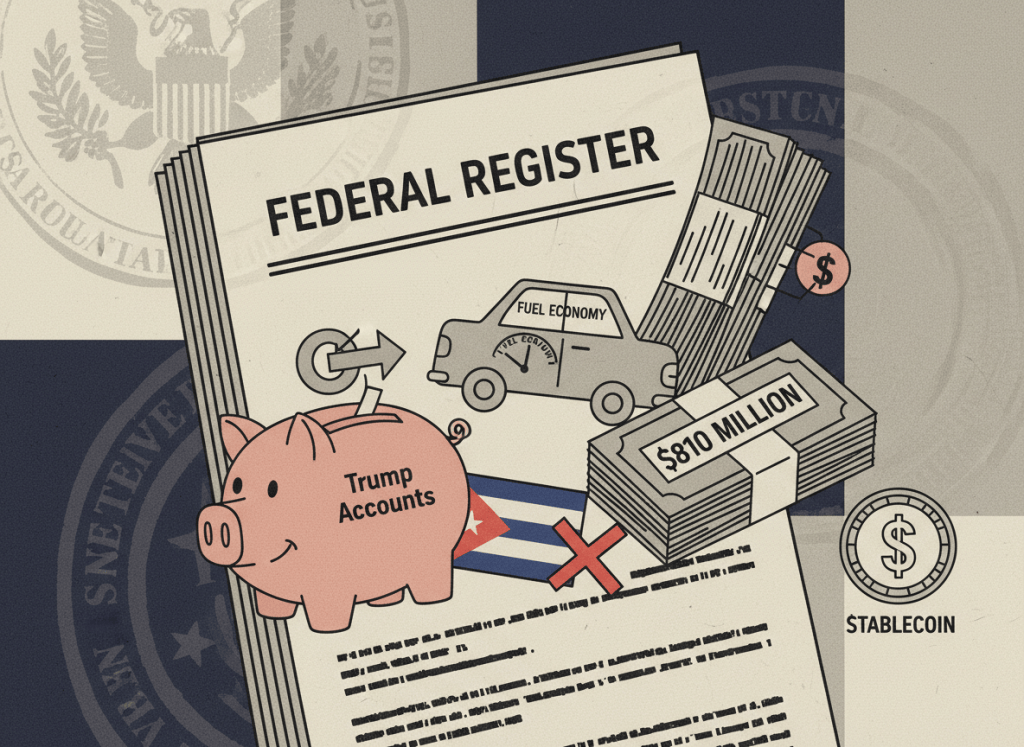
The Treasury Department and the IRS published temporary regulations today spelling out how Trump Accounts, the new tax-advantaged children’s savings accounts, will actually be established and funded, including a provision letting the Treasury Secretary open an account automatically for an eligible child even if no parent has done so first.
- Treasury Department / IRS — Trump Accounts temporary regulations lay out how the new accounts are established, including automatic enrollment of eligible children by the Treasury Secretary when a parent hasn’t opened one. That automatic-enrollment default is worth noting because it’s a different starting point than most federal benefit programs use, which typically require someone to apply; here the account can exist before a family has taken any action, raising practical questions about how parents will be notified and how they take control of an account opened on a child’s behalf.
- National Highway Traffic Safety Administration — NHTSA finalized the SAFE Vehicles Rule III, recalibrating Corporate Average Fuel Economy standards for model years 2022 through 2031 and revising how vehicles are classified for compliance purposes. The agency says the changes are needed “to ensure compliance with law,” language that signals this final rule is closing out a legal vulnerability in how the standards were set rather than simply updating them on schedule, and the classification changes matter because they can shift which fuel-economy target a given vehicle model is actually held to.
- Treasury Department, Office of Foreign Assets Control — OFAC tightened the Cuban Assets Control Regulations, eliminating the “U-turn” exception that let U.S. banks process certain Cuba-linked payments passing through the American financial system and ending authorization for group people-to-people and professional-meeting travel, carrying out a June 2025 presidential directive. The same day, OFAC also issued a brand-new Cuba Sanctions Regulations part implementing a separate May 2026 executive order, while noting that fuller definitions and general licenses are still to come; publishing the enforcement mechanism before the interpretive guidance that explains exactly what it covers is the kind of sequencing worth watching for how banks and travelers are expected to comply in the meantime.
- Office of Management and Budget — OMB published the formal notice of a presidential rescissions package sent to Congress on September 25, proposing to cancel $810 million in already-appropriated funds across the Commerce, Education, Health and Human Services, Homeland Security, Housing and Urban Development, and Justice departments, plus international assistance programs. Filing this notice starts a 45-day clock under the Impoundment Control Act during which Congress can approve the cuts or let the proposal lapse, but the administration can hold the money back while that clock runs, a mechanism that has drawn scrutiny in past rescissions fights over whether it lets the executive branch withhold spending Congress already approved.
- Treasury Department — Treasury issued an interim final rule setting the forms and procedures the new Stablecoin Certification Review Committee will use to decide whether a state’s stablecoin regulatory regime counts as “substantially similar” to the federal framework under the GENIUS Act, a call that determines whether state-chartered stablecoin issuers can operate under state rather than federal oversight. Issuing the procedures as an interim final rule means they take effect immediately without the advance public comment period ordinarily used to shape a new agency process, though Treasury says it will accept comments and may revise the rule later, worth watching given how much rides on the Committee’s decisions.
- U.S. Citizenship and Immigration Services — USCIS finalized new EB-5 immigrant investor fees and folded in provisions from the EB-5 Reform and Integrity Act of 2022 that Congress passed but USCIS is only now codifying into fee regulations. The rule follows a proposed version published back in October 2025, and that roughly year-long gap is a useful reminder of how long even routine fee rulemakings take to finalize, regardless of how long the underlying statute has already been law.
Editorial note: We screened all 118 documents published in the Federal Register on September 30, 2026, before selecting the items above. Excluded as routine: roughly two dozen agency information-collection notices submitted to OMB under the Paperwork Reduction Act; seven antidumping and countervailing-duty proceedings, sunset reviews, and court-decision notices; seven self-regulatory-organization (stock exchange) rule filings, including a batch of near-identical liquid-cooled-cabinet fee changes across four Nasdaq exchanges; sixteen NAGPRA repatriation and inventory-completion notices; a cluster of OFAC general-license republications spanning the Venezuela, Iran, and Russia sanctions programs; advisory-committee and closed-meeting notices; and three Presidential disaster-declaration amendments.

