The Slogan With an Asterisk
The FDIC’s marketing has one genuinely remarkable claim behind it: since the agency opened its doors in 1934, no depositor has ever lost a penny of insured deposits. It is the rare piece of government messaging that happens to be true. It is also, on its own, a slightly misleading way to describe what actually happened in March 2023, when the failure of three regional banks forced federal regulators to quietly abandon the very insurance limit the FDIC exists to enforce.
Of the entities covered so far in this series, the FDIC comes closest to the textbook version of a government corporation Congress imagined when it wrote the 1945 Government Corporation Control Act: funded entirely by risk based premiums on the industry it regulates, receiving no annual appropriations, and repaying its initial seed capital rather than leaning on the kind of soft, interest free financing that let TVA and the RFC balloon into open ended liabilities. That design held up for ninety years. Then three banks failed inside two weeks, and the difference between “the FDIC works” and “the FDIC has discretion to decide who actually gets protected” became very hard to ignore.
The Cleanest Design in the Series, Almost
The FDIC was created by the Banking Act of 1933 after more than 9,000 banks failed between the 1929 crash and 1933, wiping out roughly 1.3 billion dollars in depositor losses, according to the FDIC’s own institutional history. Congress gave it an initial 289 million dollar loan from the Treasury to get started, a debt the agency subsequently repaid in full. Since then, the FDIC has funded its operations entirely through insurance premiums charged to member banks and earnings on its Treasury securities holdings, a structure the Federal Reserve Bank of Minneapolis has noted receives no congressional appropriations at all, which puts the FDIC closer to actually behaving like the self-sustaining commercial entity every government corporation is nominally supposed to be.
That design worked exactly as intended for eight decades, through the savings and loan crisis and the 2008 financial crisis alike. Then, on March 10, 2023, Silicon Valley Bank failed, followed within days by Signature Bank and, weeks later, First Republic, together the second, third, and fourth worst bank failures in American history, according to reporting on the FDIC’s own inspector general findings. GAO later found that the Federal Reserve and FDIC had identified concerns about both SVB and Signature Bank as far back as 2018, but neither regulator escalated those concerns into formal enforcement action in time to force a fix before the banks collapsed. The FDIC itself estimated the failures would cost the Deposit Insurance Fund roughly 18.7 billion dollars, the bulk of it tied not to ordinary insured deposits but to the decision to protect deposits above the standard 250,000 dollar insurance limit entirely.
The Limit That Got Overridden Anyway
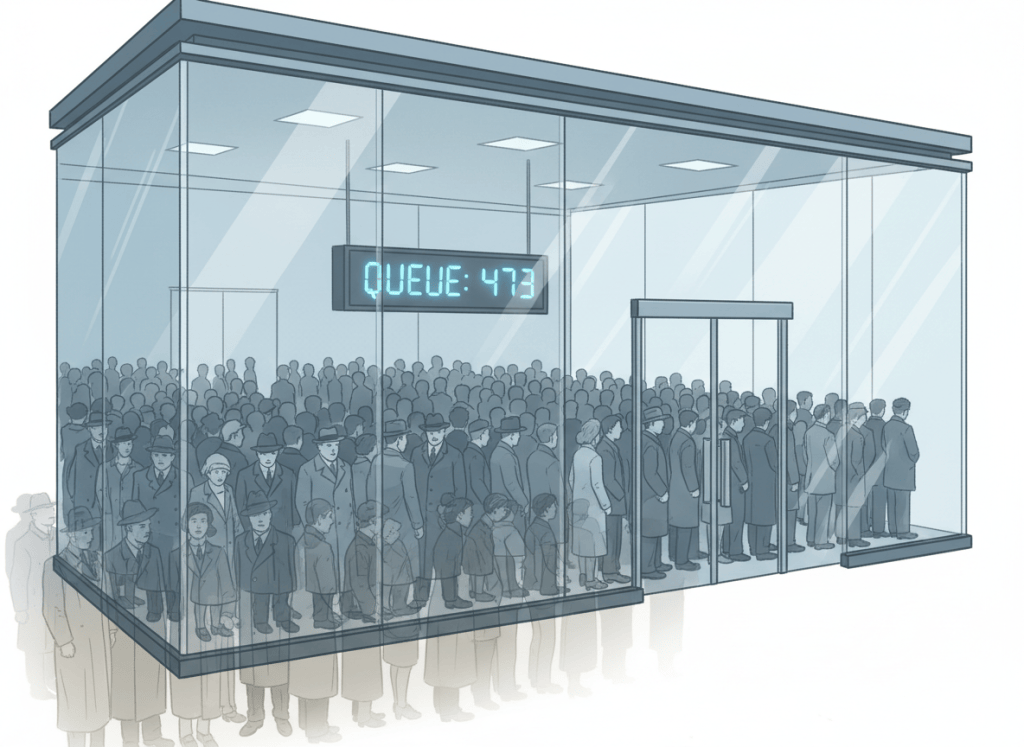
That decision is the part worth sitting with. Federal law lets Treasury invoke a systemic risk exception, on the joint recommendation of the FDIC and the Federal Reserve, to cover deposits beyond the statutory cap when a bank failure threatens the wider financial system. GAO reviewed the invocation for SVB and Signature Bank and concluded the decision likely helped prevent broader instability, noting that deposit outflows from smaller banks slowed within a week of the emergency action. In other words, the mechanism worked. But the mechanism only exists because the ordinary insurance limit, the thing depositors are told to rely on and the thing the premium structure is actually priced around, turned out not to be sufficient the moment a bank run could happen at the speed of a group chat rather than a physical line outside a branch.
The FDIC’s own inspector general did not let the agency off easy afterward. A review released in December 2024 found the FDIC’s readiness to resolve large regional bank failures was, in the OIG’s words, not sufficiently mature to facilitate a consistently efficient crisis response, citing gaps in staffing, technology, and coordination across divisions. The OIG issued eleven recommendations, and the same reporting noted GAO’s own parallel review found FDIC lacked even a centralized system for tracking supervisory recommendations across its own examiners, meaning emerging risks at supervised banks could fall through cracks nobody was specifically watching for.
Deregulating the Morning After
Here is where the story takes a turn that fits uncomfortably well with the rest of this series. Rather than responding to that OIG report with a tightening of supervisory practice, the FDIC’s new leadership moved in the opposite direction. Travis Hill, installed as acting chairman on January 20, 2025, moved quickly to reshape the agency’s regulatory posture. Within weeks, he rescinded the FDIC’s 2024 Statement of Policy on Bank Merger Transactions and withdrew four other pending regulatory proposals, part of what one law firm’s analysis described as a wholesale regulatory purge. The stated goal was making merger review faster and more predictable for the banking industry. The practical effect was that the same agency whose own watchdog had just flagged coordination and readiness failures in the run up to 2023 spent its next chapter loosening the review process for the kind of consolidation that produces exactly the large, complex institutions whose failures are hardest to manage. Hill, confirmed by the Senate as the agency’s 23rd chairman in December 2025 and sworn in the following January, had by then already set the agency’s direction.
This is not corruption or mismanagement in the way the RFC’s cronyism was, and it is not the multi-decade debt spiral TVA has been running twice now. It is something quieter: a genuinely well designed, self-funded government corporation discovering that even its cleanest structural feature, premium funded insurance with a hard dollar cap, still depends on a discretionary political judgment call about who gets bailed out beyond that cap when the alternative looks worse. The FDIC did not need a conservatorship. It needed an emergency exception to its own rules within days of a crisis starting, which is a smaller version of the same problem.
Why It Matters
Every entity in this series so far has hit the same wall from a different direction. The RFC discovered that market discretion without oversight curdles into cronyism. Fannie and Freddie discovered that dodging the 1945 Act’s accountability regime just moves the risk somewhere less visible until it detonates. TVA discovered that a debt ceiling only constrains behavior for as long as Congress declines to raise it, which turns out to be not very long at all. The FDIC, built about as well as a government corporation can be built, discovered that the line between “self-funded insurance program” and “implicit federal guarantee” gets redrawn the moment enough money is at stake, and that the agency meant to price and contain that risk can still be caught flat footed by how fast it moves in an era of instant digital withdrawals.
None of this means deposit insurance is a bad idea, any more than TVA’s debt history means public power is a bad idea. It means the closest thing this series has found to a genuine success story still needed an emergency override within its first real stress test in fifteen years, and that the policy response since has been to loosen the very oversight machinery that watchdog after watchdog just said was not ready. Whichever government corporation this series covers next, that is the question worth asking of it: not whether the design looks sound on paper, but what happens the first week the design gets tested for real.
Next in the series: Amtrak, the only government corporation here whose founding fiction was written into the planning documents on day one — by the same planners who privately doubted it.

