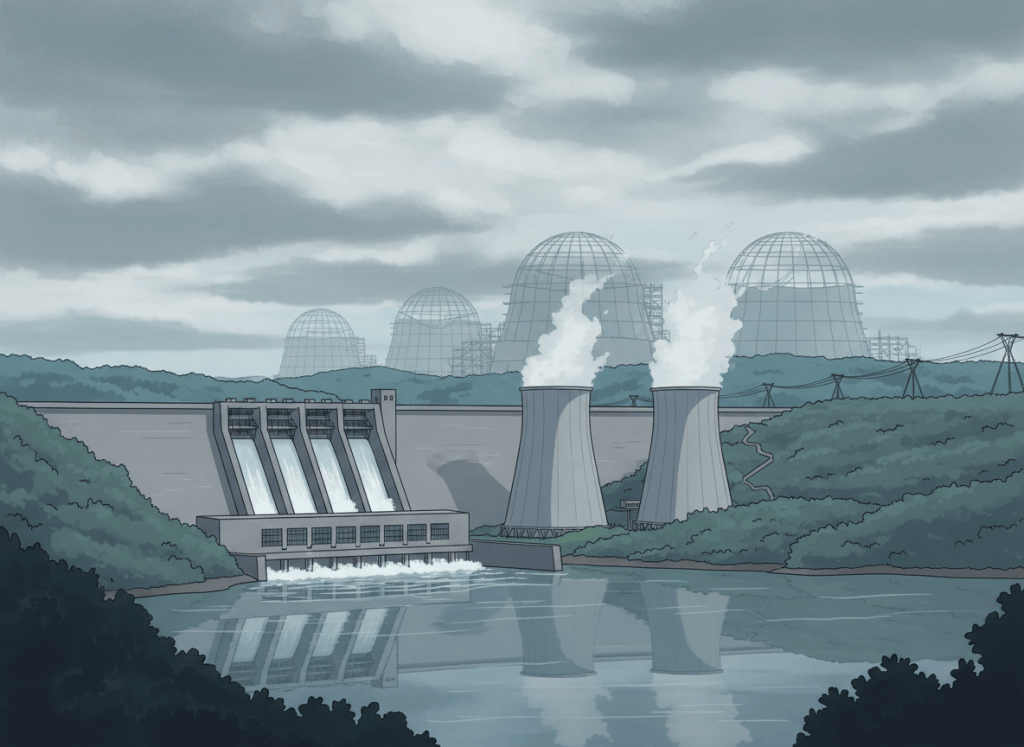
The Success Story With an Asterisk
Two articles into this series (introduced in Meet the Fourth Branch)—one on the RFC and one on Fannie Mae and Freddie Mac—both anchored on entities that blew up spectacularly, it seemed only fair to promise readers one that actually worked.
The Tennessee Valley Authority was supposed to be that entity: a New Deal creation from May 18, 1933, still delivering power to more than nine million people across seven states, still self-financing off electricity sales rather than congressional appropriations, still standing while the Reconstruction Finance Corporation and the RFC’s mortgage-guaranteeing offspring both required federal intervention to survive their own ambitions.
Here is the asterisk. TVA’s own regulator has spent the better part of four decades documenting a debt history that looks less like a success story and more like a rehearsal for one, and TVA is currently in the middle of placing the exact same kind of bet that got it into trouble the first time, on the exact same patch of land.
Forty Times the Original Debt Ceiling
TVA’s early financing was almost absurdly generous by modern standards. Congress appropriated roughly a billion dollars to the agency between 1933 and 1959, charged no interest on any of it, and ultimately treated more than a fifth of that money, 258.3 million dollars, as a straightforward taxpayer equity contribution that was never expected to be repaid at all, according to a Heritage Foundation institutional history of the agency. In 1959, Congress restructured TVA to finance itself through power revenues and its own bond issuance rather than direct appropriations, and set a statutory debt ceiling to keep the new arrangement disciplined.
That ceiling did not hold the line for long. By 1979 Congress had raised it to 30 billion dollars, forty times the amount originally authorized twenty years earlier, driven almost entirely by TVA’s nuclear construction program. TVA started seventeen nuclear generating units during the 1960s and 1970s and completed only seven of them, according to GAO’s own account of the agency’s finances, a failure rate that turned billions of dollars of half built reactors into pure liability with no offsetting electricity to sell. By 1995, GAO reported that TVA carried 26 billion dollars in debt, with 14 billion dollars of that sunk into nonproducing nuclear assets that were not even included in the rates TVA charged customers, and warned in plain language that if TVA could not compete effectively as electricity markets opened up, the federal government might end up covering TVA’s debt itself.
The debt problem eventually stabilized. The pension problem did not. By fiscal year 2016, GAO found TVA’s pension plan was only 54 percent funded, with unfunded liabilities that had grown steadily for a decade, and TVA had not even been reporting the shortfall in its own required performance plans. It got worse before it got better: TVA’s own numbers, reported by the Chattanooga Times Free Press, showed the plan falling to roughly 60 percent funded in 2019 and the underfunding widening to 5.6 billion dollars in 2020, driven largely by falling interest rate assumptions rather than any single management failure. Since then the pension picture has improved materially: according to the White House FY2026 Budget Appendix, as of September 30, 2024, the TVA Retirement System reported an estimated seventy-nine percent funding ratio and an unfunded liability of roughly 2.3 billion dollars—better than a decade ago, though still a meaningful gap on TVA’s balance sheet.
Same River, New Reactor
Here is where the story loops back on itself in a way that would be hard to invent. One of the reactors TVA never finished during its 1970s nuclear buildout was the Clinch River Breeder Reactor, a federally funded prototype fast breeder sited on TVA owned land near Oak Ridge, Tennessee, with TVA slated to buy its output. Congress killed the project in October 1983 after roughly 1.7 billion dollars had already been spent, amid years of cost estimates that kept sliding further out of reach no matter when anyone checked them.
In May 2025, TVA became the first utility in the country to submit a construction permit application to the Nuclear Regulatory Commission for a new small modular reactor, specifically the BWRX-300, a boiling water small modular reactor design developed by GE Vernova and Hitachi.
The site TVA chose is Clinch River, the same 1,200 acre property where the federal government’s last big nuclear swing already failed once. The Nuclear Regulatory Commission issued its Final Supplemental Environmental Impact Statement for the project on April 6, 2026, per the Federal Register notice, and its Final Safety Evaluation Report on June 25, 2026, finding no safety bars to issuing the construction permit, and has targeted a permit decision for the fall of 2026, meaning a yes or no could arrive shortly before or after this article appears.
The Department of Energy has since selected TVA for up to 800 million dollars in cost shared federal funding to advance the project, on top of a separate 400 million dollar DOE grant announced in December 2025; TVA’s board has also approved up to 350 million dollars to explore small modular reactor development at Clinch River, according to the White House FY2027 Budget Appendix. TVA has additionally signed on for a 6 gigawatt small modular reactor deployment program with a private developer, framed by the current administration as central to an American nuclear renaissance and an energy dominance agenda.
None of this is happening because nuclear has been quietly carrying TVA’s business. Local reporting in late 2025 found TVA’s nuclear generation had actually hit its lowest level since 2007 over the preceding year, even as the agency signed on for what would be the largest small modular reactor deployment commitment in the country.
The bet is being placed on projected future demand, principally from data centers and population growth, using the identical playbook of federally backed capital investment that produced a 26 billion dollar debt pile and a decade of underfunded pensions the last time TVA tried it.
For some background, the TVA’s total long-term debt stood at approximately twenty-three billion dollars as of June 30, 2026, according to its most recent quarterly filing with the Securities and Exchange Commission, down from the mid-1990s peak but still a substantial balance sheet obligation.
Betting the Rate Base Again
None of this means TVA is destined to repeat the Clinch River Breeder Reactor’s fate specifically. Small modular reactor technology is a genuinely different bet than a 1970s liquid metal fast breeder, and federal cost sharing this time is explicit up front rather than discovered after the fact.
But the structural pattern this series keeps returning to is exactly present here, where a government corporation with an implicit federal backstop and a statutory debt ceiling that Congress has shown a consistent willingness to raise whenever the number gets inconvenient, making a decades long capital commitment to a nuclear technology that has never been built at commercial scale in the United States, funded partly by federal grants that do not show up as taxpayer risk until something goes wrong.
TVA is not the RFC and it is not Fannie Mae. It has never needed a conservatorship or a liquidation act. But the entity billed in this series as the exception that proves government corporations can work has, on its own regulator’s paper trail, already run the exact experiment it is running again, on the same riverbank, with the same optimism about demand that never quite materialized the last time.
Whether TVA gets to keep its status as this series’ good example may depend less on nuclear physics than on whether Congress and TVA’s own management have actually learned anything from the debt ceiling they raised forty times to pay for the last round of reactors that never got built.
Sources: GAO, Shedding Light on Tennessee Valley Authority Debt (2017); GAO, Tennessee Valley Authority: Financial Problems Highlight Need for Long-Term Solutions (AIMD/RCED-95-134, 1995); NRC Final Supplemental Environmental Impact Statement, Clinch River SMR (Federal Register, April 6, 2026); DOE, TVA selected for up to $800 million SMR cost-sharing; TVA SEC quarterly filing (Q3 FY2026).
Next in the series: the FDIC, the other entity in the running for the series’ success story, and what the 2023 collapse of Silicon Valley Bank revealed about how much daylight there really is between “well run” and “the last one standing.”

