The Government Accountability Office has just handed Congress a report on veterans’ dental care, and the headline number is the kind of thing an agency press office loves. Eligibility for VA dental benefits jumped 70 percent from fiscal year 2020 to fiscal year 2025, climbing from about 1.38 million veterans to about 2.34 million. Read one press release off that stat and you’d think the VA had finally discovered flossing.
Read the actual report, GAO-26-108467, and the picture gets more interesting. The eligibility bump did not happen because the VA decided more veterans deserve dental care. It happened almost entirely because more veterans qualified for a 100 percent service-connected disability rating, largely a downstream effect of the 2022 PACT Act’s expanded presumptive conditions for burn pit and toxic exposure. The dental benefit didn’t get more generous. The population of catastrophically disabled veterans got bigger, and dental coverage rode along as a side effect.
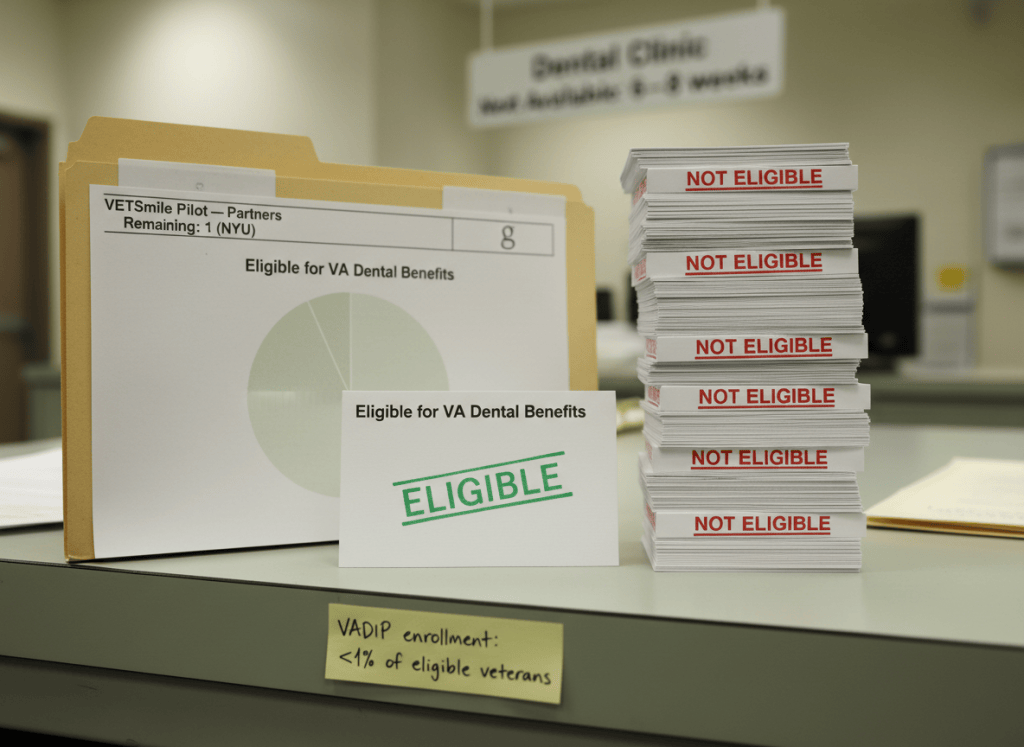
Which brings us to the number nobody is putting in a headline. Even after that 70 percent surge, only 25 percent of the roughly 9.2 million veterans enrolled in VHA care are eligible for VA dental benefits at all. Three out of four veterans who trust the VA with their medical care are, dentally speaking, on their own. This is not new information (VA’s own eligibility rules have looked like a Rube Goldberg machine since the 1970s), but it is worth restating plainly every time the agency announces a percentage increase off a denominator this small.
Eligible Is Not the Same as Treated
Even the veterans who clear the eligibility bar don’t necessarily get a cleaning. GAO found that the number of eligible veterans actually using their dental benefit did double from about 420,000 in 2020 to about 870,000 in 2025. Progress, technically. But the utilization rate, the share of eligible veterans who used the benefit in a given year, only moved from 30 percent to 36 percent. Two thirds of veterans who qualify for VA dental care are still not showing up in a VA dental chair in any given year.
Why. Lead dentists in all 18 Veterans Integrated Service Networks told GAO they do not have the staffing to meet current demand, full stop, before anyone talks about expanding eligibility to a single additional veteran. Facilities in at least two VISNs reported wait times exceeding 28 days for a dental appointment. Veterans service organizations told GAO the same thing they’ve been saying for years; the wait is the barrier, not the paperwork.
For veterans who don’t qualify for free care, the VA’s answer since 2014 has been the VA Dental Insurance Program, a discounted private insurance plan veterans pay for themselves through Delta Dental or MetLife. GAO’s numbers on VADIP are the quiet embarrassment buried in Appendix III. Enrollment ran from about 55,000 veterans in FY 2020 to about 67,000 in FY 2025, consistently under 1 percent of the veterans eligible to buy in. VA officials’ own explanation, delivered to GAO with a straight face, is that most veterans have never heard of the program. A benefit that requires a subscription almost nobody signs up for is not a benefit. It’s a line item.
The Pilot Program That Nearly Died of Loneliness
If you want the most honest data point in this entire report, skip the highlights page and go to Appendix IV, on the VETSmile pilot program. Launched in July 2021, VETSmile linked veterans who lacked dental eligibility to outside dental partners, mostly university dental schools, willing to provide free or reduced-cost care. Fourteen partners signed on at launch, seven dental schools and seven federally qualified health centers.
Within about a year, 13 of those 14 partners quit. Every single partner offering care at a reduced cost walked away. What was left, from September 2022 through July 2024, nearly two full years, was one dental school, NYU, treating veterans essentially alone on behalf of the entire national program. A second partner, the University of Nebraska, finally joined in July 2024. By the time the pilot wound down in June 2026, it had delivered about 101,000 procedures to roughly 4,700 veterans, worth an estimated $14.4 million in donated care.
That’s a genuinely good outcome for the 4,700 veterans who got treated. It is also proof that VHA ran a signature access program on the goodwill of one dental school for two years and called it a pilot rather than what it actually was, which was a single point of failure with a press-friendly name.
Congress Wants to Add Heart Disease to the List
The reason GAO wrote this report at all is the Elizabeth Dole 21st Century Veterans Healthcare and Benefits Improvement Act, which directed a 2026 pilot providing dental benefits to certain veterans with heart disease, on the theory (backed by the American Heart Association, among others) that oral health and cardiovascular health are linked. GAO modeled what full expansion would look like. Extending comprehensive dental eligibility to every veteran with a diagnosis of ischemic heart disease would add about 620,000 veterans to the eligible pool, a 25 percent increase from 2.45 million to roughly 3.07 million.
VHA officials and dental providers were blunt about what that would require (more dentists and hygienists in a profession already facing a projected nationwide staffing shortage, more clinic space, longer initial treatment plans for veterans who may not have seen a dentist in years, and closer coordination between dentistry and cardiology for an older, more medically complex population). One VHA facility already sends veterans out to community providers for root canals despite having an in-house specialist, simply because the in-house clinic can’t keep up. Expansion, in other words, would not fix the capacity problem this report documents. It would stress-test it.
Meanwhile, a separate and far more sweeping bill, the Dental Care for Veterans Act, has sat in the House Committee on Veterans’ Affairs since January 2025, proposing to scrap the entire eligibility classification system and treat dental care like every other VA medical benefit, where enrolled simply means covered. GAO’s report doesn’t mention that bill, because GAO was asked a narrower question about heart disease. But read against the backdrop of a VA system that can’t staff its current 25 percent eligible population, “everyone gets dental care” reads less like reform and more like a promise the agency has no plan to keep.
None of this makes the topline number in the highlights page false. Eligibility is up 70 percent, and that’s real. It’s just not the whole mouth.
Source: U.S. Government Accountability Office, GAO-26-108467, Veterans Health Care: Information on Eligibility for and Use of Dental Benefits (September 2026).

