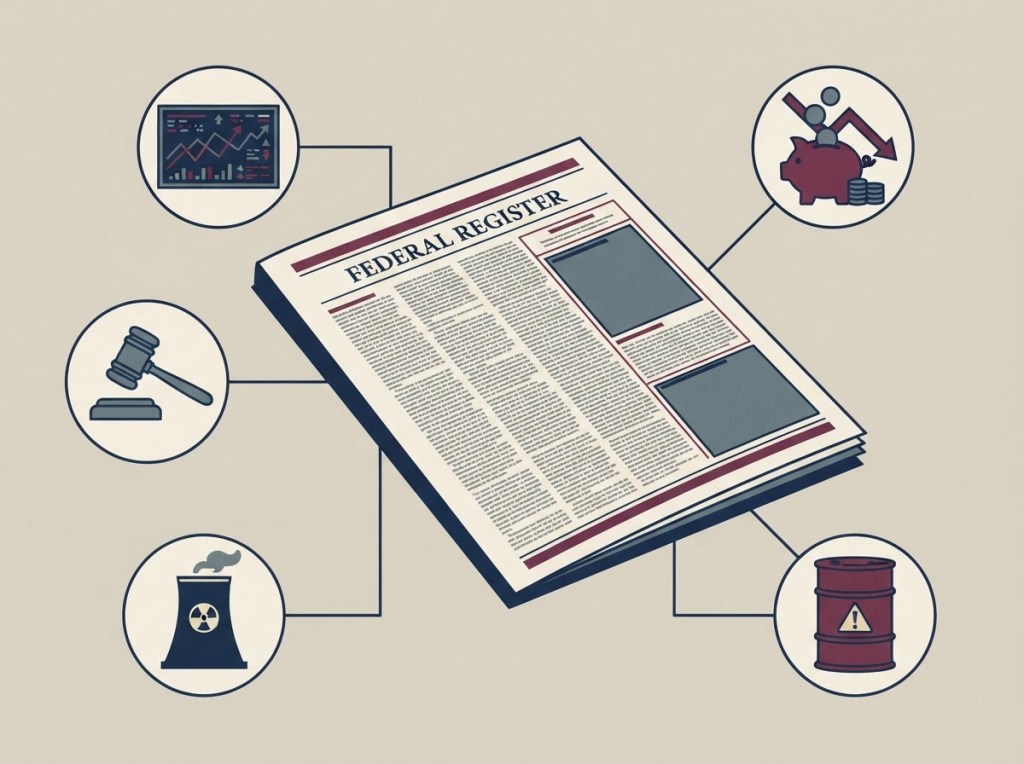
The Securities and Exchange Commission proposes rescinding the rule that let stock exchanges jointly govern Wall Street’s central trade-surveillance database, asking instead to run it directly. The Labor Department proposes narrowing ERISA’s duty of loyalty by eliminating the “tiebreaker” and participant-preference protections it adopted in 2022, while the Government Accountability Office finalizes new procedural rules for its own employee-appeals board that drop subpoena authority and the automatic start of discovery. Also in today’s issue: the Nuclear Regulatory Commission confirms safety exemptions at the Vogtle plant that it had already issued a week before this notice published, and EPA opens a request for information on “streamlining” hazardous-waste permitting.
The Consolidated Audit Trail is the database regulators use to reconstruct, trade by trade, what happened across the stock and options markets during a crash, a flash event, or a manipulation scheme. For more than a decade it has been built and run by the exchanges and FINRA themselves, operating under a joint plan the SEC approved but did not control. The Commission’s new proposal would rescind the rule authorizing that plan and take direct administration of the CAT instead, a shift from industry self-governance of the government’s core market-surveillance tool to a system the SEC runs itself.
- SEC proposes ending exchange-run governance of Wall Street’s trade-surveillance database. The Commission wants to rescind Rule 613, which since 2012 has required the stock exchanges and FINRA to jointly operate the CAT under a shared plan, and replace it with a new rule, 17a-26, that puts the SEC itself in direct charge of collecting that data. The agency says the current structure, built around one vote per exchange and no vote of its own on the committee that runs the system, has made disputes over cost and priorities hard to resolve, because the body that pays for the CAT has never fully controlled what it does. Comments are due January 25, 2027. (Federal Register)
- Labor Department moves to strip ERISA’s 2022 “tiebreaker” and participant-preference protections. The proposal frames itself as simply clarifying what the duty of loyalty “is and has always been,” but its text would delete the provision letting retirement-plan fiduciaries break a tie between equally sound investments by weighing a factor like environmental or social impact, and the separate provision assuring fiduciaries they could consider participants’ own stated preferences when building a plan’s investment menu. Presenting a substantive rollback as a restatement of existing law lets the Department skip the harder argument that a genuinely new policy would otherwise have to make for itself. Comments close January 25, 2027. (Federal Register)
- GAO finalizes new appeal rules for its own employees, dropping subpoena authority. The agency’s Personnel Appeals Board, which hears cases brought by GAO employees and job applicants rather than the wider federal workforce, is scrapping its subpoena procedures on the stated ground that it was never authorized to issue enforceable ones; an administrative judge can now only draw an “adverse inference” if an agency withholds a witness, a weaker tool than compelling testimony outright. The rule also ends the automatic start of discovery once an appeal is filed, leaving a judge to set the timing instead. The Board says the Administrative Procedure Act does not bind it, so it rejected commenters’ objections to both changes without having to meet the APA’s usual rulemaking standards. Effective December 24, 2026. (Federal Register)
- NRC publishes nuclear-safety exemptions at Vogtle that it had already issued a week earlier. The notice confirms exemptions, signed November 17, letting Southern Nuclear apply a newer ASME inspection code, Code Case N-921, to Vogtle Units 3 and 4 after the date that would normally have locked in the older standard. That code sets the schedule for examining a reactor’s critical components over its operating life, so the exemption gives two of the newest reactors built in the United States some flexibility in how that inspection calendar runs, a decision the public only saw written up after it was made. (Federal Register)
- EPA opens a request for information on “streamlining” hazardous-waste permitting. The notice ties the effort to an Administrator’s “Agency Priority Goal” and asks the public, through four virtual sessions and written comments due January 25, 2027, for ideas that would cut the time, cost, and uncertainty of RCRA permits, the permits that let hazardous-waste treatment, storage, and disposal facilities operate. EPA has not proposed specific changes yet, but because faster permitting usually means less opportunity for public and technical review before such a site is approved to operate or expand, the direction this RFI points matters more than its immediate legal effect. (Federal Register)
This edition is drawn from the 122 documents the Federal Register published on November 24, 2026. Beyond the five items above, we screened out and did not cover routine agency information-collection and Paperwork Reduction Act notices, SEC self-regulatory-organization rule-change filings, antidumping and countervailing-duty determinations, routine Sunshine Act and advisory-committee meeting notices, routine environmental-assessment and pipeline-blanket-authorization notices, airworthiness directives that did not describe a new safety issue, foreign-trade-zone subzone applications, and OFAC and State Department sanctions-list notices whose public abstracts did not name the designees.

