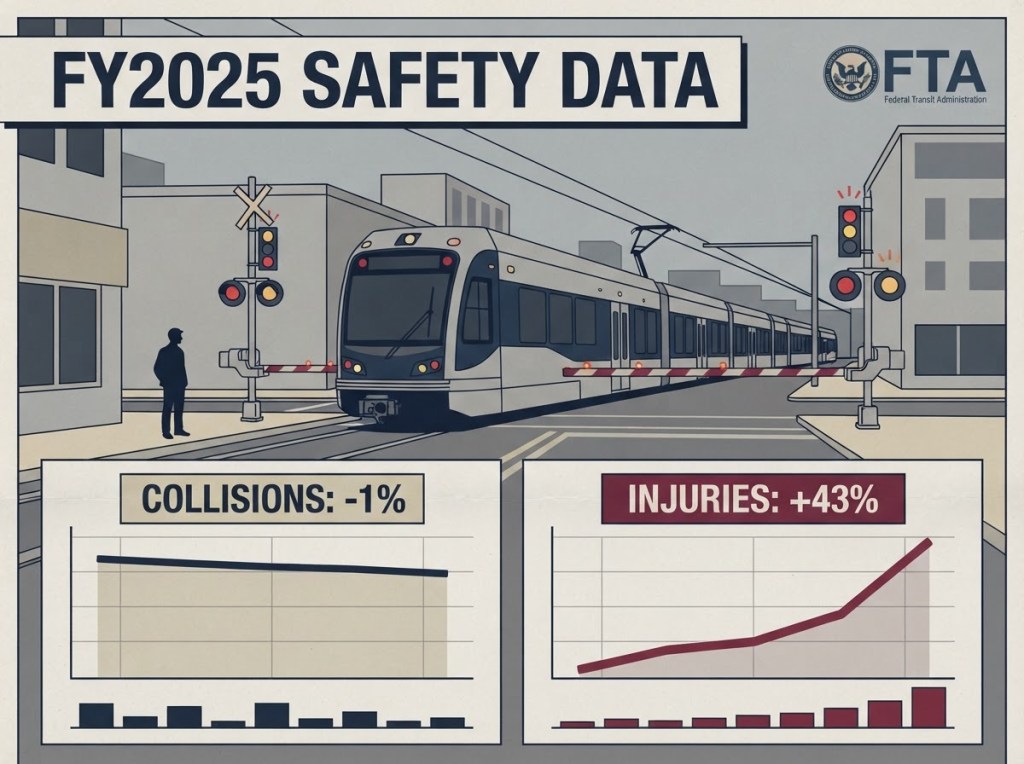
Rail transit collisions with people fell slightly in FY2025, but injuries surged 43% and fatalities rose 18%. Preliminary FY2026 data already matched all of FY2024 by the halfway point.
The number of collisions between rail transit vehicles and people declined slightly in fiscal year 2025, but the human consequences grew substantially, according to figures published by the Federal Transit Administration.
In its Fall 2026 Transit Safety Oversight Spotlight newsletter, the agency reported that rail-to-person collisions decreased by 1% compared with fiscal year 2024. Over the same period, fatalities increased 18% and injuries surged 43%.
The preliminary figures for fiscal year 2026 offer little reassurance. According to FTA, injuries recorded during the first half of the fiscal year had already equaled the total reported for all of fiscal year 2024 and were on pace to exceed fiscal year 2025.
The figures present a troubling safety question for an agency responsible for overseeing public transportation systems. If the number of collisions has remained relatively stable, why are the consequences becoming more severe? The newsletter identifies the trend but does not establish its underlying causes.
A Safety Problem That Has Not Disappeared
FTA also examined collisions between rail transit vehicles and privately owned vehicles. Those collisions increased 13% in fiscal year 2025 compared with fiscal year 2024, while injuries rose 17%. Fatalities remained unchanged at three in each year. Approximately 92% of these vehicle collisions occurred at rail grade crossings rather than intersections.
The agency highlights outreach initiatives, including Operation Lifesaver’s See Tracks? Think Train! campaign and a September 2026 webinar. Whether such efforts are producing measurable reductions in injuries and fatalities is a separate question.
Federal Officials Have Previously Identified the Danger
On November 25, 2024, FTA issued Safety Advisory 24-2 addressing street-running rail collisions. It recommended that state safety oversight agencies direct rail operators to assess risks and identify mitigations, with reporting on assessments and corrective measures due by May 27, 2025.
That intervention creates an accountability question: more than a year after the reporting deadline, what have federal officials learned about the effectiveness of those measures? The existence of an advisory does not prove its recommendations failed, nor do later injury increases prove that individual agencies neglected protections.
The newsletter reports percentage changes without providing the underlying annual collision, injury and fatality counts for its comparisons. Other FTA datasets may use narrower definitions, including street-running incidents, and cannot automatically be combined with the newsletter’s grade-crossing figures.
What the Numbers Do Not Explain
The newsletter does not identify which transit systems experienced the largest increases, whether certain crossing types were disproportionately affected, or whether reporting changes influenced the trends. Preliminary fiscal year 2026 figures may also be revised.
FTA emphasizes hazard identification, data collection and preventive measures. Associate Administrator Joe DeLorenzo points to infrastructure, maintenance, operations, technology and public awareness as ways to reduce risk. The unresolved question is whether those measures are sufficient and whether their effectiveness has been documented.
Oversight Requires More Than Awareness
The next test of federal oversight is whether FTA can demonstrate what changed after earlier warnings, which corrective measures were implemented and whether they reduced risk. For pedestrians and motorists, the distinction between identifying a hazard and mitigating it is more consequential than the number of awareness campaigns.
Source note: Federal Transit Administration, Transit Safety Oversight Spotlight, Fall 2026, Vol. 11, No. 4, page 3; FTA Safety Advisory 24-2 (November 25, 2024).

