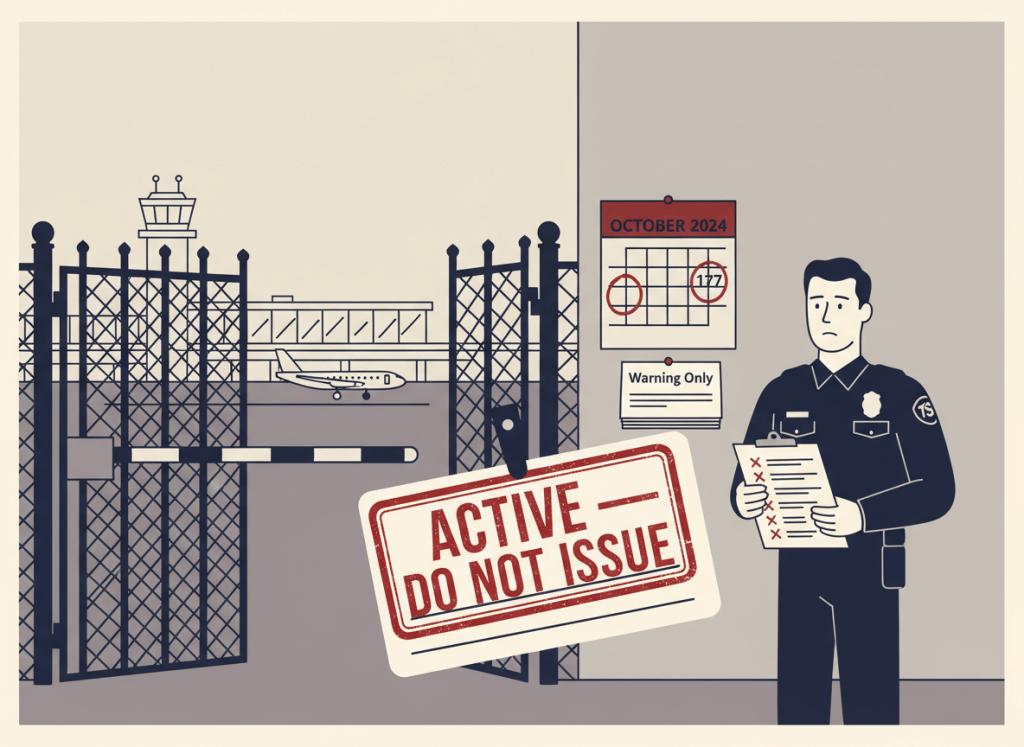
Federal auditors documented prematurely issued security badges, failures to revoke credentials, and airport violations that persisted for nearly three years. Key figures remain hidden behind government redactions.
The Transportation Security Administration failed to ensure that airport workers completed required security vetting before receiving credentials granting access to restricted airport areas, according to a November 4, 2026, Department of Homeland Security Office of Inspector General report. In one documented case, an airport worker retained an active badge for 177 days despite federal determinations that the worker’s eligibility had not been established.
The failures extended beyond premature badge issuance. Federal auditors found inaccurate applicant records, incomplete enrollment in continuing criminal-background monitoring, inconsistent inspections, and limited enforcement against airport operators that violated security requirements.
In some cases, airport-operator noncompliance continued for as long as 1,082 days.
The findings appear in DHS OIG Report OIG-27-03, Failures in TSA’s Vetting of Airport Workers Allowed Uncleared Individuals Access to Secure Areas, released in redacted form.
The report identifies serious weaknesses in a system intended to prevent insider threats at American airports. It also raises an uncomfortable question about federal oversight: What happens when the agency responsible for ensuring that airport security rules are followed fails to verify that violations have been corrected?
A Badge That Remained Active for 177 Days
One case illustrates the consequences of the oversight failures.
An airport operator issued a worker a security badge on November 27, 2023, before TSA completed its security threat assessment. On December 13, TSA conveyed a “Do Not Issue” notice, indicating that the credential should not have been issued.
The airport operator did not revoke the badge.
On February 9, 2024, TSA issued a preliminary determination of ineligibility because it could not verify the worker’s eligibility to work in the United States. The worker, who was born in Costa Rica, submitted additional documentation through the agency’s review process.
TSA rejected that documentation on March 13 because it was insufficient to establish employment eligibility.
Nevertheless, the airport operator did not revoke the badge until May 24, 2024.
The worker had held an active credential for 177 days, including more than five months after TSA’s initial “Do Not Issue” notice.
The report does not establish that the individual committed a crime or posed a confirmed terrorism threat. The documented failure concerns the issuance and continued validity of a restricted-access credential despite unresolved eligibility requirements and federal instructions.
That distinction matters. So does the fact that the badge remained active.
Violations Continued for Nearly Three Years
The inspector general found that TSA’s enforcement and inspection practices were insufficient to ensure that airport operators complied with security requirements.
Auditors examined 4,658 airport inspection records covering fiscal years 2021 through 2024. They determined that TSA did not consistently conduct required supplemental inspections after identifying instances of premature badge issuance.
Without those inspections, the agency lacked an effective mechanism to verify that airport operators had corrected violations, documented their resolution, or revoked improperly issued credentials.
The resulting noncompliance continued for as long as 1,082 days.
TSA also failed to impose substantial penalties in the cases auditors examined.
The report identifies seven enforcement actions against six airport operators. Those actions consisted of counseling one operator, requesting two corrective-action plans from two others, and issuing four warning notices to three additional operators.
In 19 instances involving 14 airport operators, TSA imposed no penalties. Auditors could not determine whether enforcement action occurred in one remaining case.
No airport operator received a fine, security-program revocation, or suspension of operations for the premature badge issuance examined in the audit.
TSA maintains a progressive enforcement framework that permits increasingly serious sanctions depending on the circumstances and severity of violations. The inspector general’s findings suggest that the existence of that framework did not ensure meaningful accountability when airport operators failed to follow credentialing requirements.
Security Checks Built on Inaccurate Information
The inspector general also identified weaknesses in the information TSA relied upon to evaluate airport workers.
Auditors compared 457 applicant records from five airports against information maintained in TSA’s Consolidated Screening Gateway, a system used to conduct transportation-worker security threat assessments.
They found discrepancies involving applicant information and credentialing records, including cases in which the access level requested by an airport operator differed from the access level recorded in TSA’s system.
In one example, an airport operator’s records indicated that an employee required access to a Security Identification Display Area, or SIDA, while TSA’s system recorded the worker as requiring access only to a public area.
Such differences can affect the level of scrutiny applied to an applicant.
The inspector general warned that inaccurate or incomplete information creates a risk that TSA could conduct a security threat assessment on the wrong individual or fail to identify adverse information associated with the actual applicant.
The audit also examined records for 2,019,667 workers granted unescorted SIDA access between October 2018 and February 2025. Auditors found applicants with missing or incomplete Social Security numbers, despite statutory requirements intended to strengthen security vetting.
The publicly released report redacts the number of affected workers.
TSA attributed data discrepancies partly to errors by airport operators and contractors entering or transmitting applicant information, as well as information-technology issues.
The agency acknowledged that data-quality improvements were necessary and plans to implement additional verification and validation controls through its modernized Vetting Credentialing System.
Continuous Criminal Monitoring Was Not Consistently Verified
A separate weakness involved the FBI’s Rap Back Program, which provides participating airport operators with notifications when new criminal-history information becomes available about enrolled workers.
Unlike a one-time background check, Rap Back supports continuing monitoring after a worker receives access credentials.
TSA policy requires applicable airport workers with unescorted access to sensitive areas to be enrolled in the program.
Of 457 workers selected for detailed review, 451 were subject to that enrollment requirement.
Auditors found that some required workers were not enrolled. They also could not determine the enrollment status of another 51 workers, approximately 11 percent of the required-enrollment sample, because the workers had been terminated and the relevant enrollment information was no longer available in airport operators’ systems.
The exact number confirmed not enrolled is redacted.
The inspector general concluded that TSA’s existing oversight process was insufficient to identify workers who had not been enrolled in required recurrent criminal vetting.
That finding does not establish that the affected workers had disqualifying criminal histories. It establishes that the required mechanism for identifying subsequent criminal-history developments was not consistently in place or verifiable.
What the Public Cannot See
Although the inspector general released a 30-page report, extensive redactions obscure several figures central to understanding the scale of the failures.
The withheld information includes the number of applicant records containing discrepancies, the number of workers with missing or incomplete Social Security numbers, the number of prematurely issued badges associated with subsequent “Do Not Issue” notices, and the number of workers not enrolled in Rap Back.
Detailed tables describing badge issuance, revocations, and enforcement outcomes are also heavily redacted.
The report is marked as containing Sensitive Security Information, a category of transportation-security information subject to federal disclosure restrictions.
Protecting genuinely sensitive operational information is a legitimate government responsibility. But the withheld aggregate figures also limit the public’s ability to evaluate the extent of the problems documented by federal auditors.
The visible findings establish that the deficiencies existed. The redactions make it harder to determine how widespread they were.
The audit examined activity spanning October 2018 through March 2025 and included visits to eight airports in seven metropolitan areas. Its detailed 457-record comparison used a judgmental sample rather than a statistically representative nationwide sample.
Consequently, the findings should not be extrapolated into a national failure rate.
TSA Promises Corrective Action, Some Not Until 2027
TSA concurred with all four inspector general recommendations.
The agency committed to strengthening applicant data-quality controls, improving verification of badge revocations, requiring more consistent inspection documentation and enforcement, and periodically confirming that covered workers are enrolled in FBI Rap Back monitoring.
Two recommendations concerning enforcement documentation and Rap Back oversight have estimated completion dates of December 31, 2026.
The remaining two, involving applicant data accuracy and verification of airport-operator compliance with “Do Not Issue” notices, are not scheduled for completion until September 30, 2027.
In its October 6 management response, TSA described ongoing modernization efforts and said it was developing systems to record when “Do Not Issue” notices are conveyed, track required deadlines, and document whether airport operators take the necessary action.
The agency also described interim reporting procedures intended to monitor compliance before those enhancements are completed.
The inspector general classified all four recommendations as open and resolved. That means TSA’s proposed actions were accepted as responsive, but their implementation had not yet been verified.
The distinction leaves an important question unanswered: How effectively are existing controls protecting restricted airport areas while the agency works toward its future deadlines?
The Accountability Question
Airport security depends on more than identifying potential threats. It also depends on accurate records, reliable communication between federal authorities and airport operators, and enforcement when established requirements are ignored.
The inspector general’s findings document failures at each of those points.
Workers received credentials before required assessments were completed. Some credentials remained active after TSA instructed airport operators not to issue them. Inspectors did not consistently verify corrective action. Required criminal-background monitoring was not reliably confirmed.
And in numerous documented instances, airport operators faced no penalties.
The report does not demonstrate that these failures resulted in a terrorist attack, sabotage, or another security incident. It demonstrates that safeguards designed to prevent such risks were not consistently enforced.
For an agency entrusted with protecting the nation’s aviation system, that is a substantial accountability finding in its own right.
TSA has agreed to address the deficiencies. Whether its corrective measures produce measurable improvements, and whether the public will be permitted to evaluate those improvements, remains to be seen.
Source: U.S. Department of Homeland Security Office of Inspector General, Report OIG-27-03, November 4, 2026. This article is based on the publicly released, redacted report. Figures obscured in the official release have not been estimated or reconstructed.

