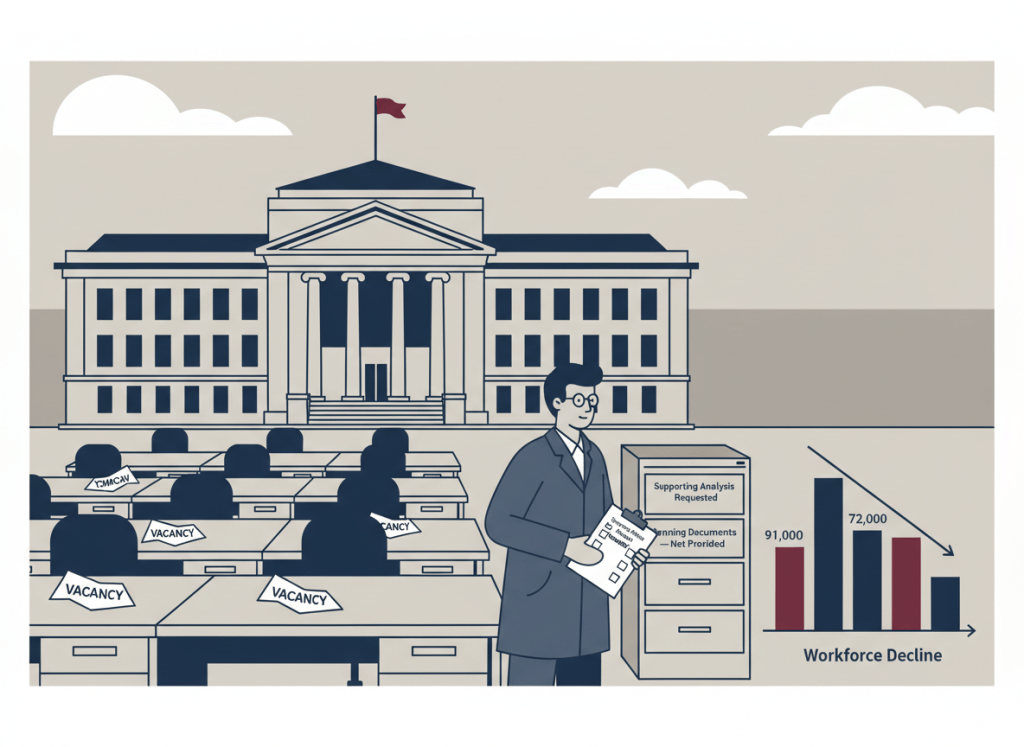
Federal auditors repeatedly sought documentation supporting the Agriculture Department’s sweeping restructuring decisions. USDA defended the changes but never produced the requested analysis.
The U.S. Department of Agriculture lost more than 18,000 employees between December 2024 and March 2026, even as federal auditors struggled to determine whether the department had adequately analyzed the consequences of its sweeping reorganization.
A November 5, 2026, Government Accountability Office report found that USDA failed to provide documentation demonstrating how it evaluated the specific decisions announced in its July 2025 reorganization plan, despite repeated requests spanning several months.
The problem was not simply that auditors disagreed with the department’s management decisions. They could not determine what analysis, if any, supported those decisions.
USDA defended the reorganization as an effort to reduce bureaucracy, improve services, consolidate operations, and bring federal resources closer to the agricultural communities they serve. GAO did not dispute the department’s authority to pursue those objectives or conclude that the reorganization itself was unwarranted.
Instead, the watchdog identified a more fundamental accountability problem. Congress and the public lack sufficient information to evaluate whether USDA examined the potential costs, operational consequences, and risks before committing to substantial organizational changes.
For a department responsible for agricultural research, food safety, nutrition assistance, rural development, and natural resource management, the unanswered questions extend considerably beyond the location of federal office buildings.
A Department Shrinks by One-Fifth
According to GAO’s analysis of Office of Personnel Management data, USDA employed 91,047 federal workers in December 2024. By March 2026, that figure had fallen to 72,671.
The decline of 18,376 employees represented a 20.2 percent reduction in the department’s workforce.
Between January 2025 and March 2026, USDA recorded 25,448 employee separations and 7,197 hires. Approximately 52 percent of the separations occurred through the federal Deferred Resignation Program.
The reductions were unevenly distributed across the department.
The National Institute of Food and Agriculture experienced the largest percentage decline among individual agencies, losing 41.4 percent of its workforce. Rural Development declined by 38.1 percent, the National Agricultural Statistics Service by 37 percent, and the Food and Nutrition Administration by 35.9 percent.
The Agricultural Research Service lost 32 percent of its workforce, while the Economic Research Service declined by 32.9 percent.
Even the Forest Service, which experienced a comparatively smaller percentage reduction, declined from 31,665 employees to 27,909.
These figures represent substantial reductions in federal staffing capacity, although GAO did not establish that every departure resulted directly from USDA’s reorganization. The department was simultaneously implementing broader workforce-reduction initiatives in response to presidential directives.
The report also does not establish that staffing reductions have caused specific failures in food safety, agricultural assistance, or research programs. Those consequences require separate examination.
Nevertheless, the scale of the reductions makes the department’s underlying workforce planning an important subject for congressional oversight.
Five Requests, No Supporting Analysis
On July 24, 2025, USDA announced a reorganization built around four principal objectives: aligning workforce size with available resources, relocating personnel outside the National Capital Region, eliminating management layers, and consolidating administrative functions.
The announcement included plans to relocate at least 2,600 of approximately 4,600 headquarters and National Capital Region employees to regional hubs and other locations.
It also identified facilities to retain or vacate, agency-specific office eliminations, regional consolidations, and administrative functions targeted for restructuring.
GAO subsequently sought documentation showing how USDA had evaluated those decisions.
Auditors requested relevant analyses and planning materials in September and December 2025, followed by January, March, and April 2026.
USDA did not produce documentation demonstrating the analysis underlying the specific decisions announced in July 2025.
The department supplied limited materials, including raw building-attendance information and an August 2024 report concerning financial challenges at the Forest Service. GAO determined that those materials did not establish how the department evaluated its specific reorganization decisions.
The distinction matters.
A building may be underutilized. An agency may face financial pressures. A department may have legitimate reasons to reduce administrative overhead.
But identifying those conditions is not equivalent to documenting why particular offices should close, which positions should relocate, how alternatives were compared, or whether projected savings outweigh implementation costs.
Without that information, Congress cannot independently assess whether the department’s chosen approach was supported by a sufficiently developed analysis.
GAO also described efforts to obtain additional Forest Service planning documents. In April 2026, a Forest Service official indicated that relevant materials were being reviewed by USDA’s Office of General Counsel before release.
Despite subsequent requests in May and July, the documents were not provided.
The report does not establish whether USDA conducted no such analysis, whether relevant records exist but were withheld, or whether internal deliberations occurred without the documentation GAO requested.
It establishes that the department did not substantiate its decisions to federal auditors.
USDA Challenges the Watchdog
USDA strongly disputed the report’s characterization of its actions.
In written comments, the department described GAO’s review as partisan, politicized, and incomplete. USDA pointed to financial pressures affecting the Forest Service, increases in departmental staffing under the previous administration, and underutilized federal office space.
The department also characterized its July 2025 reorganization memorandum as a framework capable of adjustment as implementation progressed.
Those arguments provide important context for the administration’s objectives.
Reducing unnecessary office expenses and addressing inefficient organizational structures are legitimate management goals. GAO itself has previously identified underutilized federal property as a longstanding government-wide problem.
But the auditors maintained that USDA’s explanations did not answer their central question.
GAO said it had sought evidence of analysis supporting the department’s specific decisions, not merely descriptions of the problems USDA intended to address.
In responding to USDA’s objections, GAO emphasized that its review did not take a position on whether the department should reorganize.
The watchdog also examined additional court filings and materials provided by USDA but found that they did not establish the analytical basis for the July 2025 decisions.
The disagreement therefore concerns more than whether reorganization is desirable. It concerns the documentation necessary to evaluate the reasoning behind consequential government decisions.
Previous Relocations Offer a Warning
USDA has undertaken significant agency relocations before, and GAO’s report identifies potentially relevant lessons from those experiences.
In 2019, the department relocated the Economic Research Service and National Institute of Food and Agriculture from the Washington area to Kansas City, Missouri.
Both agencies lost more than half their employees following the relocations.
The departures were accompanied by substantial changes in workforce experience and temporary reductions in agency productivity.
At the Economic Research Service, the proportion of employees with at least two years of experience declined from 84 percent to 34 percent. At the National Institute of Food and Agriculture, the corresponding figure fell from 82 percent to 21 percent.
The Economic Research Service produced fewer research reports and journal articles, while the National Institute of Food and Agriculture experienced increased processing times for competitive and capacity grants.
GAO found that overall staffing and productivity had generally returned to previous levels approximately two years after the relocations, although changes in workforce composition were more persistent.
Those findings do not demonstrate that USDA’s current reorganization will produce identical consequences.
They do, however, establish that the department had relevant historical experience showing how relocations can disrupt institutional knowledge and agency operations.
Whether USDA incorporated those lessons into its latest reorganization decisions remains unclear from the documentation provided to GAO.
Court Intervention Adds Another Layer of Uncertainty
USDA’s reorganization has also encountered legal challenges.
According to GAO, a federal district court ordered much of the reorganization halted in October 2026 while litigation proceeded. USDA subsequently filed notice of appeal to the U.S. Court of Appeals for the Ninth Circuit.
The report describes the litigation through October 2026. It does not establish whether subsequent court action has modified the restrictions.
The legal proceedings and GAO’s findings address different questions.
The courts are considering challenges to implementation of the reorganization, while GAO examined workforce changes and the transparency of the department’s decision-making process.
Together, they illustrate the uncertainty surrounding a restructuring initiative that has already coincided with substantial changes in the department’s workforce.
The Missing Accountability Record
The most consequential finding in GAO’s report is not necessarily the number of employees who departed.
It is the absence of documentation demonstrating how USDA evaluated the specific organizational changes it announced.
The department has offered reasons for restructuring. It has identified financial pressures, administrative inefficiencies, and opportunities to reduce office expenses.
What GAO could not establish was whether those concerns were translated into documented assessments of alternatives, economic effects, workforce needs, service-delivery risks, and safeguards for federal property.
That leaves several important questions unresolved.
What savings did USDA project from relocating thousands of positions, and how were those estimates calculated? What costs did the department anticipate for relocation, recruitment, training, and temporary productivity losses? How did officials assess whether agencies could continue meeting their statutory responsibilities with substantially smaller workforces?
And what lessons, if any, did USDA apply from earlier relocations that resulted in significant employee departures and operational disruptions?
GAO’s findings do not prove that USDA made the wrong decisions. They demonstrate that the department did not provide auditors the information necessary to evaluate how those decisions were reached.
For Congress, that distinction is central to meaningful oversight.
Federal agencies can reorganize, reduce expenses, and pursue operational efficiencies. But when major decisions affect thousands of employees and programs serving communities across the country, the public has a legitimate interest in knowing what evidence informed those decisions.
In this case, the workforce reductions are documented. The department’s objectives are publicly stated.
The analysis connecting those objectives to its specific reorganization decisions remains unsubstantiated.
Source: U.S. Government Accountability Office, GAO-27-108734, Department of Agriculture: Little Transparency on Whether Key Issues Were Analyzed Before Reorganization Decision, November 5, 2026.

