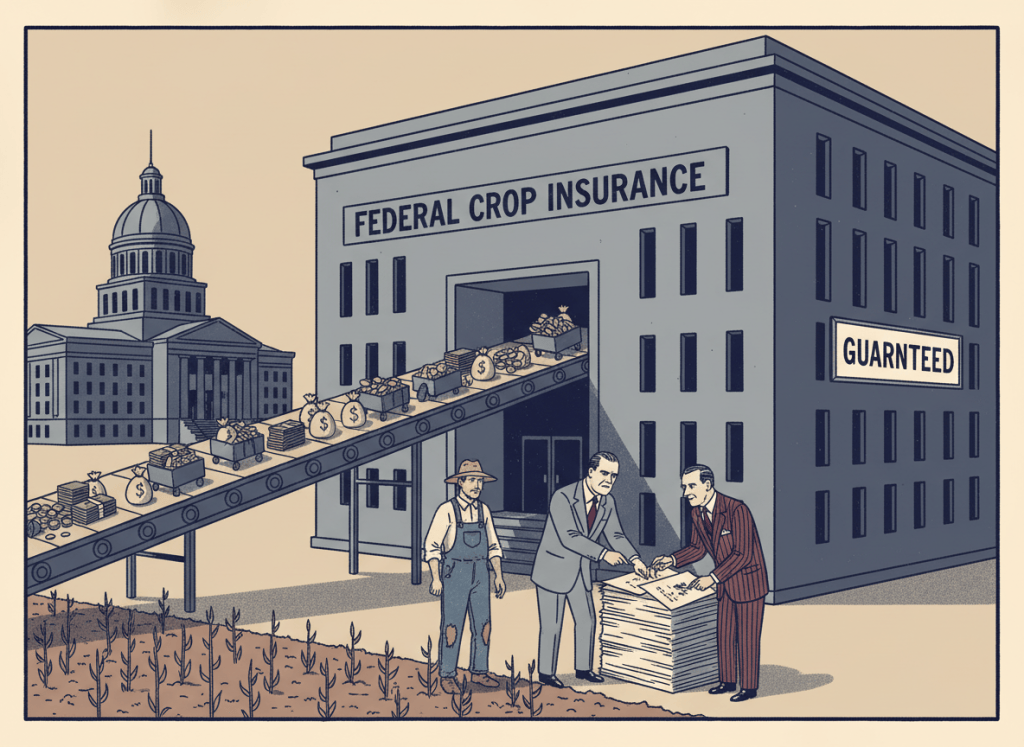
Eighty-Eight Years Without an Empty Pocket
The Federal Crop Insurance Corporation is a wholly owned government corporation, chartered on February 16, 1938. Its job is to insure American farmers against bad weather and bad prices.
On September 30, 2025, it held $7.2 billion in assets against $18.9 billion in liabilities. Its net position was negative $11.7 billion, according to its audited annual report.
KPMG gave those books a clean opinion with no material weaknesses. That is not a contradiction, because FCIC was never built to stand on its own.
Its insurance fund runs on a permanent indefinite appropriation, with “such sums as necessary” to carry out the program. The report says FCIC could ask the Commodity Credit Corporation for borrowing authority, but it did not. It simply draws what it needs from Treasury.
Earlier in this series, entities like the Postal Service and the Export-Import Bank had to pretend they could cover their own costs. FCIC does not even pretend. It is a corporation in name and a standing line of credit in practice.
Who Actually Sells the Insurance
The government sets premium rates, subsidizes premiums, and reinsures the policies. Twelve private companies sell and service them, and a 413-person agency in Washington and its regional offices oversees roughly 1.35 million policies and $198.9 billion in coverage.
The government also pays the companies twice. It reimburses their administrative costs, $2.3 billion for 2025, and it shares underwriting gains with them.
That administrative payment is a percentage of premiums, so it rises with crop prices even when the workload does not. GAO found that the 14 largest policies in 2022 each carried more than $1 million in administrative subsidies.
The industry says the payments do not cover its costs. GAO noted that company expense reports are not required to be audited, and that the companies spent more than 90 percent of the subsidies on agent commissions in 2020 and 2021.
GAO found that from 2011 through 2022 the companies earned an average return of 16.8 percent on the premiums they retained. A market-based return was 10.2 percent, and the 2011 agreement set a target of 14.5 percent, according to GAO-24-106086.
The companies posted underwriting gains in 11 of those 12 years. GAO estimated that moving to a market return could save about $720 million a year.
The 2025 numbers show how sturdy the arrangement is. FCIC’s report puts the companies’ estimated gain for reinsurance year 2025 at $2.97 billion, and the gain for 2024 at $1.88 billion, in a year when the program’s loss ratio was 0.94.
GAO also found that seven of the 13 companies in 2022 had foreign parents. Those seven took about 72 percent of the $3.7 billion paid to insurers that year.
Then there is the law that keeps it all in place. A provision in the 2014 farm bill requires that any renegotiated reinsurance deal cannot reduce the companies’ total expected gains. Any savings the government finds must go back to the companies as higher gains or higher administrative payments.
GAO has urged Congress to consider repealing that provision since 2017. Its 2023 report said no such legislation had passed.
Sixty Percent Off, No Questions About Income
Farmers paid $7.5 billion in premiums for crop year 2025. The government paid $11.25 billion on their behalf, about 60 percent of the total, according to FCIC’s report.
Congress sets those subsidy rates without regard to income. Other farm programs cut off participants whose adjusted gross income tops $900,000, but crop insurance does not.
GAO found that in 2022 about 1 percent of policyholders collected 22 percent of subsidy dollars, an average of $464,900 each. Nineteen policyholders received more than $3 million apiece, including a nursery that took in $7.7 million.
GAO’s own modest fix, a 15-point subsidy cut for high-income policyholders, would have saved about $15 million that year. That is a rounding error against $12 billion in premium subsidies.
The Congressional Research Service now puts subsidies near $15 billion for 2026, about 66 percent of premiums, with no per-farmer cap. Corn, soybeans, wheat, and cotton claimed 74 percent of subsidies from 2016 through 2025.
The 2025 reconciliation law raised several subsidy rates. CBO scored the changes at about $6 billion over a decade, according to a summary of the CRS report.
A Clean Opinion and a Rising Error Rate
The audit is not a disaster. It is a reminder of how little the clean opinion covers.
KPMG flagged one significant deficiency in information technology controls. FCIC did not effectively review user access, could not show that departed users lost access, and did not review security logs for certain financial applications.
FCIC’s improper payment rate rose to 3.29 percent in fiscal 2025 from 2.43 percent the year before. That is above both its 3.00 percent baseline and its 2026 target.
Its loss projections are shaky too. The agency admits the gap between actual and estimated loss ratios exceeded 10 points in seven of the last ten years.
The compliance office reported $29 million in premium and liability adjustments and $13.9 million in restitution. Those are real recoveries, set against a $198.9 billion book.
The board that governs the corporation includes USDA officials, four policyholders, a member from the insurance industry, and another with reinsurance expertise. Beneficiaries and vendors share the table with the regulators.
The Guarantee Is Written Into the Charter
Every entity in this series eventually runs into the implicit guarantee problem. FCIC is the version where nobody has to imply anything.
Congress wrote the backstop into the funding statute, and the only live questions are about distribution. Who captures the money passing through, how much, and for how long.
The farmers get a subsidy set by statute. The companies get a rate of return set by agreement and protected by a budget neutrality clause. The Treasury gets the bill. CBO expects the government to pay the companies $5.1 billion in 2026 alone, according to Cato’s summary of CBO estimates.
An insurer that cannot go broke is not really an insurer. It is a conduit with a charter.

