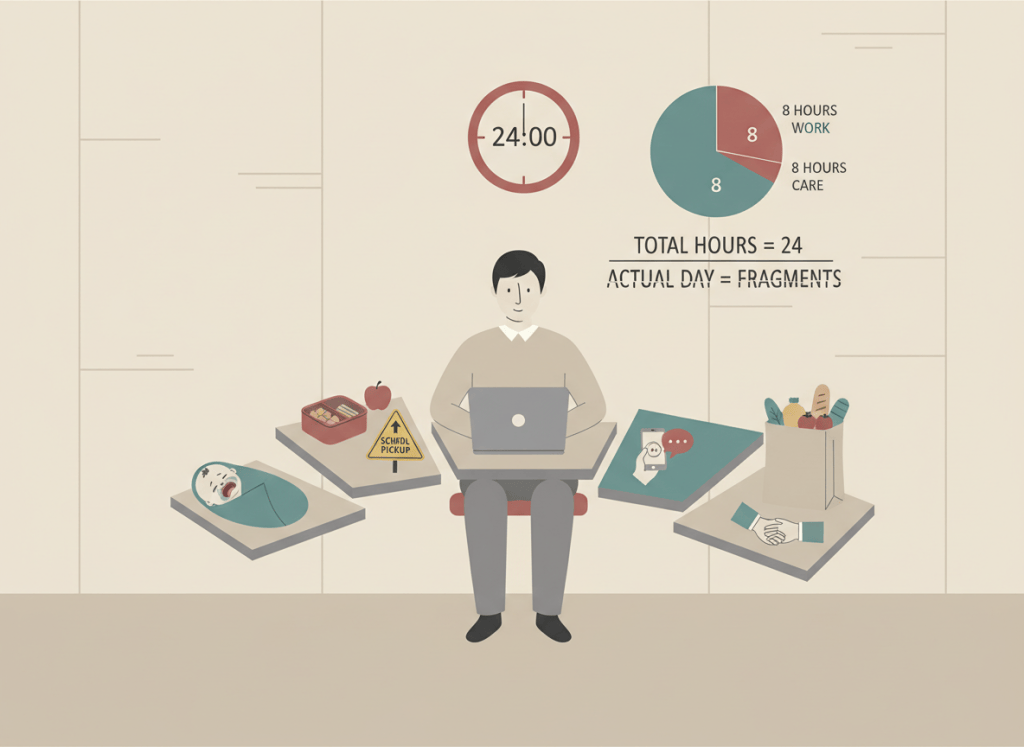
The Bureau of Labor Statistics has spent years telling Americans how many hours they work, clean, and care. A new article in its own flagship journal suggests the hours were never the interesting part.
In the October 2026 Monthly Labor Review, MinJee Keh and Yu-Ling Chang use American Time Use Survey data from 2018 through 2023 to study workers with caregiving responsibilities. The period spans the prepandemic baseline, the early pandemic, and the reopening that followed. (Read the article at BLS.)
They track three things. Total work-family burden is paid work plus caregiving. Fragmentation is the number of separate work and care episodes in a day. Multitasking is caregiving done while on the clock for paid work.
The Total Was Never the Problem
The conventional way to measure strain is to add up minutes. Hours of paid work, hours of care, one sum, one tidy number.
The authors’ emphasis points somewhere else. By their account, the structure of daily time use changed substantially across the period, and that is where the article finds its action.
Consider two hypothetical workers. One does two hours of care in a single block. The other does the same two hours in six interruptions scattered across a workday.
On a spreadsheet they are identical. In real life they are living different days, and only one of them is likely to describe the experience with words unsuitable for a federal journal.
A Day in Fragments
The sex differences the authors document are more pronounced in the structure of the day than in the raw totals. The racial and ethnic breakdowns, which the article also reports by sex, tell a similar story: the changes during and after the pandemic did not land evenly, and they did not land the same way for everyone.
The article’s tables, which break the figures out by group, are worth reading in full for anyone who wants the specific magnitudes.
Separate research points the same direction. A 2022 research note in Demography, also built on American Time Use Survey data, looked at the early pandemic. It found the gender gap in total parenting time narrowed by 18 percent.
Good news, until you read the rest. The gap in time spent on educational activities grew by 113 percent, and the time mothers spent pairing paid work with caregiving rose 346 percent relative to fathers.
The headline total improved while the hardest, most interruptive work stayed put. The two studies use different measures and different periods, so this is a parallel and not a confirmation. It is a revealing parallel all the same.
Your Job Title Will Not Save You
If the pressure on working caregivers were mostly a function of which job they hold, occupation is where it would show. It mostly does not.
The authors report that occupational differences were modest for both men and women over the period. Total burden varied little by occupation and held relatively steady, and in 2018, before the pandemic, multitasking did not differ meaningfully by occupation for either sex.
One inference, resting on those occupational findings: the strain appears to follow the caregiver, not the desk. If pay grade, profession, and workplace culture were doing the heavy lifting, the article would likely show larger occupational gaps than it does.
That matters for how policy gets framed. A problem attached to the person is not solved by a better office chair, a nicer break room, or a laminated poster about balance.
What the Averages Leave Out
The Bureau’s best-known time-use product is the annual American Time Use Survey news release. The 2023 edition reports the average time per day that people spent working, doing household activities, and on leisure, along with the share of people who did each.
It says, for instance, that 86 percent of women and 71 percent of men spent some time on household activities on an average day. It is useful, careful, and built entirely around averages.
Another inference, resting on how that release is constructed: an average minutes-per-activity table cannot show whether those minutes arrived in one block or in a dozen interruptions. The new article says the interruptions are where the story is. The flagship release, as described above, is not built to show them.
Bureaucracy Times is directing questions to the Bureau of Labor Statistics. Three examples of what remains unanswered:
- Why does the analysis end in 2023?
- Will BLS publish fragmentation and multitasking measures alongside its routine averages?
- How did pandemic-era disruptions to survey collection shape the early-pandemic estimates?
The hours are in the book. The day, for now, is not.

