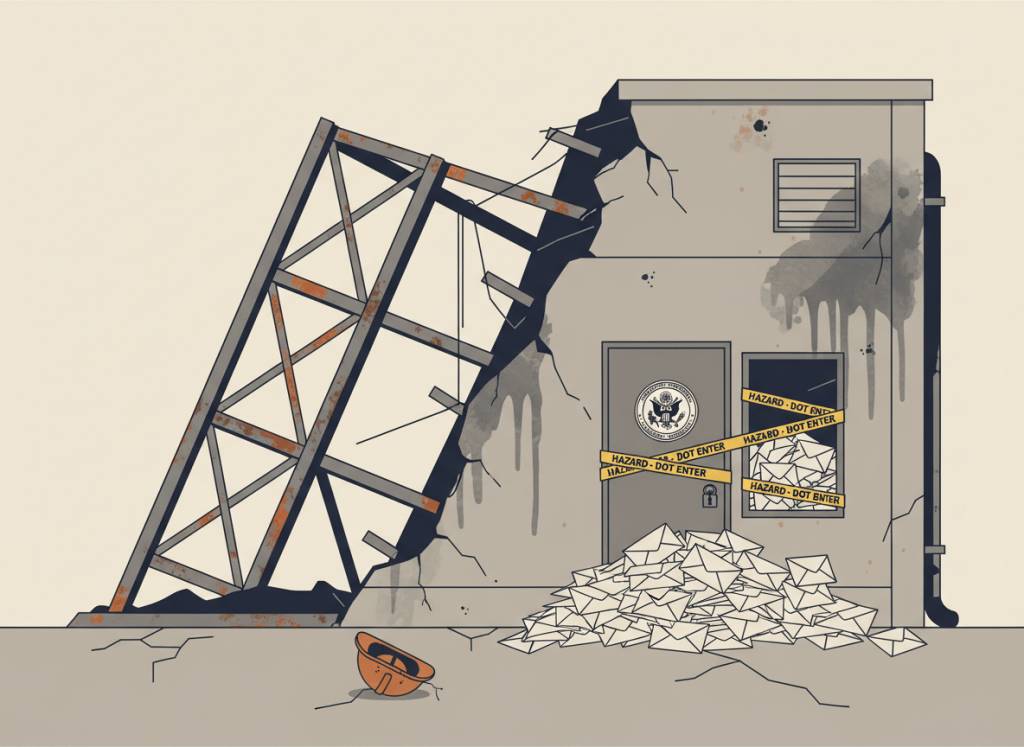
Five years after a deadly Ohio chemical plant explosion, the former operator has dissolved, federal prosecutors have secured a guilty plea, and safety investigators are still seeking answers about five recommendations intended to prevent another disaster.
COLUMBUS, Ohio — More than five years after an explosion tore through a Columbus chemical plant, killing one worker and seriously injuring eight others, the federal agency responsible for investigating the disaster says the company has failed to respond to any of its five safety recommendations.
The U.S. Chemical Safety and Hazard Investigation Board (CSB) announced October 19 that Yenkin-Majestic/OPC Polymers had neither demonstrated implementation of the recommendations nor substantively responded to repeated requests for information dating to December 2023.
The announcement followed a September 1, 2026, federal criminal guilty plea by Yenkin-Majestic Paint Corporation for its role in the April 2021 explosion.
But another development complicates the accountability picture. Yenkin-Majestic dissolved in August 2026, after selling its operating businesses. Meanwhile, the industrial property associated with the explosion is being marketed for sale or lease.
Together, those developments raise a question that the federal government’s investigations and enforcement actions have not publicly resolved: Who is responsible for ensuring the safety failures identified after the deadly explosion have actually been corrected?
A Catastrophe Years in the Making
Shortly after midnight on April 8, 2021, a mixture of flammable solvent vapors and hot resin escaped from a processing vessel known as Kettle 3 at the OPC Polymers resin manufacturing operation on Leonard Avenue in Columbus.
According to the CSB’s November 2023 investigation report, the vessel had been modified with a replacement access cover, or manway, that was not properly designed, constructed, or tested.
The equipment had experienced pressure spikes, and the replacement manway began leaking shortly after installation. Nevertheless, the vessel remained in service.
On the night of the explosion, pressure inside the kettle increased, forcing flammable material through the manway seal. The released vapors spread through the facility before finding an ignition source.
The resulting explosion and fire killed one employee and injured eight others. One worker suffered injuries requiring a leg amputation after being trapped beneath collapsed debris.
Investigators also identified failures that affected workers’ ability to escape and protect themselves. Flammable-gas detectors registered hazardous conditions but were not configured to provide audible warnings. Emergency preparedness and training were inadequate, and employees were not required to wear flame-resistant uniforms.
The explosion was therefore not simply the consequence of a defective component. Federal investigators documented a combination of equipment-integrity deficiencies, inadequate safeguards, and failures in emergency preparedness.
Five Recommendations, Nearly Three Years of Silence
The CSB issued five recommendations to Yenkin-Majestic/OPC Polymers in November 2023.
Two addressed mechanical integrity and engineering standards for pressure vessels, including equipment operating at relatively low pressures. Another called for inherently safer engineering practices in future resin plant designs.
The remaining recommendations addressed flammable-gas detection, automatic audible and visual alarms, evacuation training, and flame-resistant clothing.
The recommendations were intended to address both the causes of the explosion and the conditions that contributed to its devastating consequences.
According to the CSB, the agency first transmitted the recommendations to Andrew O. Smith, then identified as the company’s president and chief executive officer, on December 4, 2023.
After receiving no substantive response, the agency sent another letter on February 5, 2026. A third letter followed on September 10, shortly after the company’s federal guilty plea.
The CSB says none of those efforts produced a response.
In its October announcement, CSB Executive Director of Investigations and Recommendations Stephen Klejst characterized the company’s continued silence as particularly troubling in light of the criminal proceeding.
The agency’s public recommendation records continue to list all five recommendations as open.
That designation, however, requires an important distinction.
An open recommendation does not necessarily establish that every underlying safety deficiency remains uncorrected. It means the CSB has not closed the recommendation through its evaluation process. In this case, the agency specifically reports that the company has failed to provide the information needed to demonstrate implementation.
Whether corrective measures were undertaken independently, documented through another regulator, or implemented by a subsequent operator remains unresolved.
Federal Prosecutors Enter the Picture
The CSB was not the only federal agency investigating the disaster.
On September 1, 2026, Yenkin-Majestic Paint Corporation pleaded guilty to negligent endangerment under the Clean Air Act, according to the Department of Justice.
The criminal case, United States v. Yenkin Majestic Paint Corporation, was filed in the U.S. District Court for the Southern District of Ohio under case number 2:26-CR-00093.
The Justice Department’s account corroborated several of the CSB’s findings, including the failure to pressure-test the replacement manway, continued operation despite leakage, and gas-detection equipment that did not sound an audible alarm.
The guilty plea establishes criminal responsibility for the offense admitted by the corporation. It does not, by itself, establish that the CSB’s five preventive recommendations have been implemented.
The publicly reviewed Justice Department materials also do not establish the final sentencing terms or whether the criminal proceeding imposed additional safety-compliance requirements.
Those details matter because criminal punishment and prevention are not necessarily the same thing. A company can be held responsible for past conduct while questions remain about whether the conditions that contributed to the incident have been corrected.
OSHA Had Already Identified Enforceable Violations
The Occupational Safety and Health Administration also investigated the explosion.
In October 2021, OSHA announced two willful and 33 serious violations, proposing $709,960 in penalties against Yenkin-Majestic.
The agency’s citation documents identified deficiencies involving pressure-vessel alterations, engineering controls, equipment maintenance, and emergency procedures.
Several overlapped directly with the problems later addressed by the CSB.
Unlike the Chemical Safety Board, OSHA has statutory authority to issue citations and seek penalties for violations of workplace safety requirements.
But the existence of those citations does not establish their final disposition. The company contested the enforcement action, and the public records reviewed for this article do not establish the complete outcome of the contested proceedings or the final status of every required corrective measure.
At least one OSHA inspection entry identifies abatement as completed. That is evidence that the enforcement record cannot simply be characterized as showing no corrective action.
The distinction is central to understanding the case.
OSHA’s citations, the CSB’s recommendations, and the Justice Department’s criminal prosecution are separate accountability mechanisms. Each addresses different legal or investigative responsibilities, and a finding or action by one agency does not automatically resolve the requirements or recommendations of another.
The Company Dissolved. The Questions Did Not.
While federal authorities pursued accountability for the explosion, Yenkin-Majestic underwent significant corporate changes.
The company’s industrial coatings business was sold in 2022, and OPC Polymers subsequently operated through a separate limited liability company structure.
According to the company’s notice of dissolution, Yenkin-Majestic Paint Corporation dissolved effective August 18, 2026, after selling its operating businesses.
That was approximately two weeks before the corporation entered its federal criminal guilty plea.
The timing is notable, although the available evidence does not establish that the dissolution was intended to avoid regulatory or criminal responsibility.
Corporate dissolution does not automatically eliminate existing legal obligations. Nor does a business sale necessarily establish which liabilities, operating responsibilities, or contractual obligations transferred to a purchaser.
The relevant transaction agreements and corporate records would be needed to determine those questions.
Another development further complicates the picture.
Commercial real estate firm JLL is marketing the former OPC industrial campus at 1920 Leonard Avenue for sale or lease.
The listing describes industrial facilities and safety-related infrastructure, including flammable-gas detection equipment and fire-protection systems.
However, the listing does not establish whether those systems were installed before or after the explosion, whether they represent corrective actions responding to federal findings, or whether the original resin manufacturing operation remains active at the property.
The CSB’s investigation indicates that the severely damaged resin facility was demolished after the explosion. The property listing therefore should not be mistaken for evidence that the original production building remains in operation.
What the corporate changes and property listing do establish is the need to distinguish the corporation that operated the facility in 2021 from any subsequent business owner, current property owner, or operating entity.
That distinction becomes especially important when federal safety recommendations remain directed toward an organization whose structure and operations have changed substantially.
The Limits of a Federal Safety Recommendation
The Chemical Safety Board occupies an unusual position in federal industrial safety oversight.
Congress established the independent agency to investigate serious chemical incidents, determine their causes, and recommend measures to prevent similar disasters.
Unlike OSHA or EPA, however, the CSB does not issue regulatory citations or impose fines. Its recommendations depend on recipients taking action and providing information demonstrating implementation.
The agency can investigate, publish findings, communicate with responsible parties, and publicly identify recommendations that remain unresolved. It cannot independently compel a company to implement every recommendation.
That limitation does not mean the federal government lacks enforcement authority over workplace hazards. OSHA and other regulators may enforce applicable requirements through their own statutory powers.
It does mean that a CSB recommendation and an enforceable regulatory order are not interchangeable.
In the Yenkin-Majestic case, the distinction is particularly significant. Federal authorities documented serious safety failures, OSHA issued citations, and prosecutors obtained a criminal guilty plea. Yet the CSB says it still has not received a substantive response to its five recommendations.
Whether that reflects a failure to undertake corrective action, a failure to document actions already taken, complications arising from corporate restructuring, or some combination of those circumstances remains to be established.
Who Verifies the Fixes?
The unresolved questions now extend beyond the original explosion.
What became of OSHA’s contested citations, and which corrective measures were independently verified? Did the federal criminal proceeding impose any safety-related conditions? Which company or companies acquired the relevant manufacturing operations, and what responsibilities accompanied those transactions?
And perhaps most importantly, has the CSB identified the current entity responsible for responding to recommendations issued to Yenkin-Majestic/OPC Polymers?
Those are questions about the continuity of industrial safety oversight, particularly when the business responsible for a catastrophic incident changes ownership or corporate form before the government completes its accountability processes.
The CSB’s October 19 announcement makes one fact unmistakable. Nearly three years after issuing five recommendations intended to prevent another deadly chemical plant disaster, the agency says it still has not received a substantive response.
The federal government has investigated the explosion, documented its causes, pursued workplace safety enforcement, and secured a criminal guilty plea.
What the available public record does not yet establish is whether the preventive measures recommended after a worker’s death have been fully implemented and independently verified.
For the workers who may encounter similar hazards, that distinction is considerably more important than whether the government’s paperwork has reached its final destination.

