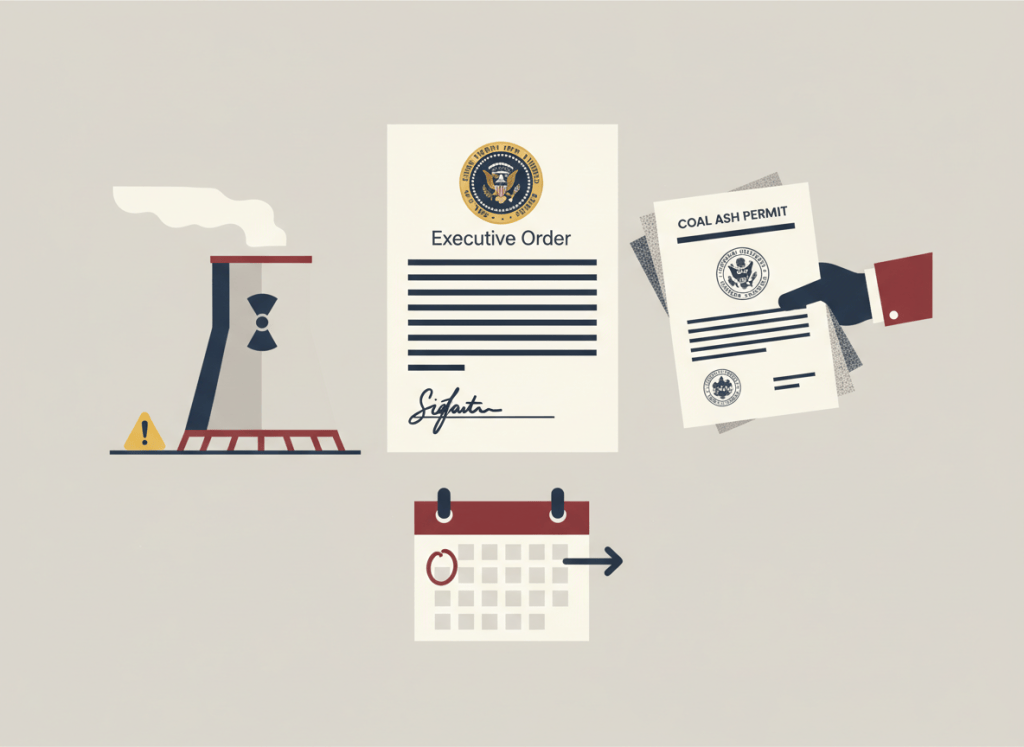
Thursday’s Federal Register carries a new executive order that unwinds the prior administration’s women’s health research framework, an emergency fix at a recently restarted nuclear plant, a second postponement of a customs crackdown on cheap mail-order imports, and two separate handoffs of federal permitting authority to state regulators, all inside a 96-document issue spanning 32 agencies.
Here’s what stood out:
- Executive Office of the President: A new executive order, signed October 19 and published today as EO 14437, revokes a 2023 executive order and a companion presidential memorandum on women’s health research, replacing them with a new framework. It gives HHS 90 days to stand up a Women’s Health Division inside the National Institutes of Health and creates a White House task force spanning HHS, the Department of War, Agriculture, Labor, Education, and Veterans Affairs, plus the heads of EPA, FDA, CDC, NIH, ARPA-H, and CMS. The 90-day clock is the order’s only enforceable deadline, which matters because it gives the public a specific date to check whether the new division actually gets built rather than leaving the reorganization open-ended. Read the order.
- Nuclear Regulatory Commission: The NRC issued an emergency license amendment letting Palisades Energy move a fuel assembly that tilted roughly 30 degrees during reactor reloading, using equipment and a route its own safety analysis report doesn’t describe. Normally the NRC publishes a proposed amendment and its safety findings for public comment before approving a change like this; here the agency said “time did not permit” that step, so it approved the fix first and is only now opening a hearing window, with requests due December 21. The same site is in the middle of a separate NRC review of a construction permit for two new small modular reactors, Pioneer Units 1 and 2, meaning one plant is generating an unusually heavy volume of regulatory activity on two very different tracks at once. Read the notice.
- Environmental Protection Agency: EPA approved Virginia’s application to take over permitting for coal combustion residuals, the ash byproduct of burning coal that utilities store in ponds and landfills with a history of leaking into groundwater nationwide. Effective November 23, Virginia’s own regulators, not EPA, will issue and enforce most coal ash permits in the state, though EPA is keeping several provisions under its own authority, including vegetative-cover and groundwater-monitoring rules currently tied up in litigation. Handing enforcement to a state regulator is a real shift in oversight, since state agencies can set different inspection priorities and penalty practices than EPA’s own program does. Read the rule.
- Environmental Protection Agency: EPA proposed giving Utah primary authority over Class VI wells, the type used to permanently inject carbon dioxide underground for carbon capture projects, a responsibility EPA itself currently holds nationwide outside a handful of states. The proposal comes with a comment period running through December 7 and a virtual public hearing, which matters because communities near a future injection site get a formal chance to raise concerns about groundwater contamination or induced seismicity before Utah’s own Division of Oil, Gas and Mining takes over permitting in EPA’s place. Read the proposal.
- U.S. Customs and Border Protection: CBP pushed back, for the second time, the compliance deadline on its June 2026 rule ending duty-free de minimis treatment for low-value mail packages, moving the date from today, October 22, to January 20, 2027, to give importers and carriers more time to build the required data systems. CBP issued this extension as a final rule with no public comment period at all, invoking the Administrative Procedure Act’s “good cause” exception on the grounds that a normal comment process would have run past today’s deadline; using that shortcut twice in a row on the same rule is worth watching, since it suggests the agency’s own enforcement infrastructure, not just importers’ systems, may not be ready either. Read the rule.
- Federal Trade Commission: The FTC, with the Justice Department’s Antitrust Division, published its monthly list of mergers granted early termination of the Hart-Scott-Rodino waiting period, about 86 transactions from September 2026. Under the HSR Act, merging companies normally must wait 30 days after notifying antitrust regulators before closing a deal, giving the agencies time to flag competition problems; an early-termination grant lets a deal close sooner because the agencies have already decided it raises no concerns, so the size of a given month’s list is a rough, real-time gauge of how quickly the current merger-review apparatus is clearing deals. Read the notice.
This edition is drawn from the full 96-document Federal Register issue published October 22, 2026, across 32 agencies. Excluded as routine: roughly twenty National Park Service Notices of Inventory Completion and Intended Repatriation under NAGPRA; Foreign-Trade Zone production-activity notifications; Sunshine Act meeting notices; bank holding company formation and change-in-control notices; standard agency information-collection and OMB review notices; FAA airworthiness directives and Class E airspace actions; Coast Guard safety-zone and drawbridge-operation rules; routine antidumping and countervailing-duty determinations; and Securities and Exchange Commission self-regulatory-organization rule filings other than those flagged above.

