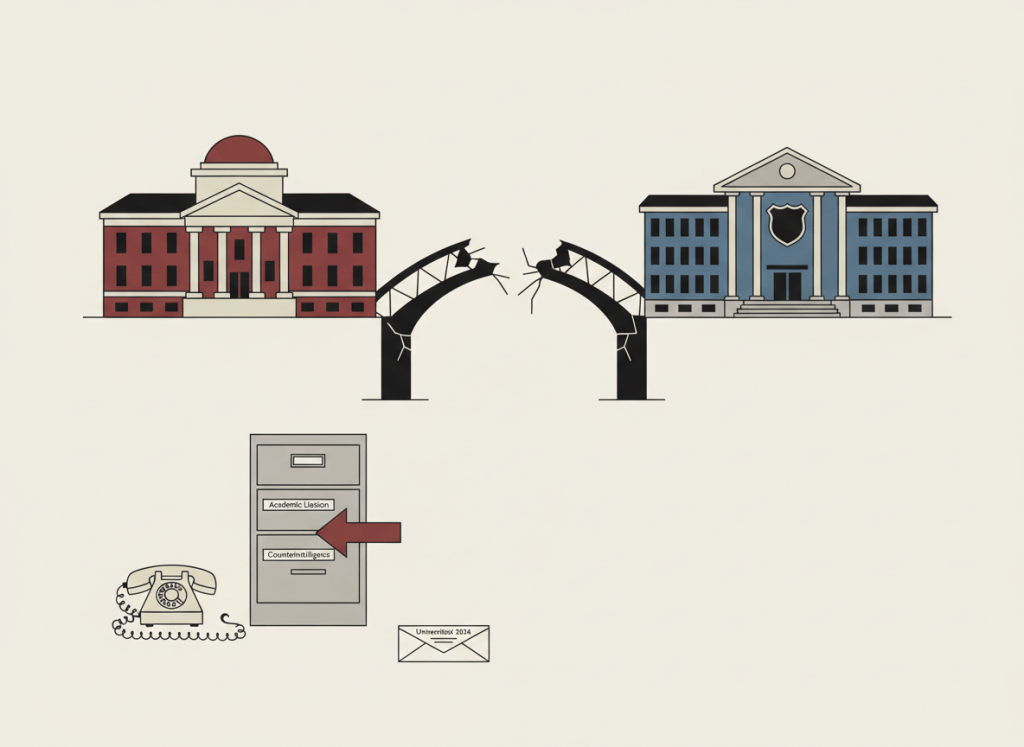
The FBI moved a university liaison function into its counterintelligence operation, prompting warnings from higher education leaders about weakened coordination. A new federal watchdog report finds the Bureau still lacks a plan to strengthen those relationships.
WASHINGTON, October 21, 2026 —
The FBI discontinued a centralized academic outreach program in 2023, prompting warnings from university leaders that the agency was weakening an important channel for communicating national security threats. More than two years after those concerns were formally raised, federal auditors have found that the Bureau still lacks an identified plan to strengthen its relationships with American universities.
An October 15 Government Accountability Office report concluded that inconsistent relationships between FBI field offices and academic institutions are hindering efforts to protect American research, intellectual property, and sensitive technologies from foreign intelligence collection.
The findings raise questions about a restructuring that higher education organizations had already challenged in May 2024, when four national associations urged then-FBI Director Christopher Wray to reverse the transfer of the Bureau’s academic liaison function from its Office of Private Sector to the Counterintelligence Division.
The organizations warned that the transfer threatened the FBI’s ability to coordinate with universities across multiple investigative divisions, including those responsible for cybersecurity, terrorism, and threats involving dangerous biological materials.
The Bureau’s subsequent arrangements did not eliminate university outreach. Academic coordinators remained assigned to its 56 field offices, and senior field-office officials assumed responsibility for institutional engagement. But the GAO report indicates that the decentralized structure has not resolved longstanding communication problems.
The FBI agreed with the watchdog’s recommendation to develop and implement a plan to strengthen those partnerships. It provided no formal written comments on the report.
A Program Built to Bridge Institutional Divides
The academic liaison function emerged from an earlier disagreement between the FBI and the higher education community. In 2018, the Bureau disbanded its National Security Higher Education Advisory Board, an established forum through which university leaders and federal security officials discussed national security concerns affecting academic institutions.
The decision drew objections from higher education associations, which argued that regular communication was essential to addressing emerging threats while preserving the openness of American research.
Following those concerns, the FBI established an academic liaison within its Office of Private Sector, creating a centralized contact capable of coordinating with multiple Bureau divisions and field offices.
According to the associations, the arrangement produced measurable institutional activity, including academic summits at FBI headquarters in 2018 and 2019, regional meetings, classified briefings for university presidents, and coordination with federal research agencies.
The liaison also helped universities navigate threats extending beyond conventional espionage. In 2022, for example, a series of bomb threats targeting historically Black colleges and universities prompted the academic liaison to coordinate a briefing involving affected institutions and relevant FBI divisions.
That kind of coordination became central to the universities’ subsequent objections.
The 2023 Restructuring
According to GAO, the FBI’s Office of Private Sector stopped operating its Academia Program in 2023 because of policy changes. The report does not identify the directive responsible for that decision, the official who authorized it, or the specific rationale behind the restructuring.
However, a May 15, 2024 letter from the American Council on Education, Association of American Universities, Association of Public and Land-grant Universities, and Council on Governmental Relations identifies a consequential organizational change. The FBI had moved its academic liaison role from the Office of Private Sector to the Counterintelligence Division.
The associations argued that the transfer undermined the liaison’s ability to serve as a central point of contact across the Bureau. Although university leaders acknowledged the importance of counterintelligence cooperation, they emphasized that campus security concerns extended into cybersecurity, terrorism, criminal investigations, and biomedical threats.
Their letter identified a practical consequence. When universities sought coordinated FBI outreach concerning antisemitism-related threats on campuses, the associations reported difficulty obtaining the kind of cross-divisional assistance previously available through the centralized liaison.
They urged FBI leadership to restore a coordinating function with sufficient organizational authority to operate across the Bureau’s divisions and directorates. They also requested clarification about where the academic liaison program belonged within the FBI’s organizational structure and how institutions should communicate concerns involving multiple investigative responsibilities.
The letter provides contemporaneous evidence that university leaders considered the restructuring problematic well before GAO’s latest review. It does not, however, establish that the transfer of the liaison role was the entirety of the policy change GAO referenced, nor does it identify the internal directive authorizing the decision. Those questions remain unresolved.
The FBI Had Already Reported Progress
The restructuring occurred against a backdrop of earlier federal oversight. In June 2022, GAO recommended that the FBI improve its identification and assessment of universities facing elevated risks of sensitive technology transfers. The Bureau agreed with those recommendations.
According to the latest GAO report, the FBI subsequently examined additional risk factors and reported in July 2023 that it had established periodic discussions between its Office of Private Sector, Counterintelligence Division, and four major academic associations. Those meetings were intended to improve the identification and communication of research-security risks. The earlier recommendations were subsequently classified as implemented.
The timing presents an important distinction. The FBI was reporting progress on academic research-security coordination during the same year its Office of Private Sector reportedly stopped operating the Academia Program.
That does not necessarily indicate a contradiction. Periodic meetings with national associations could continue even after a centralized liaison function was reorganized. But it raises a question about whether the arrangements considered sufficient to satisfy earlier oversight recommendations were adequate to maintain the broader institutional relationships that universities had come to rely upon. The 2026 GAO report suggests that significant weaknesses remained.
A National Network, but Uneven Relationships
The FBI maintains an extensive counterintelligence infrastructure. Its 56 field offices have academic coordinators, private-sector coordinators, and counterintelligence personnel. The Bureau also coordinates with approximately 50 federal agencies through the National Counterintelligence Task Force. That task force established a research-security focus group in December 2025 to help protect sensitive technologies.
Despite those resources, GAO found that the FBI’s relationships with universities varied considerably. Representatives from all four academic associations interviewed for the audit said the Bureau could improve its research-security outreach. Representatives from two associations described inconsistent relationships between individual universities and local FBI offices.
One representative reported that agents sometimes contacted individual researchers directly about security concerns rather than coordinating through university research-security offices, creating frustration within the institutions. Other representatives reported diminished outreach following the end of the former Academia Program. One university research-security representative specifically described a decline in FBI briefings in recent years.
The FBI, meanwhile, acknowledged that relationships with academic institutions are essential to identifying potential intelligence collectors. Unlike traditional foreign intelligence officers, non-traditional intelligence collectors may be researchers, students, businesspeople, or other individuals whose primary occupations are unrelated to intelligence gathering.
Their activities can be difficult to distinguish from legitimate academic or commercial work, particularly before sensitive information is transferred to a foreign entity. FBI officials told GAO that they rely on tips from universities and businesses to identify potential threats. That dependence makes the quality of those relationships an operational concern rather than simply an administrative preference.
The Problem the FBI Acknowledged
By February 2026, FBI officials were publicly acknowledging the need to strengthen relationships with academic institutions. According to GAO, officials attending a research-security conference recognized that the Bureau could provide universities with important information unavailable through other channels. They also acknowledged that FBI-university relationships needed improvement.
Yet auditors found that officials had not identified a plan to accomplish that objective. The resulting recommendation was straightforward: the FBI director should develop and implement a plan to strengthen partnerships with academic institutions, improve information exchange, and better address threats posed by non-traditional intelligence collectors. The FBI concurred.
The watchdog’s recommendation remains listed as open. The report does not establish that the 2023 restructuring caused specific espionage incidents, compromised research projects, or losses of intellectual property. Nor does it quantify the nationwide reduction, if any, in academic outreach activity following the organizational change.
GAO’s interviews with academic and private-sector representatives were not designed to produce nationally representative findings. Nevertheless, the audit documents concerns that closely resemble those university associations raised directly with FBI leadership in 2024.
Security Without Communication
The institutional challenge extends beyond the organization of a single FBI program. American universities depend on international collaboration, open scientific exchange, and the movement of researchers across national borders. Federal counterintelligence agencies, meanwhile, are responsible for identifying foreign efforts to exploit those relationships to obtain sensitive information.
Both objectives can be legitimate, but they require cooperation between institutions operating under fundamentally different professional cultures. GAO found that some universities may hesitate to report suspicious activity because they do not want to be perceived as turning over their students to federal investigators.
Businesses face different concerns, including reputational damage and the possibility that disclosing an intelligence breach could undermine confidence in their intellectual property protections. Classified intelligence presents another obstacle. Universities cannot always receive the information federal investigators possess about potential threats.
Those challenges make established relationships and reliable communication channels particularly important. The FBI’s 2023 restructuring placed greater responsibility for university engagement with individual field offices. University associations subsequently questioned whether the resulting arrangement retained sufficient authority to coordinate across the Bureau.
More than two years later, GAO found that relationships remained inconsistent and that a national improvement plan had not been identified.
The sequence leaves several questions unanswered. What specific policy directive prompted the 2023 restructuring? Who approved the change, and what institutional problems was it intended to solve? Did the FBI formally respond to the May 2024 objections? And has the Bureau evaluated whether the reorganization improved or diminished its ability to communicate security threats to universities?
Those questions are not answered in the public documents reviewed for this article. For now, the record establishes a narrower but consequential finding: university leaders warned the FBI that an organizational change threatened an established security relationship, and a subsequent federal audit found that the Bureau still needed a plan to strengthen its academic partnerships.
The federal government has spent years emphasizing the importance of protecting American research from foreign intelligence collection. The latest watchdog findings suggest that maintaining the institutional relationships necessary to accomplish that mission remains unfinished business.
And this time, the warning did not come from an intelligence adversary. It came from the universities the FBI was supposed to be working with.
Sources: GAO-27-109057; May 2024 associations letter; GAO-22-105727; COGR September 2023 update.

