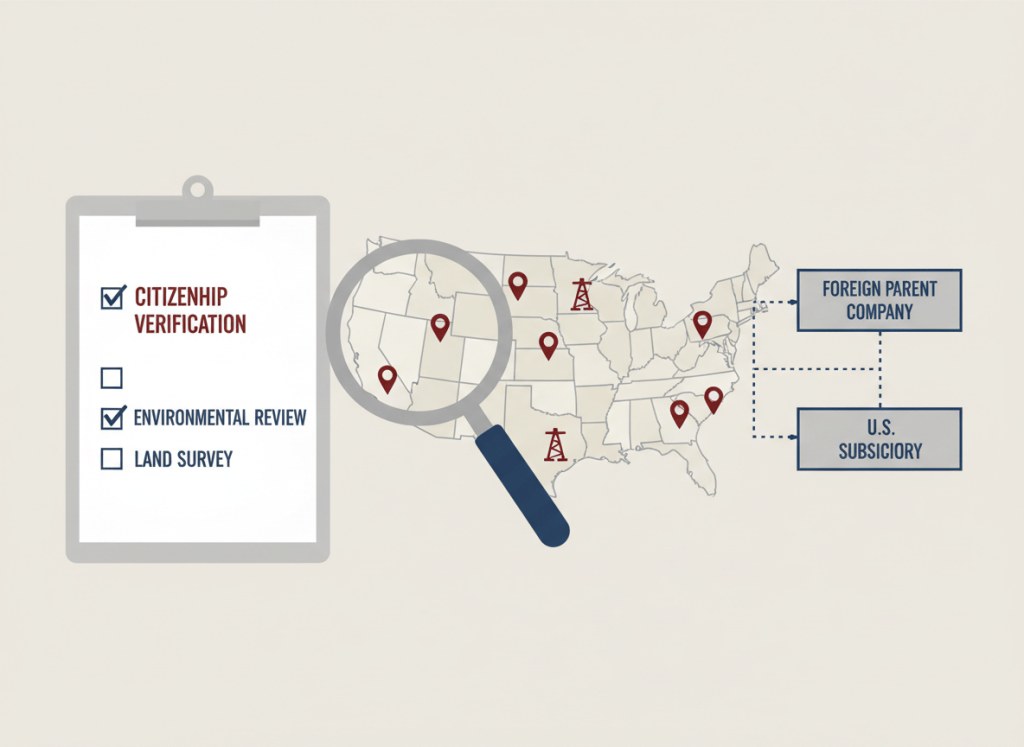
Federal law is not vague about who may mine federal land. Under the General Mining Act of 1872, claimants must be U.S. citizens, a category that includes companies incorporated in a U.S. state or territory.
The Bureau of Land Management administers those claims. The Government Accountability Office recently asked a simple question: how does BLM know the claimants qualify?
It doesn’t.
A Rule Nobody Checks
According to GAO-27-108196, signed October 6 and publicly released October 16, BLM collects basic identifying information from claimants, such as names and addresses. It does not collect proof of U.S. incorporation, a signed statement affirming citizenship, or any information about parent companies.
Nor does the agency record whether claimants meet the requirement. BLM officials said it rarely verifies.
State office staff told GAO they skip the step because BLM has never directed them to take it, or explained how. The agency’s regulations do not require claimants to supply the information either.
This is not a boutique caseload. BLM has recorded an average of more than 60,000 mining claims a year since 2021.
Seven of Fifteen
So GAO checked for itself. It started with 236 claimants tied to approved mining operations that appeared to be business entities, and matched 162 of them to U.S. incorporation records through OpenCorporates, an aggregator of state business filings.
That left 74 unmatched. GAO drew a sample of 15 from them: all seven that matched Canadian incorporation records, plus eight chosen at random.
Further searches of legal databases, state business registries, and SEC filings turned up U.S. incorporation for eight. For the other seven, GAO found nothing. Four were the Canadian matches and three were random picks.
GAO asked BLM to help confirm where those seven were incorporated. The agency could not, because it does not hold the information.
The caveats matter. GAO describes the sample as nongeneralizable, says some misses could reflect data entry differences, and acknowledges some of the seven may be U.S. entities after all. Individual claimants could not be analyzed because BLM’s data held limited identifying information on them.
So this is not a count of illegal claimants. It is a count of claimants the agency responsible for checking cannot vouch for.
The Subsidiary Door
None of this means foreign money is barred. A foreign company’s U.S.-incorporated subsidiary qualifies as a claimant, and BLM officials told GAO the agency has no discretion to deny a claim to a U.S.-incorporated entity wherever its parent sits.
One BLM state office official acknowledged that entities from foreign adversaries could use the same route. Officials also said foreign investment supplies capital for an industry with steep upfront costs, along with jobs and tax revenue for mining communities.
What BLM cannot see is who sits behind the subsidiary. Claimants under the 1872 law, which covers about 90 percent of federal land, need not disclose a parent company or foreign investors.
On the roughly 10 percent of land under the leasing system, BLM requires qualifications statements naming anyone holding more than 10 percent of a corporation’s stock, along with their citizenship. The stricter rule governs the smaller share of land.
BLM’s claims handbook adds that the agency will not summarily challenge a claimant with a foreign address. Challenges are left to rival claimants, who must take them to court.
A companion report, GAO-27-108094, tried to map ownership from the outside. It examined 43 claimants and operators tied to critical mineral mines on federal lands and determined ownership for 32. Fourteen of those were subsidiaries of foreign entities.
GAO found none of the 14 had a Chinese parent company, but in at least two cases Chinese entities held a financial interest in the foreign parent. Eleven of the 43 stayed unidentified.
Here is an inference, not a finding. GAO reports in GAO-27-108196 that Treasury’s August 2026 final rule removed U.S. companies, including U.S.-based subsidiaries of foreign companies, from Corporate Transparency Act beneficial ownership reporting.
Combined with BLM’s lack of parent data, that suggests the entity type BLM cannot see through is now also the one Treasury no longer asks about. That conclusion rests on GAO’s description of the rule’s scope and on its account of what BLM collects, and I have not independently reviewed the rule text.
Ottawa Asks. Canberra Asks. Washington Waves.
GAO looked at how Australia and Canada handle the same problem. Both require investors to disclose beneficial owners, at a 5 percent stake in Australia and 10 percent in Canada.
Both screen mining investments for national security or national interest concerns, and both have ordered foreign investors to divest from critical minerals companies in recent years. In Australia, acquiring mining rights triggers mandatory screening regardless of dollar value, with exceptions for certain free trade partners.
Washington’s stated policy points the other way, toward more mines. Executive Order 14241, issued in March 2025, directs agencies to expand domestic mineral production, including from federal lands, and to speed permitting.
The blind spot is not new, either. In 1984, GAO examined foreign participation in mineral leases and mining claims on federal land in three states. It reported that part of the request, on agency control over the relevant data, could not be answered because the data either did not exist or was not available.
That is a 42-year gap between the first look and the latest. The latest was requested by House Democrats, according to the committee’s May 2024 announcement, who argued then that calls to expand production had not addressed who controls and profits from extraction.
GAO’s recommendation is modest. The BLM Director should direct staff to collect citizenship information from claimants and document that they meet the requirements.
GAO sent a draft to Interior and the Department of Agriculture. Agriculture had no comments. Interior provided none, which leaves the recommendation without an agency answer, at least in the published record.
Open questions remain. How many of the roughly 60,000 annual claims involve entities BLM could not place? Will BLM adopt the recommendation, and what will it ask for?
The citizenship requirement has been on the books since 1872. The follow-up question, it seems, was never added.

