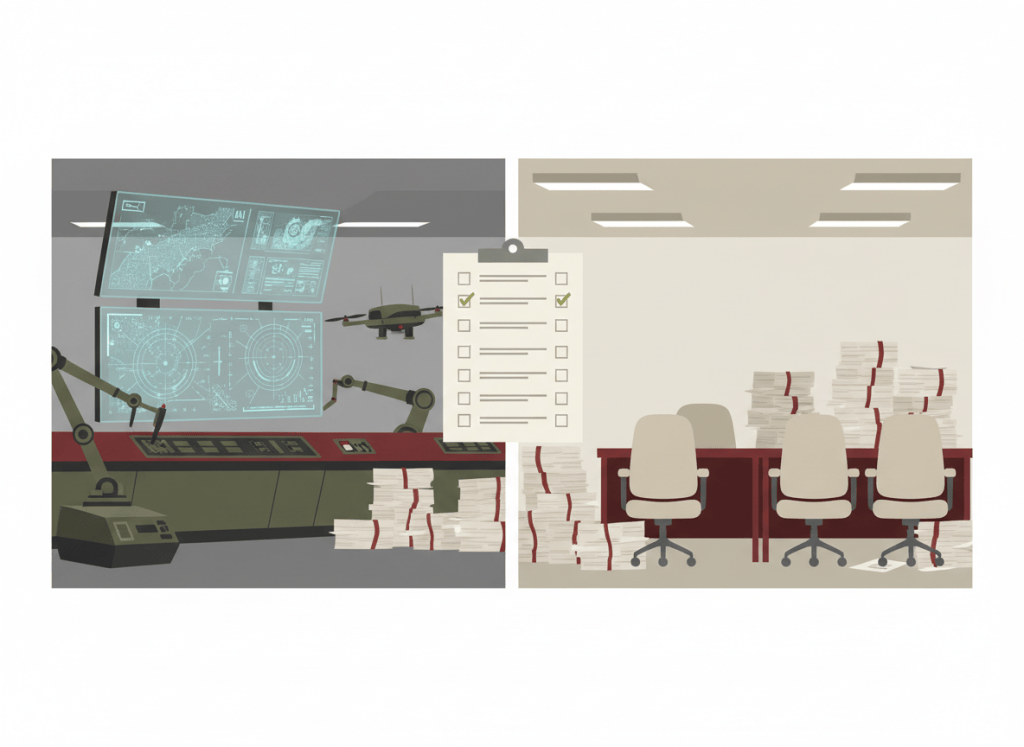
As the military accelerates artificial intelligence deployment, a new federal audit reveals an understaffed oversight office, unfinished implementation requirements, and coordination problems dating back years.
The Pentagon wants artificial intelligence to move at the speed of modern warfare. Its oversight bureaucracy, meanwhile, is having difficulty keeping up with its own paperwork.
As the Department of Defense accelerates the integration of artificial intelligence into battlefield operations, intelligence gathering, autonomous systems, and military decision-making, the federal office responsible for coordinating responsible AI implementation is operating with just three of its 10 authorized positions filled.
Nearly half of the department’s original Responsible AI implementation plan remains unfinished. Its principal working-level coordination council stopped meeting for months. And several longstanding recommendations intended to improve AI governance and workforce management remain unresolved.
Those findings appear in a Government Accountability Office report released October 14, which examines the Pentagon’s efforts to implement its own standards for developing, evaluating, and deploying artificial intelligence.
The findings become considerably more consequential when compared with the department’s January 2026 Artificial Intelligence Strategy, which calls for accelerating AI integration throughout military operations and transforming the department into an AI-first warfighting force.
The central problem is not that the Pentagon lacks an AI strategy. It has several. The question is whether the department has built the institutional capacity to implement, evaluate, and enforce those strategies before the technology moves further into operational use. And by the government’s own measurements, that work is falling behind.
The Pentagon’s AI Plan Is Missing Its Own Targets
In 2022, the Defense Department published its Responsible Artificial Intelligence Strategy and Implementation Pathway, establishing 64 lines of effort intended to incorporate responsible-use principles throughout the development and deployment of military AI systems.
The plan was not simply a declaration of ethical aspirations. It assigned responsibilities to specific organizations and called for tools, governance processes, workforce development, testing, and mechanisms for evaluating implementation.
By April 2026, however, GAO found that 29 of those 64 lines of effort remained incomplete. That means approximately 45 percent of the department’s original implementation agenda was unfinished nearly four years after its publication.
In its Fiscal Year 2025 Strategic Management Plan, DOD established a performance measure tracking completion of the Responsible AI implementation pathway. The department set targets of 56 percent completion by fiscal year 2024, 76 percent by fiscal year 2025, and 84 percent by fiscal year 2026.
Yet GAO’s April 2026 finding places documented completion at approximately 54.7 percent. That is roughly 21 percentage points below the department’s fiscal year 2025 target and 29 percentage points below its fiscal year 2026 target.
The comparison requires one qualification: GAO’s April 2026 figure is a point-in-time assessment, not a formal fiscal-year-end performance result. The fiscal year 2026 deadline had also not yet arrived.
Nevertheless, the discrepancy raises an unavoidable question. If DOD intended to complete more than three-quarters of its Responsible AI implementation plan by the end of fiscal year 2025, why was documented progress still below 55 percent several months later?
GAO identified another problem. Although CDAO had been tracking completion of individual implementation activities, it had not developed metrics to measure the implementation of Responsible AI itself. The Pentagon could count completed assignments without necessarily demonstrating whether those assignments were producing trustworthy AI systems.
Completing a policy memorandum is not the same as verifying that a battlefield AI system functions reliably under operational conditions.
An Oversight Office With Seven Empty Chairs
Responsibility for coordinating the Pentagon’s AI efforts rests principally with its Chief Digital and Artificial Intelligence Officer, or CDAO. Within that organization, the Responsible AI Division supports the development of governance practices, evaluation tools, technical guidance, and collaboration across military components.
A 2023 resourcing memorandum authorized 10 positions for the division, including specialized expertise in systems engineering, program management, and AI ethics. According to GAO, only three positions were filled as of February 2026.
That represents a 70 percent vacancy rate in an office tasked with helping coordinate responsible AI implementation across an increasingly AI-dependent military.
The report does not identify which seven positions remained vacant, preventing an assessment of precisely which technical specialties were missing. It does, however, establish that officials expected continued difficulty filling the vacancies.
CDAO was undergoing organizational restructuring following its August 2025 realignment under the Under Secretary of Defense for Research and Engineering. Officials told auditors that the restructuring, together with the new AI strategy, made additional staffing unlikely.
The Pentagon has elevated AI adoption to a strategic military priority while leaving the office responsible for coordinating critical elements of its responsible-use framework substantially below its authorized staffing level.
In a 2023 GAO report on DOD’s AI workforce, auditors found that the department had not completed fundamental steps necessary to identify and manage its AI personnel. DOD had developed AI-related work roles but had not fully incorporated them into workforce data systems, established a qualification program, or assigned responsibility and timelines for completing several outstanding workforce-management tasks.
Those shortcomings complicate the department’s ability to determine what expertise it possesses, what expertise it needs, and where personnel shortages could affect mission requirements. Several recommendations from that earlier audit remained open in 2026.
The Council That Stopped Meeting
The Pentagon established its Responsible AI Working Council as a permanent forum for coordinating implementation, sharing expertise, identifying obstacles, and resolving problems among military organizations. The council previously met monthly. Then, according to GAO, it stopped meeting from late 2024 until August 2025.
Officials attributed the interruption to competing priorities, including work on generative AI guidance and government-wide risk-management resources. Those assignments were themselves related to responsible AI. But the consequence was that the department’s principal collaborative forum was unavailable for an extended period while individual military components continued developing their own implementation approaches.
Officials from four DOD components told GAO that they encountered challenges during the interruption that would have benefited from collaboration. The Air Force was developing its own governance structure and struggled to obtain comparable practices from other organizations. The Navy sought opportunities to validate its approach. The Defense Threat Reduction Agency wanted greater coordination on interpreting guidance for high-impact applications.
Some components continued collaborating informally. The council’s absence therefore did not mean that all oversight or coordination ceased. It did, however, reveal a structural vulnerability: GAO found that the Working Council lacked a formal charter establishing its roles, responsibilities, and meeting frequency.
The council resumed meetings in August 2025, but without those foundational requirements, auditors warned that another interruption remained possible.
In its 2022 review of DOD AI strategies and collaboration, GAO recommended that the department clarify the responsibilities of military services and other organizations participating in AI activities.
The department subsequently issued a CDAO charter in November 2024, but a separate directive defining department-wide collaboration responsibilities remained outstanding. According to GAO’s recommendation tracking, DOD officials reported in August 2026 that they were still coordinating the necessary updates and estimated completion by April 2027.
That projected date would place resolution of the earlier collaboration recommendation approximately five years after GAO first issued it. The Pentagon’s AI technology is advancing rapidly. Its governance documentation has been considerably less agile.
These Are Not Merely Office Chatbots
GAO reported that DOD had identified 378 AI use cases across the department as of February 2026. The audit examined 10 selected applications involving military services, intelligence organizations, and combatant commands.
Among them were an Army counter-drone capability associated with the XM30 combat vehicle, Navy autonomous systems employing automatic target recognition, Air Force geospatial intelligence applications, Marine Corps AI-assisted tactical decision-making, and Special Operations Command software supporting autonomous operations. The report also examined applications involving the Defense Intelligence Agency and U.S. Cyber Command.
These capabilities can influence how military personnel identify objects, analyze intelligence, interpret battlefield conditions, and make operational decisions. That does not establish that any of the systems examined are unsafe.
GAO did not identify a department-wide pattern of operational AI failures, nor did its limited survey establish that military AI systems were being deployed without testing. Its findings instead reveal weaknesses in the institutional processes intended to support consistent, trustworthy development and evaluation.
Air Force officials reported that proprietary AI models developed by industry partners lacked transparency into underlying data, algorithms, or model characteristics, limiting objective assessments. Marine Corps officials reported that Responsible AI tools were unavailable in the classified environment where their work occurred.
Other organizations had developed approaches that might help. The Defense Intelligence Agency established a quality-assurance framework, while Special Operations Command adapted an existing classified accreditation process to incorporate Responsible AI considerations.
In GAO’s survey of 10 selected use cases, seven components identified additional Responsible AI personnel or expertise as potentially beneficial. Six identified improved access to tools in classified environments, while four identified a need for greater transparency into externally developed models.
Those findings cannot be generalized to all 378 reported AI use cases. The sample was deliberately limited, and GAO expressly cautioned against extrapolating its results across the department.
A New Strategy, With the Old Problems Still Unresolved
In January 2026, the Pentagon issued its new Artificial Intelligence Strategy for the Department of War, emphasizing rapid adoption, operational integration, and AI capabilities capable of improving military decision-making.
The strategy calls for an AI-first warfighting force and establishes seven pace-setting projects covering warfighting, intelligence, and enterprise applications. One initiative, Agent Network, addresses AI-assisted battle management and decision support, including applications connected to the military kill chain.
The strategy also directs development of model-objectivity benchmarks and procurement provisions intended to ensure AI systems can support lawful military applications without restrictive usage policies interfering with those missions. Existing departmental AI guidance must align with the new strategy.
How will the Pentagon preserve and verify testing, traceability, transparency, and accountability practices established under its earlier Responsible AI framework while pursuing this acceleration agenda?
The January strategy does not establish that DOD eliminated those safeguards. Nor does the GAO report demonstrate that the new policy has already produced unsafe systems. But the two documents reveal a potential mismatch: new demands on the AI enterprise alongside incomplete implementation, insufficient staffing, and unresolved governance responsibilities.
The Acquisition Problem Behind the Oversight Problem
A separate 2026 GAO report on federal AI acquisitions noted that DOD’s Responsible AI pathway called for an acquisition toolkit containing standard solicitation language, evaluation criteria, contract provisions for testing and monitoring, and appropriate data-delivery and intellectual-property rights. As of September 2025, that toolkit was reportedly still under development.
When military organizations purchase proprietary AI capabilities, their ability to inspect, test, and monitor those systems may depend on contract terms. If agreements do not adequately address access to technical information, evaluation rights, and performance monitoring, oversight problems can become embedded in contracts before systems reach operational users.
The Air Force’s reported difficulty evaluating proprietary models illustrates why those requirements matter. A system’s suitability for military missions and the government’s ability to independently evaluate that system are related but distinct questions.
Congress Has Been Warned Before
GAO raised concerns about strategy, collaboration, and organizational responsibilities in 2022; identified weaknesses in AI workforce management in 2023; and has now documented a substantial Responsible AI implementation backlog, an understaffed coordinating office, and a council that went months without meeting.
The pattern does not establish that DOD ignored every recommendation or failed to make meaningful progress. The department has developed guidance, established oversight bodies, created technical evaluation tools, and undertaken implementation activities.
GAO found that nine of the 10 selected components had established or begun establishing oversight bodies in guidance, and seven had taken steps toward establishing oversight activities. But progress in some areas does not erase deficiencies in others.
The latest report recommends that the Secretary of Defense ensure CDAO issues a formal charter for the Responsible AI Working Council and addresses the Responsible AI Division’s workforce needs. DOD concurred with both recommendations. GAO also recommended that Congress consider directing action on outstanding recommendations concerning collaboration and workforce management.
Which 29 implementation activities remained incomplete in April 2026, and how many involve operational safeguards? Which seven positions remained vacant? Has the Working Council adopted a charter and maintained regular meetings? What evidence can the Pentagon provide that revised AI policies and procurement practices preserve adequate evaluation as adoption accelerates? The public findings do not fully answer these questions.
The Speed of Deployment and the Speed of Accountability
Artificial intelligence has the potential to improve military operations, reduce analytical burdens, and provide commanders with information at speeds that conventional processes cannot match. The Pentagon is pursuing those advantages in an environment where technological competition increasingly shapes national-security planning.
But faster decisions do not eliminate the need to understand how they are produced, how systems are evaluated, and who is responsible when performance falls short. DOD’s own Responsible AI framework recognizes that reliable, trustworthy systems are essential to accelerating adoption.
That makes the unfinished implementation work more than an administrative inconvenience. It represents a measurable gap between the institution’s stated objectives and its documented progress.
The Pentagon has established ambitious deadlines for transforming military operations with artificial intelligence. It has also established performance targets for implementing safeguards intended to support that transformation. According to its own auditors, those efforts are not proceeding at the same pace.
Is the Pentagon accelerating artificial intelligence faster than it can demonstrate the technology is ready to be trusted?

