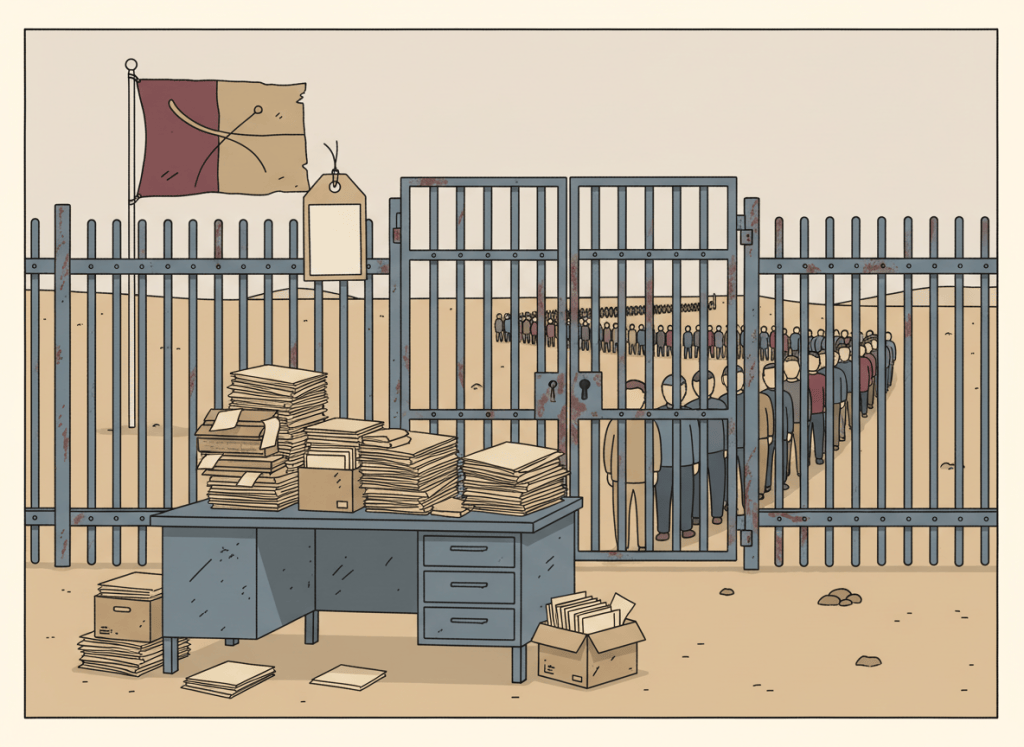
The anti-ISIS coalition has declared “true victory” in Iraq while pledging more than $75 million for counterterrorism, detention and humanitarian needs. What it did not disclose is who is paying, who gets the money, or how much of it will go toward housing thousands of ISIS detainees the United States recently transferred into Iraqi custody.
The international coalition assembled more than a decade ago to destroy the Islamic State’s territorial caliphate met in Rome last week with something worth celebrating.
Victory.
At least, that is the word the governments of the United States and Italy chose.
In an October 1 meeting of the Global Coalition to Defeat ISIS, coalition officials congratulated Iraq and Syria on the success of Operation Inherent Resolve, the military campaign launched in 2014 against the terrorist organization also known as ISIS, ISIL or Daesh.
“The ending of OIR’s mandate in Iraq represents true victory,” the governments declared in a joint U.S.-Italian statement.
Then came the bill.
Coalition members announced commitments totaling more than $75 million for Syrian counterterrorism requirements, increased detention capacity, health and sanitation services, and assistance for displaced and detained populations in Iraq and Syria.
The announcement did not identify which countries pledged the money. It did not disclose how much the United States committed, which governments or organizations will receive the funds, how the money will be divided among those purposes, or which detention facilities might be expanded.
Those omissions matter because the military campaign against ISIS has left behind a considerably less photogenic problem than the black flags and armored columns of the caliphate’s heyday.
There are thousands of prisoners.
And earlier this year, the United States moved 5,704 of them into Iraq.
A ‘veritable ISIS army in detention’
The transfer was not a minor logistical exercise.
Beginning Jan. 21, U.S. forces launched a 23-day operation to remove ISIS detainees from northeastern Syria as the security situation there deteriorated. By Feb. 12, according to U.S. Central Command, American forces had transported more than 5,700 detainees from Syrian detention facilities into Iraqi custody.
U.S. and coalition forces under Combined Joint Task Force-Operation Inherent Resolve planned and executed the mission.
The reason was straightforward: Washington feared the prisons might not remain prisons for much longer.
CENTCOM commander Adm. Brad Cooper explained the stakes more bluntly in his 2026 posture statement to Congress.
The rapidly changing situation in Syria, Cooper said, created the risk of a mass prison break followed by “large-scale ISIS reconstitution,” potentially undoing years of battlefield gains and creating a direct threat to the United States.
By the end of the operation, CENTCOM had moved exactly 5,704 detainees into Iraqi custody while the FBI biometrically enrolled every person transferred.
Cooper described what remained as a “veritable ISIS army in detention.”
The National Counterterrorism Center separately confirmed that it supplied intelligence and coordination support for the operation.
ISIS, in other words, may no longer control its former caliphate.
But thousands of people associated with the organization still have to be guarded, investigated, prosecuted, repatriated, treated when sick and, in many cases, imprisoned somewhere.
For the moment, that somewhere is largely Iraq.
Iraq inherited an international case file
The scale of the legal problem is nearly as significant as the security problem.
In September, Iraq’s Supreme Judicial Council announced that the First Karkh Investigation Court had completed interrogations of all 5,704 transferred defendants and was beginning the process of sending cases to trial.
The investigation found people from 67 nationalities among the detainees, including 474 Iraqis and 3,497 Syrians. Iraqi investigators also identified what the judiciary described as highly dangerous individuals who had served in senior leadership, military, security, religious and media positions within ISIS.
That means Iraq is not simply holding thousands of Iraqi terrorists.
It has inherited an international detention and prosecution problem involving defendants from dozens of countries.
And the accommodations are apparently getting tight.
Human Rights Watch reported Monday that the transferred detainees are being held in separate sections of Al-Karkh maximum-security prison near Baghdad International Airport.
Citing an Iraqi prison authority, the organization reported that cells are filled to 158 percent of capacity.
The medical burden is substantial as well. Human Rights Watch reported, based on interviews with Iraqi and Western officials and other sources, that more than 1,100 detainees arrived suffering from serious or contagious illnesses, including tuberculosis. Fourteen reportedly died after reaching Iraqi custody, apparently from serious medical conditions, while another man died during the transfer.
The organization also reported that more than 440 of those transferred are children, including one who is 12, while as many as 1,000 others were originally captured while they were minors.
Some of the cases may not result in prosecution at all. Human Rights Watch reported that Iraq had begun preparing to return roughly 460 Syrians because of insufficient evidence.
The Iraqi government has disputed allegations of mistreatment of detainees, and Human Rights Watch said it could not independently confirm torture allegations made by several prisoners.
But regardless of those disputes, one basic fact is difficult to avoid.
Moving 5,704 people from Syria did not solve the detention problem.
It moved it.
And then there is the money
The financial dimension is where last week’s $75 million announcement becomes particularly interesting.
Human Rights Watch reported that Iraq has sought at least $250 million in initial international assistance to pay for detention, medical care, investigations and prosecutions involving the transferred population. The organization attributed that figure to a Western source familiar with the discussions, rather than to a publicly available Iraqi budget document.
That distinction is important.
So is the arithmetic.
Iraq reportedly wants at least $250 million.
Four days before Human Rights Watch published that figure, the U.S.-led coalition announced more than $75 million in new commitments for counterterrorism requirements, detention capacity, health and sanitation, and assistance to detained and displaced populations in Iraq and Syria.
The coalition did not disclose whether the $75 million includes funding requested by Baghdad to manage the detainees transferred there by the United States.
It did not disclose how much is earmarked for detention at all.
Nor did it identify whether additional detention capacity means expansion at Al-Karkh, construction or rehabilitation of other Iraqi facilities, facilities in Syria, or some combination of them.
Italy’s Foreign Ministry provided a little more context in its separate account of the Rome meeting, saying delegates discussed improving coordination among international donors supporting counterterrorism and stabilization efforts in Iraq and Syria.
But it did not provide the accounting either.
Thus, the coalition has announced the size of the check while leaving blank several of the lines normally used to explain who wrote it and what it buys.
Victory, with continuing operations
None of this means the coalition’s claim of military success is fictitious.
ISIS today bears little resemblance to the organization that once controlled substantial territory across Iraq and Syria.
CENTCOM says ISIS’s territorial caliphate was destroyed in 2019, that the organization holds no territory in the Middle East and that ISIS Core has dwindled to several hundred scattered remnants. Attacks across Iraq and Syria are at their lowest levels since 2013 and have fallen 70 percent since 2023.
Iraqi security forces, according to CENTCOM, are now capable of managing the ISIS threat inside Iraq without coalition combat operations.
That is a substantial achievement.
But the ending is more complicated than the word “victory” suggests.
Operation Inherent Resolve has not vanished.
Its headquarters moved.
CENTCOM says the OIR headquarters has transitioned to Jordan, where the mission can continue counterterrorism operations while American personnel and assets leave Iraq. Combined Joint Task Force-Operation Inherent Resolve was still active enough in August to hold a formal change-of-command ceremony.
The military campaign in Iraq is therefore giving way to something more complicated: Iraqi counterterrorism operations, bilateral security relationships, intelligence cooperation, prosecutions, detention, repatriation and international financial assistance.
The war did not so much end as change departments.
And Damascus is now a partner
Syria represents another remarkable transformation buried inside the Rome announcement.
The coalition statement celebrated having “a partner in Damascus” willing to confront ISIS.
That would have been a rather extraordinary sentence during much of Operation Inherent Resolve.
CENTCOM says Damascus formally joined the Global Coalition to Defeat ISIS in November 2025 and that the United States is now expanding counterterrorism cooperation with the Syrian government.
At the Rome meeting, Syrian officials presented their own counterterrorism priorities and identified areas where they want international assistance.
Some portion of the newly announced $75 million is explicitly intended to support Syrian counterterrorism requirements.
Again, the coalition did not say how much.
That leaves the United States and its partners entering a new phase in which the military coalition built to destroy ISIS territory is increasingly supporting governments responsible for preventing its return.
In Iraq, that includes dealing with thousands of people transferred there because Washington feared they could become the manpower for a renewed ISIS insurgency.
In Syria, it means building the counterterrorism capacity of a government that only recently became a formal coalition partner.
And across both countries, it means finding governments willing to pay for prisons, sanitation, medical treatment, prosecutions, displaced populations and the long-running problem of countries reluctant to take their nationals back.
The black flags are largely gone. The caliphate is gone. The sprawling military operation inside Iraq is winding down.
What remains is perhaps the most bureaucratic phase of the war imaginable.
Someone has to process the prisoners.
Someone has to prosecute them.
Someone has to decide where they ultimately go.
And someone has to pay the bill.
The coalition has now found at least $75 million.
It just hasn’t said who is paying it, where exactly it is going, or how much more the victory is going to cost.

