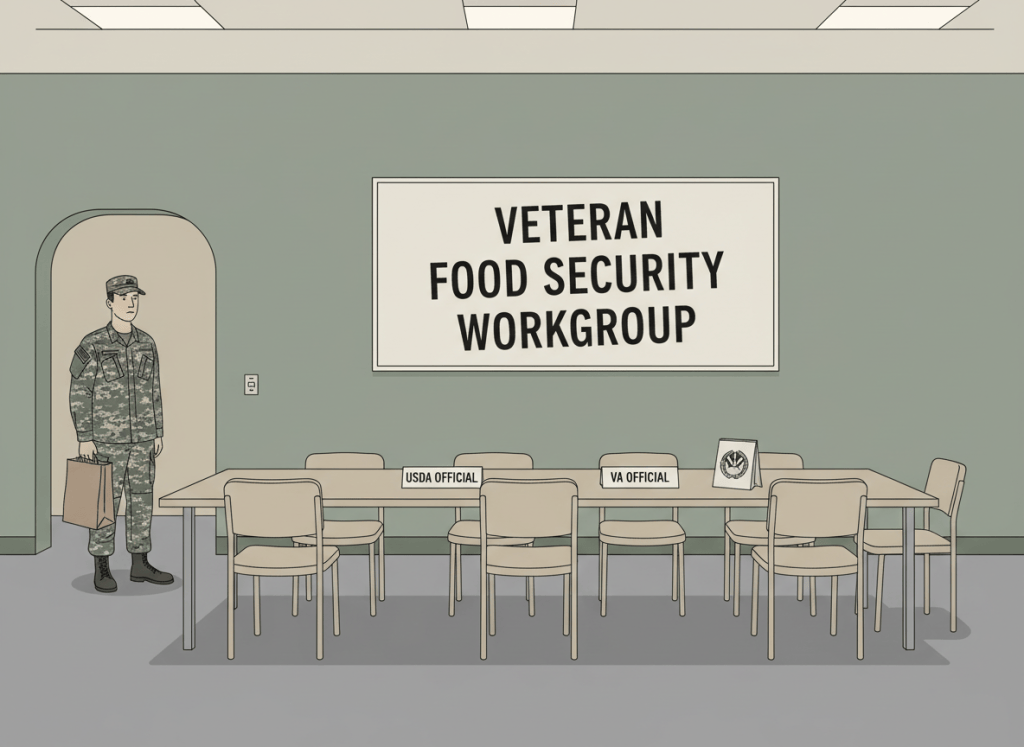
A GAO review found the USDA-VA partnership created to combat veteran food insecurity stopped holding its workgroup meetings after key USDA staff departed, while the government continued directing veterans to outdated eligibility information.
More than a million American veterans are estimated to experience food insecurity. The federal government has programs to help them, websites explaining those programs, state outreach plans intended to connect veterans with benefits, and even a formal agreement between two Cabinet departments to coordinate the whole enterprise.
There is just one bureaucratic complication.
Part of the machinery stopped working.
A new Government Accountability Office review found that collaboration between the Department of Agriculture and Department of Veterans Affairs on veteran food insecurity slowed considerably after key USDA employees departed in April 2025. USDA, despite being designated to lead an interagency workgroup on the issue, has not convened a workgroup meeting since those departures.
Meanwhile, USDA was still providing veterans outdated information about a major SNAP eligibility rule more than a year after federal law changed it.
The findings are contained in GAO-27-108111, Supplemental Nutrition Assistance Program: Federal Actions Needed to Help Veterans Access Benefits, released October 1.
The report begins with a substantial underlying problem. Citing RAND research, GAO said an average of approximately 1.4 million veterans lived in food-insecure households each year between 2015 and 2020. Food insecurity means those households lacked enough food to support an active and healthy life.
GAO’s own analysis of Census Bureau data found that an estimated 6.9 percent of veterans lived in households receiving Supplemental Nutrition Assistance Program benefits in 2024. Participation varied considerably by state, from an estimated 2.2 percent in South Dakota to 12.7 percent in Oregon.
The federal government has spent years trying to connect potentially eligible veterans with SNAP.
In September 2023, USDA and the Veterans Health Administration signed a memorandum of agreement formalizing an existing interagency effort to improve veteran food security. The agreement established a workgroup and identified USDA’s Military Veterans Agricultural Liaison office as the department-level lead. The liaison had already been leading the informal USDA-VA workgroup since 2020.
For a while, things happened.
USDA and VA held a Veteran Food Security Summit in July 2024. USDA conducted two SNAP training webinars for VA clinicians during fiscal 2024. USDA officials subsequently participated in VA Food Security Office conference calls in September 2025 and March 2026.
But the formal workgroup itself essentially went quiet.
According to Veterans Health Administration officials interviewed by GAO, collaboration slowed after key USDA employees, including the Military Veterans Agricultural Liaison, left the department in April 2025.
“Despite being the lead agency, USDA has not held a workgroup meeting since then,” GAO reported.
That personnel loss produced another problem.
The USDA-VA agreement wasn’t simply supposed to sit in a filing cabinet once everybody signed it. Its terms called for an annual review to determine whether the partnership remained necessary, whether its goals were being achieved, whether expectations were being met and whether each department was fulfilling its responsibilities.
That review didn’t happen.
VHA officials attributed the failure to USDA’s staff attrition. USDA officials told GAO that the department nevertheless considers the agreement to remain in effect.
When GAO asked USDA why the agreement had not been reviewed, USDA did not respond to the question.
So the federal government currently has an agreement that USDA considers active, but the agencies did not conduct the review specified by the agreement to determine whether the partnership was working as intended.
GAO recommended that both departments make sure a formal collaboration mechanism actually exists going forward, whether by reviewing and updating the existing agreement or replacing it.
The Website Was Wrong, Too
While the interagency machinery was sputtering, another problem was sitting in public view.
Federal SNAP rules generally limit able-bodied adults without dependents who fail to satisfy applicable work requirements to three months of benefits during a 36-month period.
Beginning in September 2023, veterans were among several groups specifically exempted from that time limit. That changed in July 2025, when Public Law 119-21 removed the veteran-specific exception.
Veterans can still qualify for other exceptions, but veteran status alone no longer exempts someone from the SNAP time limit.
USDA’s website didn’t keep up.
As of September 2026, according to GAO, the Food and Nutrition Administration’s SNAP eligibility webpage still contained outdated information suggesting veterans might not be subject to the time limit. A banner informed visitors that USDA was updating the page to reflect the statutory changes.
“Until USDA updates its website, veterans seeking information on SNAP eligibility rules will receive misleading information,” GAO wrote.
That is particularly awkward for an agency simultaneously trying to overcome misinformation about SNAP among veterans.
Stakeholders interviewed by GAO reported that some veterans mistakenly believe receiving VA benefits automatically makes them ineligible for SNAP. Others believe applying for SNAP could take benefits away from someone else. Organizations working with veterans told investigators that veteran-specific materials addressing such misconceptions would help.
USDA officials told GAO the department had not developed additional SNAP outreach materials specifically tailored to veterans during the previous five years, including training materials or talking points for organizations working directly with veterans.
In other words, organizations trying to correct misconceptions among veterans were asking the federal government for better information while the federal government’s own eligibility website contained information GAO described as misleading.
States Are About to Carry More of the Load
The timing matters for another reason.
States may conduct SNAP outreach and receive federal reimbursement for part of their allowable administrative expenses. Until October 1, 2026, USDA reimbursed as much as 50 percent of those costs.
Beginning October 1, the federal share fell to 25 percent, leaving states responsible for 75 percent, pursuant to changes enacted in Public Law 119-21.
Federal emphasis on veteran outreach has also shifted.
USDA encouraged states to prioritize veterans in SNAP outreach every fiscal year from 2022 through 2025. USDA officials told GAO that the department does not plan to issue an outreach-priority memorandum for either fiscal 2026 or 2027.
Veterans have not disappeared entirely from state plans. Of 47 states with federally approved SNAP outreach plans for fiscal 2026, 39 identified veterans as a target population.
But that was down from 44 states in fiscal 2025.
Taken together, the federal government is entering a period in which states shoulder a greater percentage of SNAP administrative costs, USDA has stopped issuing its annual outreach-priority memorandum emphasizing veterans, and the formal federal partnership intended to coordinate veteran food-security efforts has not operated according to its own agreement.
VA Is Still Finding Hungry Veterans
The report does not describe a wholesale collapse of federal efforts.
VA, in particular, has several programs addressing veteran food insecurity.
VA medical centers have screened veterans for food insecurity since 2017. In fiscal 2025, VA reported screening approximately 4.4 million veterans. About 103,000, or 2 percent, screened positive for food insecurity, and approximately 78,000 accepted referrals to a VA social worker or dietitian for additional assistance.
VA social workers can help veterans apply for SNAP and, according to staff interviewed by GAO, may accompany them through telephone calls or in-person SNAP interviews.
VA has also expanded a Food Hub pilot that provides same-day access to food and connects veterans with longer-term social work and nutrition services. More than 6,000 veterans were served during the pilot year, and the initiative expanded to 18 sites in fiscal 2026.
That makes the breakdown identified by GAO more peculiar rather than less.
The government is finding veterans who need food. VA employees are referring them for assistance. States and nonprofit organizations are conducting SNAP outreach. Federal programs and pilot projects continue operating.
Yet the formal USDA-VA coordinating mechanism established specifically to tie some of those efforts together faltered when several key federal employees left.
Four Recommendations and One Unanswered Question
GAO issued four recommendations.
USDA should update its SNAP eligibility website, develop and distribute additional veteran-specific outreach materials with VHA, and ensure that a formal mechanism exists for continued collaboration with VA. VA received a corresponding recommendation to ensure that it has a formal collaboration mechanism with USDA.
VA concurred with its recommendation. USDA generally concurred with GAO’s recommendations and said efforts were already underway to update the SNAP eligibility website.
That may fix the website.
The more interesting question is what happened to the partnership.
GAO has established a remarkably useful chronology: USDA and VA formalized their veteran food-security work in 2023. The agreement assigned leadership responsibilities, established expectations and required annual review. Key USDA personnel departed in April 2025. The USDA-led workgroup stopped meeting. The required review didn’t occur. And when federal auditors asked USDA why it hadn’t occurred, the department did not provide an answer.
For a program intended to help veterans find food, the next useful federal search may be for whoever was supposed to be running the meeting.

