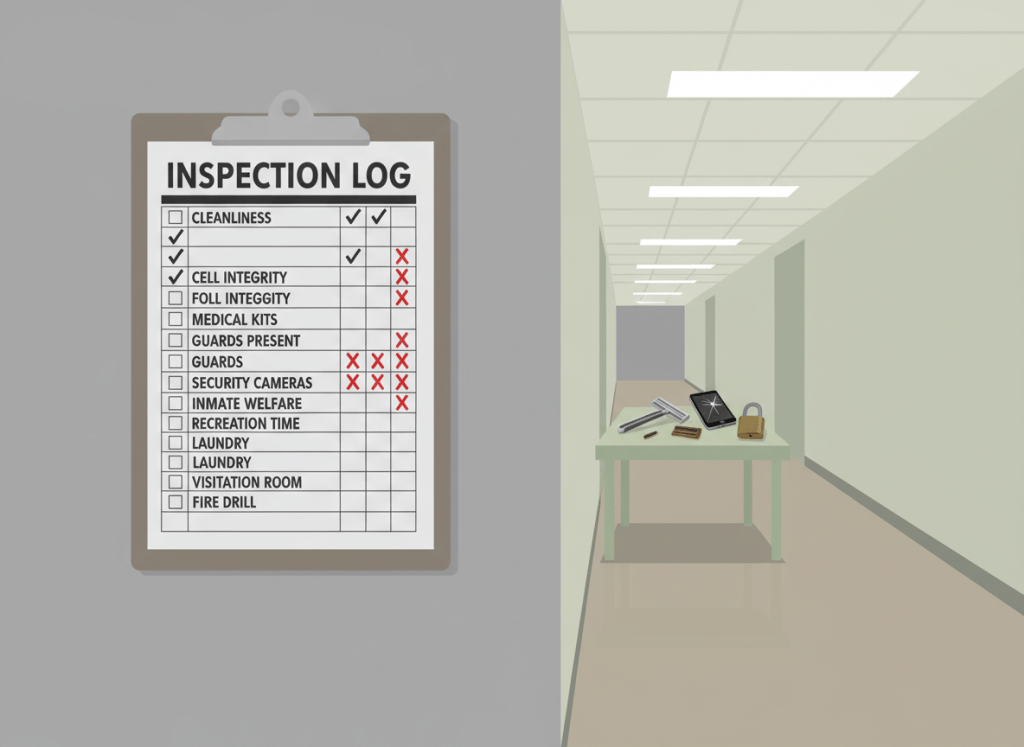
U.S. Immigration and Customs Enforcement had already found enough problems at a privately operated New Mexico detention center to put the facility under weekly inspections and dock its contractor nearly $29,000.
Then ICE went back.
It found 54 razors in two housing units, more than $1,000 in cash, a cellphone, two gallons of jail-made alcohol, broken glass, a metal rod and pieces of broken fencing.
Then the Department of Homeland Security’s Office of Inspector General showed up unannounced.
The problems weren’t over.
A new DHS OIG report documents a remarkably persistent series of security and management failures at the Cibola County Correctional Center in Milan, New Mexico, a facility operated by CoreCivic that houses ICE detainees.
The September 28 report found Cibola deficient in portions of six federal detention standards, covering use of force, environmental health and safety, contraband, food service, personal hygiene, special management units, and admission and release procedures. Medical care was the notable exception. Inspectors found the facility compliant with the medical standards they examined.
But the more consequential finding isn’t simply that Cibola failed an inspection.
ICE already knew it had problems.
ICE had been documenting the problems for a year
DHS OIG conducted its unannounced inspection on September 11, 2025, examining Cibola’s compliance with ICE’s Performance-Based National Detention Standards.
The inspection arrived after a year of documented trouble.
ICE issued a Contract Discrepancy Report to Cibola on September 3, 2024, after finding that staff weren’t properly tracking or collecting razors. Detainees were left with sharp objects for extended periods, while important security posts in housing units were left unmanned.
Follow-up inspections in October and December didn’t exactly produce the reassuring conclusion one might expect from something called a corrective-action process.
Inspectors found an unsecured razor blade in the general population, multiple razors inside housing units, at least one razor missing its blade, and another unmanned unit.
By April 18, 2025, ICE had apparently seen enough.
The agency informed Cibola that the continuing deficiencies would result in weekly inspection checks and a one-time $28,727.66 deduction from the contractor’s invoice.
Two months later, ICE issued another Contract Discrepancy Report.
This one is difficult to dismiss as paperwork.
ICE found 30 razors in one housing unit and another 24 in a second. The facility’s razor-issuance log couldn’t properly account for them.
Inspectors also found more than $1,000 in cash, rocks, a cellphone, two gallons of jail-made alcohol, broken glass, a metal rod and broken fence links. ICE also found deficiencies involving pat-down searches and the security of detainee property, including cash, debit cards and a cellphone.
ICE’s own Contract Discrepancy Report didn’t mince words: “The contractor failed to maintain the security of the facility and jeopardized the safety of ICE and CoreCivic staff.”
And yet the story continued.
OIG arrives without warning
When DHS OIG inspectors arrived unannounced in September 2025, they again found dangerous and prohibited items inside detainee housing areas.
One bunk-bed ladder had broken metal with sharp, jagged edges. Photographs included in the report show the exposed metal protruding from the ladder.
Inspectors also found loose string being used by detainees to hang towels. String was prohibited as contraband because, OIG noted, it could be combined into rope and used for self-harm or to harm others.
By then, this was no longer a matter of ICE discovering a previously unknown problem.
The chronology matters.
ICE identified problems in September 2024. Follow-up inspections found continuing problems in October and December. The agency escalated to weekly inspections and a financial penalty in April 2025. Another inspection in June uncovered dozens of razors and an assortment of contraband.
Then DHS OIG arrived in September and found more hazards.
The corrective process, in other words, had generated reports, inspections and a $28,727.66 invoice deduction.
What it had not yet generated was sustained compliance.
Four of five use-of-force incidents had problems
The security failures weren’t OIG’s only concern.
Cibola reported five use-of-force incidents between September 1, 2024, and August 31, 2025. OIG reviewed all five.
Inspectors identified compliance problems in four of them.
In one incident, staff used pepper spray while responding to an aggressive detainee who eventually placed a staff member in a headlock. OIG said the force itself was appropriate, but inspectors couldn’t verify that Cibola notified ICE within the required two working days because the facility hadn’t dated its notification memorandum.
Another incident was less ambiguous.
Detainees in a high-custody housing unit weren’t following orders to return to their beds when a staff member accidentally discharged pepper spray onto the floor.
According to the facility’s own use-of-force memorandum, even though the discharge was accidental, there had been “insufficient confrontation” from the detainees to warrant the use of spray.
In another case, a detainee covered the window of his cell. After he refused orders to remove the covering, staff opened the food port and sprayed pepper spray inside.
The facility’s subsequent review concluded that staff should have waited and assembled a calculated use-of-force team instead of resorting to immediate force.
The same detainee later covered his window again. Staff eventually deployed what the report describes as “inflammatory agents” into the cell.
This time, OIG found another problem: the warden hadn’t completed the conclusion of the after-action report.
That unfinished section was supposed to determine whether facility policy had been violated, whether staff actions were reasonable, whether the force was appropriate, and whether improvements should be recommended.
Apparently even the paperwork documenting whether the paperwork-worthy incident was appropriate remained unfinished.
Food trays came up hundreds of calories short
The inspection also found deficiencies far removed from razors and pepper spray.
Cibola didn’t consistently provide all the food required under dietitian-approved menus, particularly on specialty diets.
In one case examined by OIG, an approved meal was supposed to contain eight items. A detainee was served the meal without mashed potatoes, peas, margarine and cake.
A staff member monitoring that detainee’s meals estimated that, when items were missing, the meals were deficient by approximately 200 to 300 calories per day.
That continued for roughly three months.
OIG recommended that ICE ensure Cibola provides all food necessary for adequate nutrition.
Four housing units didn’t have enough toilets
Then there were the bathrooms.
ICE detention standards require at least one toilet for every 12 detainees.
Four of the eight housing units inspected at Cibola didn’t meet that standard.
One had three toilets for 40 detainees. Another had three for 38. A third had three for 39.
The fourth had three toilets for 41 detainees, a ratio of approximately one toilet for every 13.7 people.
OIG warned that inadequate access to personal hygiene facilities can increase the risk of spreading infectious and communicable diseases.
Three hours disappear from a watch log
Inspectors also examined Cibola’s Special Management Unit, commonly referred to as segregation.
Only one detainee was being held in administrative segregation on the day inspectors arrived.
ICE standards require staff observations to be recorded at least every 30 minutes.
OIG found a three-hour gap in the observation log outside the detainee’s cell, with neither recorded observation times nor staff signatures.
For a system built around documenting half-hour checks, six consecutive missing intervals is rather more than a clerical hiccup.
The handbook was available in eight languages. English wasn’t one of them.
Perhaps the most bureaucratically perfect finding concerned something much less dangerous.
The ICE National Detainee Handbook explains detainee rights, facility rules and prohibited conduct.
Cibola had copies available in eight languages.
It didn’t have one in English.
Staff confirmed to inspectors that no English version was available, meaning English-speaking detainees could have been unable to fully access the information ICE requires facilities to provide.
Somewhere, presumably, a multilingual compliance box was very thoroughly checked.
One part of the facility passed
The report isn’t universally negative.
DHS OIG’s medical contractor inspected the areas where health services were provided, reviewed records and interviewed staff.
Cibola complied with all of the medical standards examined, including staffing, medical screening for new arrivals, dental treatment, sick call, medication delivery, mental-health care and sexual-abuse protocols.
That distinction matters. OIG did not conclude that everything at Cibola was dysfunctional.
It concluded that specific, and in several cases recurring, operational requirements weren’t being met.
ICE agrees to fix it, again
DHS OIG issued six recommendations.
ICE concurred with all six.
The agency said its El Paso Field Office would work with Cibola leadership on use-of-force procedures, contraband control, food service, toilet availability, Special Management Unit observations and detainee-handbook access.
For the security and contraband problems, ICE said the facility would conduct documented inspections, reinforce razor-accountability procedures and strengthen searches and property controls. ICE said it would monitor compliance using inspection and contraband logs, maintenance records, corrective-action documentation and follow-up observations.
Most of the corrective actions carry an estimated completion date of December 31, 2026.
All six recommendations remain resolved but open, meaning ICE has agreed to corrective action but OIG has not yet received sufficient evidence to close them.
There is also a reason the public is only now reading about an inspection conducted more than a year ago.
DHS OIG says publication of the report was “significantly delayed” by three government shutdowns during fiscal 2026. According to OIG, those shutdowns collectively consumed 123 days of the fiscal year.
So the report released in September 2026 describes conditions inspectors observed in September 2025, while ICE’s newest corrective actions aren’t expected to be completed until the end of 2026.
That leaves a rather important question unanswered by the report.
ICE knew Cibola had security problems. It documented them. It conducted follow-up inspections. It required corrective action. It increased oversight. It even deducted $28,727.66 from the contractor’s invoice.
And months later, federal inspectors were still finding hazards and contraband.
The government had no shortage of documentation showing there was a problem.
The harder question is what it took to actually fix it.

