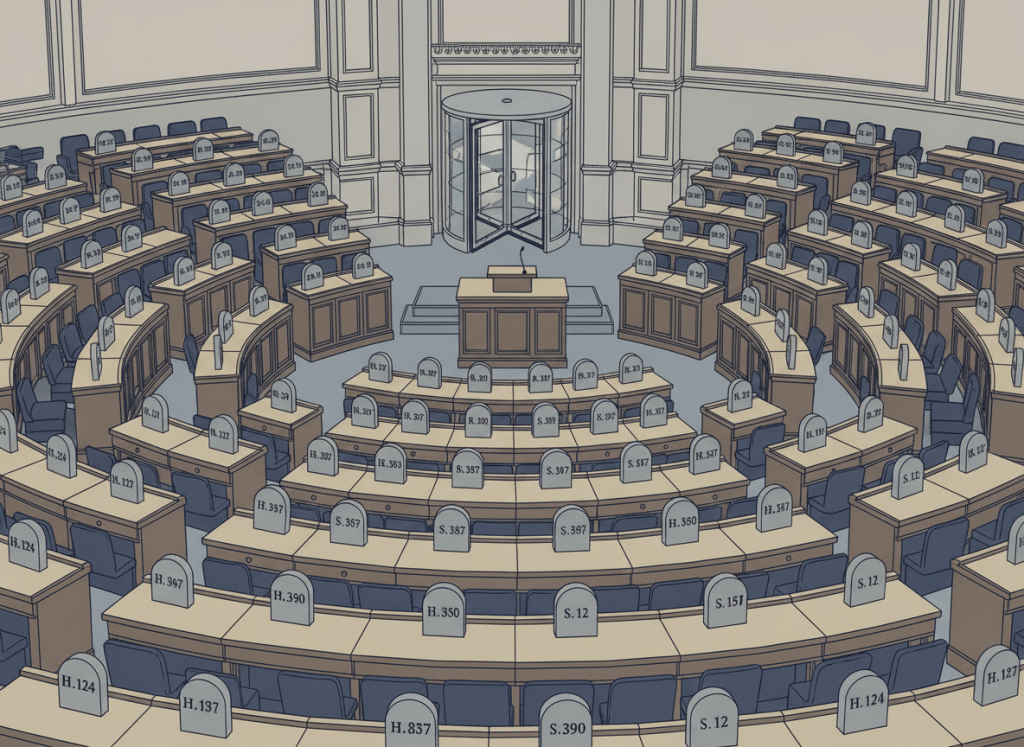
Every two years, Congress performs a remarkable feat of administrative housekeeping.
It makes thousands of unfinished bills disappear.
Not by passing them. Not by rejecting them. Not necessarily by voting on them at all. When a two-year Congress ends, legislation that has not completed the legislative process dies with it. A proposal that lawmakers still want to pursue must generally be introduced again in the next Congress, receiving a fresh bill number and beginning the journey anew.
That procedural reset makes Congress’s legislative inventory look considerably younger than some of its ideas actually are.
A bill introduced in 2025 may officially be a product of the 119th Congress. Its legislative ancestry, however, might stretch back through the Obama administration, the George W. Bush administration, the Clinton administration, or even farther.
Some proposals have been making this trip for decades.
And Congress produces an extraordinary number of opportunities for them to get lost along the way.
The U.S. Senate’s official Résumé of Congressional Activity provides annual congressional statistics dating to 1947. The historical record shows an institution that introduces legislation on an industrial scale while only a comparatively small fraction ultimately emerges as federal law.
Looking across roughly the last 20 completed years, our reconstruction found approximately 120,000 bills and law-capable joint resolutions introduced, while roughly 3,700 became law. Depending on precisely which legislative forms are included in the denominator, the broad result is the same: only a few percent of the legislation capable of becoming law actually does.
That works out to roughly 6,000 introductions per year and fewer than 200 enactments per year across that period.
Put another way, something on the order of 97 out of every 100 law-capable measures introduced during that period did not become law.
That does not mean 97 percent were formally rejected. Quite the opposite. Many never get that far.
The Congressional Funnel
The familiar Congress.gov legislative tracker makes the process look pleasantly straightforward: Introduced. Passed House. Passed Senate. To President. Became Law.
The actual route is considerably less accommodating. A bill may be introduced and referred to one or several committees. It can be referred to a subcommittee, receive hearings, undergo a markup, be amended, reported by committee, placed on a calendar and eventually receive consideration by a chamber. Or it can simply stop.
A bill that passes one chamber must then contend with the other. Differences between House and Senate versions may have to be reconciled. Both chambers ultimately must agree to the same text before legislation can be presented to the president.
And the clock is always running. When that Congress ends, unfinished legislation does not wait patiently for everyone to return. It dies.
The next Congress begins with a clean legislative slate, at least on paper. That last qualification turns out to matter quite a bit.
Congress’s Legislative Reincarnation Program
Consider H.R. 40, the Commission to Study and Develop Reparation Proposals for African Americans Act.
The current bill was introduced on January 3, 2025, by Rep. Ayanna Pressley and referred to the House Judiciary Committee. Its purpose is to establish a commission to examine slavery and subsequent discrimination and recommend potential remedies to Congress.
Judged strictly from its current bill number, H.R. 40 is a creature of the 119th Congress. It isn’t.
The proposal was first introduced by Rep. John Conyers in 1989. A 2023 statement placed in the Congressional Record expressly described the legislation as first introduced by Conyers that year. The Congressional Record documenting H.R. 40’s 1989 origin provides the historical reference.
Versions of the proposal have returned Congress after Congress. That gives the legislative family a history stretching approximately 36 years before the current Congress even finishes its work.
Its history also demonstrates why “nothing happened” can be too simplistic a description of old legislation. Earlier versions did receive congressional activity. The 116th Congress version, for example, received a House Judiciary subcommittee hearing in 2019. The legislation nevertheless never completed the journey into law. So it returned. Again.
The Wilderness Bill That Has Been Wandering Since 1989
H.R. 40 has company.
The current America’s Red Rock Wilderness Act, H.R. 2467 was introduced March 27, 2025, and referred to the House Committee on Natural Resources.
The proposal would designate specified federal lands in Utah’s Colorado Plateau and Great Basin Deserts as wilderness. Its legislative family also reaches back to 1989.
Versions have appeared repeatedly over the intervening decades, including Senate counterparts beginning in the 1990s. Even the current legislation contains traces of its previous lives. Its statutory text incorporates maps and materials produced in connection with earlier versions of the proposal.
On Congress’s current ledger, H.R. 2467 is a 2025 bill. Viewed historically, the proposal is old enough to have watched seven presidential administrations come and go.
The Sunset Bill That Will Not Set
Then there is perhaps the most bureaucratically elegant specimen we found.
H.R. 489, the Federal Agency Sunset Commission Act of 2025, was introduced January 16, 2025, by Rep. Michael Cloud and referred to the House Committee on Oversight and Government Reform and the Committee on Rules.
The bill proposes establishing a Federal Agency Sunset Commission. The basic idea is to create a systematic mechanism for reviewing federal agencies and determining whether they should continue to exist.
Congress has been debating federal sunset mechanisms since the 1970s. A direct legislative lineage for the Federal Agency Sunset Commission model can be traced at least into the 1990s, with versions of the concept repeatedly resurfacing thereafter.
The current H.R. 489 has, so far, remained at the referral stage reflected in the official bill record.
There is a certain institutional symmetry here that deserves appreciation. Congress has spent decades considering legislation designed to identify federal institutions that continue existing year after year without sufficient justification. The legislation establishing that process has itself continued existing, in successive incarnations, year after year without becoming law.
Washington occasionally writes its own punchlines.
Not Every Zombie Stands Still
Long-lived legislation should not automatically be confused with legislation that receives no consideration whatsoever.
The Tribal Labor Sovereignty Act of 2025, H.R. 1723 illustrates the difference.
The proposal concerns application of the National Labor Relations Act to enterprises owned and operated by Indian tribes on Indian lands. Variations of the Tribal Labor Sovereignty Act have appeared repeatedly since 2007.
The current version has done considerably more than merely collect dust. The House Education and Workforce Committee reported H.R. 1723 with an amendment in January 2026, and the measure was committed to the Committee of the Whole House and ordered printed as House Report 119-458.
That distinction matters. Legislation can survive for decades without remaining motionless for decades. Some proposals repeatedly receive hearings, committee action or even passage by one chamber before ultimately failing to complete the entire process. Others are repeatedly introduced and referred to committee, where the congressional clock eventually expires.
Both become casualties at adjournment. Their histories are very different.
The REINS Act: Another Repeat Visitor
The Regulations from the Executive in Need of Scrutiny Act, commonly called the REINS Act, offers another example of recurring legislation that has made substantial progress without completing the process.
A version was moving through the House as far back as 2011. That proposal, H.R. 10, would have required congressional approval before certain major federal rules could take effect. House committee records show that the legislation was marked up and favorably reported that year.
Subsequent versions have returned in later Congresses, sometimes advancing substantially. That makes the REINS Act less a forgotten bill than an unresolved legislative argument repeatedly reopened by successive Congresses.
And that distinction is one reason simply counting old bills is not enough. What Congress needs, at least for purposes of understanding its own legislative archaeology, is genealogy.
The Numbers Are Enormous, but They Need Context
The current 119th Congress is still underway, so any enactment percentage calculated today is necessarily provisional.
The Senate’s official legislative activity system publishes cumulative statistics during a session and a final résumé when the session is complete.
That matters because a bill sitting in committee on October 2 could still move before the 119th Congress expires. It also matters because not everything Congress introduces is a “bill” in the ordinary sense.
Congress considers House bills, Senate bills, joint resolutions, concurrent resolutions and simple resolutions. Some resolutions are never intended to become federal statutes. Throwing every congressional measure into one giant denominator and comparing the result with public laws would therefore produce an artificially dramatic failure rate.
For purposes of measuring the legislative pipeline, the cleaner comparison is H.R. and S. bills plus those joint resolutions capable of becoming law, followed through enactment.
Even with that methodological caution, the scale is striking. Modern Congresses routinely introduce thousands upon thousands of bills while enacting only a comparatively small share of them.
But “unenacted” is not synonymous with “rejected.” A proposal can disappear because Congress affirmatively voted it down. It can disappear because leadership never scheduled a vote. It can disappear in committee. It can be superseded by another bill. Its provisions can be incorporated into larger legislation. A House bill can become unnecessary because the Senate companion becomes the legislative vehicle. And sometimes Congress simply runs out the clock.
The Graveyard Is Emptied Every Two Years
That brings us to the peculiar heart of the system.
Congress does not technically maintain a decades-old backlog of unfinished legislation. It regularly destroys the backlog.
At the conclusion of each two-year Congress, pending legislation expires. Lawmakers who want another attempt generally introduce the proposal again during the next Congress.
Imagine a proposal introduced in 1989. It dies. It returns in 1991. It dies again. It returns in 1993. Repeat the process long enough and eventually a legislative concept with roots in the first Bush administration appears in a modern congressional database wearing a 2025 bill number.
Nothing about that is improper. Every new Congress is a newly constituted legislature, and legislation must be considered by the Congress actually empowered to enact it.
But the procedure has an interesting effect on the historical record. It resets the apparent age of unfinished business.
Congress’s legislative cemetery therefore has a revolving door.
Measuring the Zombies
The next phase of this project is straightforward in concept, although considerably less straightforward in data.
For every current bill with a predecessor, Bureaucracy Times intends to reconstruct its legislative genealogy: when the underlying proposal was first introduced, how many Congresses have considered a substantially equivalent version, how many separate bills carried it, how many received committee hearings or reports, whether either chamber ever passed it, and how far it has ever traveled.
And perhaps most interestingly: How much cumulative time has the proposal spent waiting for congressional action?
A hypothetical proposal introduced in 15 successive Congresses might technically consist of 15 separate bills. Historically, however, it could represent one legislative argument spanning three decades.
If those 15 versions collectively spent thousands of days sitting in congressional committees, that tells us something the current bill number cannot.
It also creates a distinction between two kinds of legislative zombies. There are bills that repeatedly fight their way through portions of the legislative process but never quite reach enactment. And there are bills that Congress repeatedly introduces, refers to committee, allows to expire, and then introduces again.
The first category represents unresolved legislative disagreement. The second may represent something closer to congressional ritual.
The Oldest May Be Older Still
Our initial reconstruction has already identified currently active legislative families stretching back more than three decades.
H.R. 40 reaches to 1989. America’s Red Rock Wilderness Act reaches to the same period. The direct Federal Agency Sunset Commission lineage reaches into the 1990s, while the broader congressional sunset movement reaches into the 1970s. The Tribal Labor Sovereignty Act has versions extending back nearly two decades.
Other recurring legislative families, including regulatory-review, health-policy and family-leave proposals, also merit reconstruction.
And constitutional amendments create an entirely separate category. The Equal Rights Amendment, for example, has a congressional history stretching back to 1923, with later proposals concerning both the amendment itself and the disputed legal effect of the ratification deadline. Constitutional amendments follow a different legal path than ordinary legislation, so mixing them into a ranking of bills would obscure more than it reveals. They deserve their own ledger.
Congress Is Not Necessarily Doing Nothing
There is an obvious temptation in these numbers to conclude that Congress introduces thousands of bills and accomplishes almost nothing. The records do not support something that simple.
Legislation serves purposes besides producing a standalone public law bearing the original bill number. Bills can establish negotiating positions, generate hearings, shape subsequent legislation, be absorbed into omnibus packages, force recorded votes, or eventually provide language for a different vehicle that does become law.
And the number of bills introduced is partly a product of the freedom individual lawmakers have to introduce legislation.
The more defensible finding is narrower, and more interesting.
Congress produces vastly more legislation than it completes, and its two-year lifecycle can conceal how long some unfinished legislative ideas have actually been circulating.
That is measurable. It is also largely invisible if one looks only at the current Congress.
The official record tells us H.R. 40 was introduced January 3, 2025. That is correct. It just isn’t the whole story.
The whole story begins in 1989.
And somewhere among the thousands of measures now sitting in the 119th Congress may be an even older idea, dressed in a new bill number, waiting for Congress to decide whether this incarnation will finally be the one that makes it out alive.
If not, there is always the 120th Congress.

