Three People, Thousands of Complaints, and a Ledger of Convenience
The Securities and Exchange Commission keeps an Office of the Ombudsman for a sensible reason. Retail investors who believe the agency, or a self-regulatory organization it oversees, has wronged them need somewhere to take the grievance that is not the front door of the party being complained about. By statute, the Ombudsman helps resolve those problems and reports on its activities to the Investor Advocate twice a year, and the Investor Advocate folds the results into reports to Congress. The office logged 2,772 submissions in fiscal year 2024 and 2,496 in fiscal year 2025, and it did so with three employees, an Acting Ombudsman, a senior counsel, and a detailed staff member.
On September 28, 2026, the SEC’s Office of Inspector General published Report No. 592, an evaluation that agency management itself requested. The title is a small masterpiece of the genre, “The Office of the Ombudsman Appropriately Handled Investor Concerns But Reporting Was Inaccurate and Unclear.” The good news lives in the first half of that sentence. This article concerns the second half.
Two limits on what the inspectors established deserve stating before anything else. First, they reviewed 140 judgmentally selected matters out of 5,268 opened and 125 reopened during the two fiscal years. The sample was stratified by date and category but was nonstatistical, and the OIG declined to project its results onto the whole caseload. The error counts below describe those 140 matters and nothing more. Second, the OIG relied on data from the Ombudsman Matter Management System (OMMS) even after finding 65 gaps in the system’s matter numbers and conceding it could not determine whether the population of matters was complete. Its stated judgment was that the data were sufficiently reliable for the purpose of the evaluation. Readers may weigh that call as they see fit, but it belongs in the open and not in Appendix I, where the report keeps it.
The Atypical Case of the Test Matters
Of the 140 matters, the OIG found that staff miscategorized 24 and recorded incomplete or inaccurate dispositions for 43. In some cases staff failed to log a referral to another regulator when they sent an investor to the Commodity Futures Trading Commission. In others they logged both “Submit TCR” and “Referral to Enforcement-TCR” for the same matter, two entries that office policy treats as different acts. The Acting Ombudsman told inspectors the organization did not always prioritize getting categories and dispositions right. She began reviewing matters in March 2025, but not for that.
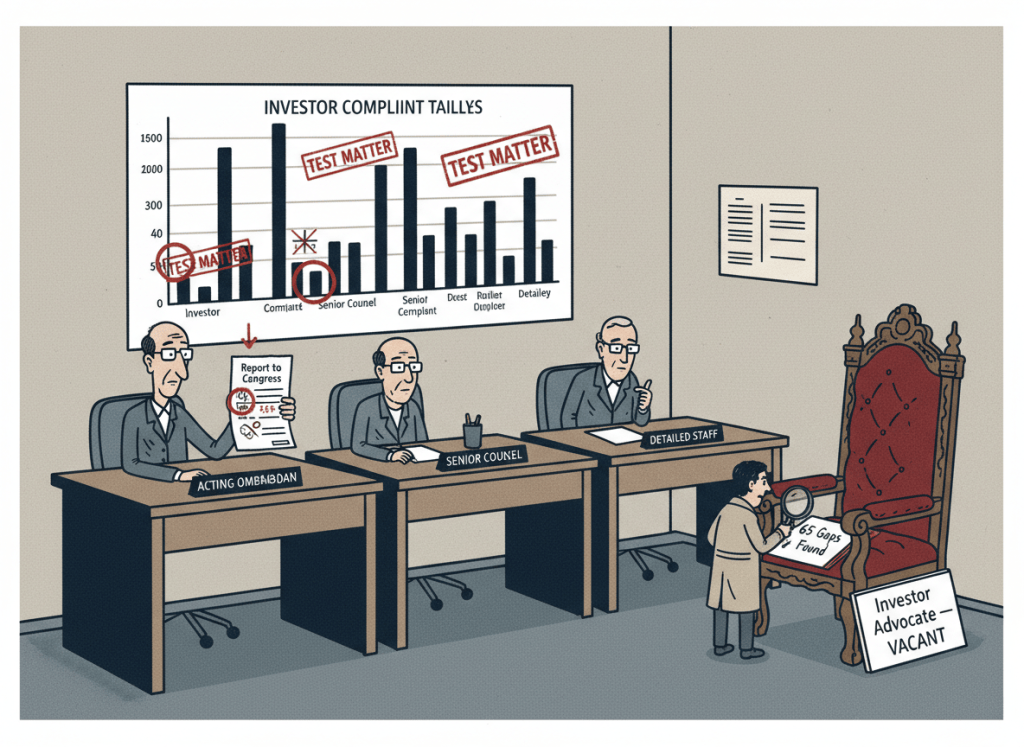
The larger embarrassment is arithmetic. The Ombudsman’s section of the Investor Advocate’s reports to Congress counted 133 test matters (16 in fiscal 2024, 117 in fiscal 2025) as though they were investors with concerns. The Acting Ombudsman knew about them and considered them properly filed under “Atypical Matters.” She had not thought to remove them from the reporting population, and nobody had asked her to. The result was that new matters received were overstated by about 0.6 percent in 2024 and 5 percent in 2025, while the Atypical Matters category swelled by about 1.5 percent and 46 percent. A matter, it turns out, is not an investor merely because the software believes in it.
A Report Edited by Nobody
When the Investor Advocate issued the fiscal 2025 Report on Activities in December 2025, the OIG was in the middle of planning this evaluation and spotted trouble immediately. The Ombudsman’s section gave the reporting period as October 1, 2024 through March 31, 2025, six months short of the year it claimed to summarize. The figures in the body did not match the graphs. The year over year percentages were wrong. The Acting Ombudsman corrected them and the report was reissued within a week.
The cause, according to the OIG, was the absence of any quality control process. The section went to the Investor Advocate without a second reader and without anyone checking the numbers against supporting documents. Which is how both the 2024 and 2025 reports came to say that “the Ombuds must submit biannual reports to Congress,” when the statute requires semiannual reports to the Investor Advocate. The Acting Ombudsman called it an oversight. She also told inspectors she was encouraged not to make substantive changes to the 2025 language, in the name of consistency with prior years. The report does not say who did the encouraging, which is a question for someone with a telephone.
Then there are the missing numbers. OMMS assigns each matter a sequential identification number and never reuses one. The OIG found 65 gaps, more than 300 missing numbers in all, and OO could not definitively explain them. The office does not monitor for gaps, has no formal policy for retaining the documents behind its published figures, and uses a system that cannot generate a report as of a prior date. In plain terms, it could not check its own homework after the fact. Management’s response offers a footnote observing that the Salesforce software underlying OMMS may skip a consecutive number under certain circumstances. That may well be true. It is not the same as showing which of the 65 gaps were skips, which were deleted test matters, and which were something else.
The Chair Nobody Has Filled
The report’s last section, filed as an “Other Matter of Interest” with no recommendation attached, may be its most consequential. The Investor Advocate position has been vacant since January 2026. Under the Securities Exchange Act, the Investor Advocate must send Congress a report on the next fiscal year’s objectives by June 30. The fiscal 2027 report was not issued, and the Ombudsman’s reporting went missing with it. The Act also bars anyone employed by the SEC in the preceding two years from the job, which narrows the field considerably. Management sought candidates in February and July 2026. The same statute has the Investor Advocate appoint the Ombudsman, and the current Ombudsman has been acting since January 2025.
Management concurred with all six recommendations and promised fixes between January and March 2027, mostly hitched to a new OMMS platform due in December 2026. Its response also insists that the findings do not indicate “any deficiencies” in the office’s underlying investor-service functions, which the OIG’s sample, to its credit, largely supports, within the limits described above. It is worth remembering that the OIG is not meeting this office for the first time. Its 2021 management letter on investor submissions was followed by a separate investigation in which the OIG found that the former Ombudsman misrepresented facts in responding to that letter.
The next Report on Activities is due to Congress by December 31, 2026. The quality controls are due by March 2027, and no Investor Advocate is in place to submit it. Congress, in other words, will receive its next set of Ombudsman numbers before the office has finished learning to count.

